On Sunday, November 1, 2026, more than 50,000 runners will cross all five boroughs, and something like two million people will stand on curbs to watch them. Most spectators make the same mistake: they pick one famous corner, arrive too early, wait two cold hours, and miss their runner in a crowd ten deep. This NYC Marathon spectator guide is built the other way around: start with your runner’s pace, pick two realistic spots near a subway line, and plan a warm café between them.
I’ve always thought the marathon is the one day New York agrees to slow down for strangers. You don’t need to see every mile to feel it. You need the right two corners, a coffee in your hand, and a sense of when to look up.
Quick Answer
- Date: Sunday, November 1, 2026. Daylight saving time ends the same morning, so clocks fall back an hour and sunset comes early.
- Best first spot: Fourth Avenue or Lafayette Avenue in Brooklyn (miles 3–9). The crowds are friendly and the coffee is close.
- Best for being heard: Vernon Boulevard in Long Island City (mile 14). Fewer people, and runners have just finished a quiet bridge.
- Loudest: First Avenue, Upper East Side (roughly miles 16–19).
- Where cheering matters most: Fifth Avenue, 110th to 90th Streets (miles 22–23), the long uphill.
- Two-spot plan most people can pull off: First Avenue, then a walk west to Central Park South (mile 25).
- Don’t plan on: the start, any bridge, or a free, guaranteed view of the finish line.
When Your Runner Will Actually Pass (Do This First)
The race doesn’t arrive as a single pack. It arrives as a long river that thickens through the middle of the day. Based on the 2025 schedule, the wheelchair divisions start around 8:00 a.m., professional women around 8:35 a.m., and professional men with the first general wave around 9:05 a.m. Later waves leave until about 11:30 a.m. (As of October 2026, NYRR had published the mass-wave times but not the final professional start times. Check the official app in race week.)
That means a runner in the last wave may reach First Avenue well after 2 p.m. So before choosing a corner, find your runner’s wave start time and target pace, then use the table below.
| Course point | Mile | 8:00/mile pace | 10:00/mile pace | 12:00/mile pace |
|---|---|---|---|---|
| Lafayette Ave, Fort Greene | 8 | ~1:04 after start | ~1:20 | ~1:36 |
| Vernon Blvd, Long Island City | 14 | ~1:52 | ~2:20 | ~2:48 |
| First Ave, Upper East Side | 18 | ~2:24 | ~3:00 | ~3:36 |
| Fifth Ave, near 100th St | 23 | ~3:04 | ~3:50 | ~4:36 |
| Central Park South | 25 | ~3:20 | ~4:10 | ~5:00 |
| Finish | 26.2 | ~3:30 | ~4:22 | ~5:14 |
These are even-pace estimates measured from the moment your runner crosses the start line, which can be 10–20 minutes after their wave’s official gun time. The bridges slow most people down, so treat the numbers as a window, not a promise.
Add your runner in the official TCS New York City Marathon app the night before, on Wi-Fi. On race day the live splits matter more than any table.
The Best Places to Watch the NYC Marathon, Borough by Borough
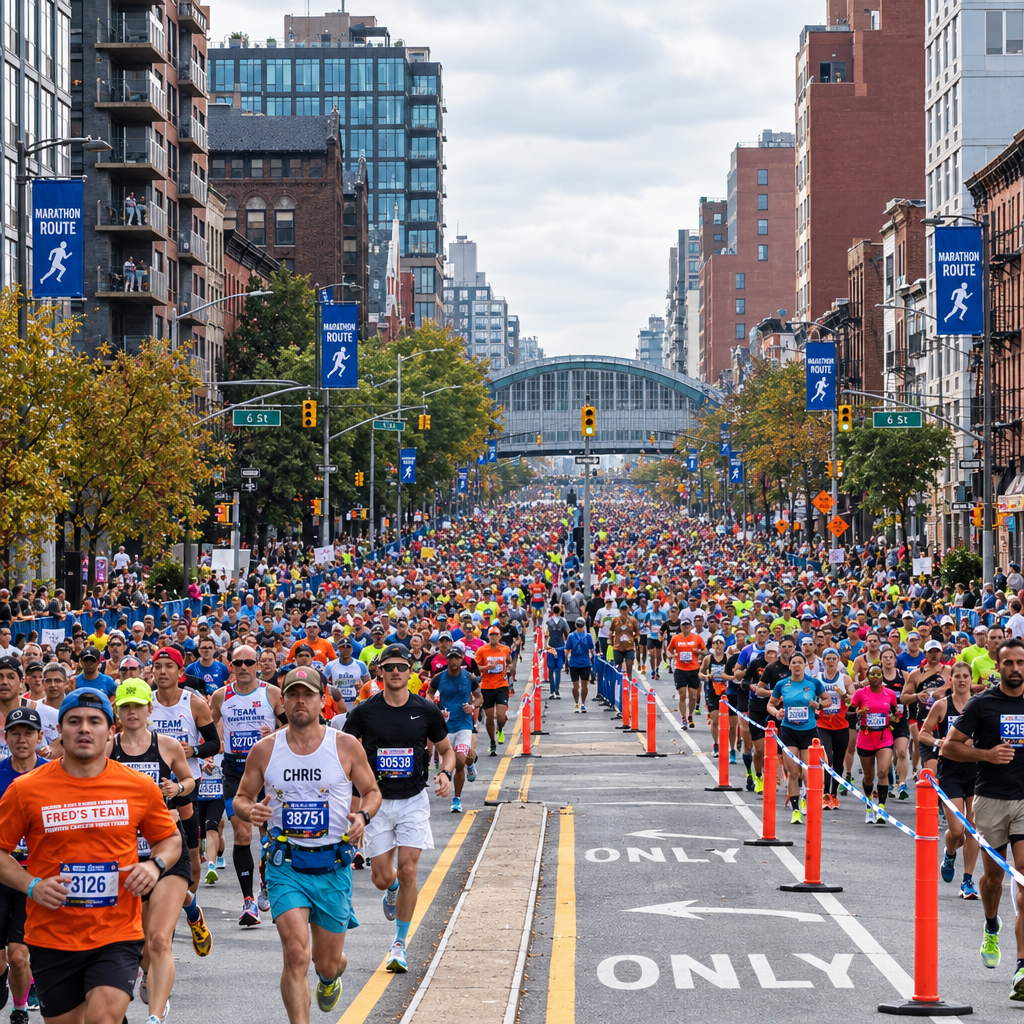
The course starts in Staten Island, but spectators can’t watch the start or the Verrazzano-Narrows Bridge. In fact, every bridge on the course is closed to spectators. Here are the seven stretches that work, in race order.
1. Fourth Avenue, Brooklyn (Miles 3–7)
This is where you see the field while it’s still a field: fresh legs, tight packs, and enough sidewalk to reach the curb. It suits first-timers who want to understand the scale of the day. The R train runs right under the avenue, with stops every few blocks.
2. Lafayette Avenue, Fort Greene (Miles 8–9)
Brownstone blocks, live music, and deep but good-natured crowds. Many longtime spectators call this the best atmosphere on the course. Take the C to Lafayette Avenue or the G to Fulton Street or Clinton–Washington Avenues.
Coffee nearby: Bittersweet at 180 DeKalb Avenue, a narrow neighborhood café at the southeast corner of Fort Greene Park, a few minutes’ walk north of the course. Expect a line on race morning; it moves.
3. Bedford Avenue, Williamsburg (Miles 11–12)
Young, loud, and relentlessly festive. The street is narrower than Fourth Avenue, so the noise concentrates. The L, J, M, and G trains all bring you within walking distance.
Coffee nearby: Devoción at 148 Grand Street, a skylit Colombian roastery with a wall of plants. It’s a short walk west of the course and a good place to defrost before you move on. Weekend opening is listed around 7:30–8 a.m. (confirm before you go).
4. Vernon Boulevard, Long Island City (Mile 14)
This is the underrated choice. Runners have just crossed the Pulaski Bridge at the halfway mark, where nobody is allowed to cheer, and the Queens stretch is short. Crowds thin out noticeably, so this is the spot where your runner can actually hear their name. Take the 7 to Vernon Blvd–Jackson Ave or the G to 21st Street.
Coffee nearby: Sweetleaf at 10-93 Jackson Avenue, a longtime LIC coffee bar in the shadow of the Pulaski Bridge. It’s one of the few cafés where you can practically step out of the door and onto the course. Sunday hours have historically started around 9 a.m. (confirm before you go).
5. First Avenue, Upper East Side (Roughly Miles 16–19)
Coming off the long, quiet Queensboro Bridge, runners turn onto First Avenue and hit a wall of sound. It’s the moment most people picture when they imagine marathon day. The tradeoff is crowds: reaching the barricade takes patience. Take the Q to 72nd, 86th, or 96th Street, or the 4/5/6 along Lexington Avenue.
Coffee nearby: Le Moulin à Café at 1439 York Avenue, a French café-bistro with a small grocery and a fireplace in the back. It sits two avenues east of the course, so it’s best if you plan to stay on the east side.
One practical tip: If you plan to see your runner again later, watch from the west side of First Avenue. Crossing the course is only allowed at designated points, and you don’t want to be stuck on the wrong side.
6. The Bronx and Fifth Avenue, 110th to 90th Streets (Miles 20–23)
Runners spend only about a mile in the Bronx (6 train to 3rd Ave–138th St), then return to Manhattan and head down Fifth Avenue along the park. The stretch from 110th to 90th Street is a steady uphill at exactly the point where legs stop cooperating. Crowds are thinner and your voice counts most. Take the 6 to 96th or 103rd Street and walk west.
Coffee nearby: Bluestone Lane at 1085 Fifth Avenue (near 90th Street), where runners enter the park. Café Sabarsky inside the Neue Galerie, a block south, is a quieter Viennese option but was closed for renovation over summer 2026 with an autumn reopening planned. Check whether it has reopened before counting on it.
7. Central Park South (Mile 25)
This is the last full mile, with the finish close enough that runners can feel it. Most people are spent and elated at the same time, which makes for the best photographs of the day. Take the N/R/W to 5th Ave–59th St or the F to 57th Street.
Comparing the Spots at a Glance
| Spot | Miles | Crowd level | Best for | Nearest trains | Café to warm up |
|---|---|---|---|---|---|
| Fourth Ave, Brooklyn | 3–7 | Moderate | First-timers, seeing the full field | R | Many on 5th Ave nearby |
| Lafayette Ave, Fort Greene | 8–9 | Heavy, friendly | Atmosphere, music | C, G | Bittersweet |
| Bedford Ave, Williamsburg | 11–12 | Heavy, loud | Party energy | L, J, M, G | Devoción |
| Vernon Blvd, LIC | 14 | Light | Being heard by your runner | 7, G | Sweetleaf |
| First Ave, UES | 16–19 | Very heavy | The famous wall of sound | Q, 4/5/6 | Le Moulin à Café |
| Fifth Ave, 110th–90th | 22–23 | Light to moderate | Support when it’s hardest | 6 | Bluestone Lane |
| Central Park South | 25 | Heavy | Final-mile emotion, photos | N/R/W, F | Hotel lobbies, Midtown cafés |
How to See Your Runner Twice (Without Sprinting Across the City)
The shape of the course makes one double easy, and it’s the one most experienced spectators use.
The Manhattan double (recommended): Watch on the west side of First Avenue somewhere in the 70s or 80s. Once your runner passes, walk west and south toward Central Park South. Runners are inside the park from 90th Street down, so you won’t need to cross the course on that walk. With roughly eight miles between the two points, you’ll have about an hour or more, depending on pace.
The Brooklyn double (tight): Fourth Avenue, then Bedford Avenue. It only works if you leave the moment your runner passes and your runner isn’t fast. The subway connection between south and north Brooklyn is slow, so I’d only try it for a runner pacing 10:00/mile or slower.
The calm double: Lafayette Avenue, then Vernon Boulevard. Take the G north to 21st Street. You trade some atmosphere for a much better chance of a face-to-face moment at mile 14.
In every version, walking is often faster than any vehicle once you’re near the course. Marathon Sunday closes a long list of streets, so check the MTA service updates the morning of the race.
Reality Check: What Nobody Mentions
- The finish line isn’t a free walk-up. Grandstand seats near the finish are sold in advance through New York Road Runners, and standing areas inside the park fill and close. Central Park South is the reliable free version of the finale.
- Cell service drops in big crowds. Agree on a meeting point (a specific street corner, not “near the finish”) before race day.
- Restrooms are scarce. In practice, buying a coffee is how you get access to one. That’s another reason to plan your café stops.
- It’s cold to stand still. Early November mornings in New York can be near freezing, and you’ll be motionless for hours. Bring layers, gloves, and something warm to hold.
- The clocks change that morning. Daylight saving time ends November 1, so double-check your phone and your runner’s start time. Light fades by late afternoon, which matters if your runner is in a late wave.
- Crossing the course is limited. Choose your side of the street on purpose, especially on First Avenue.
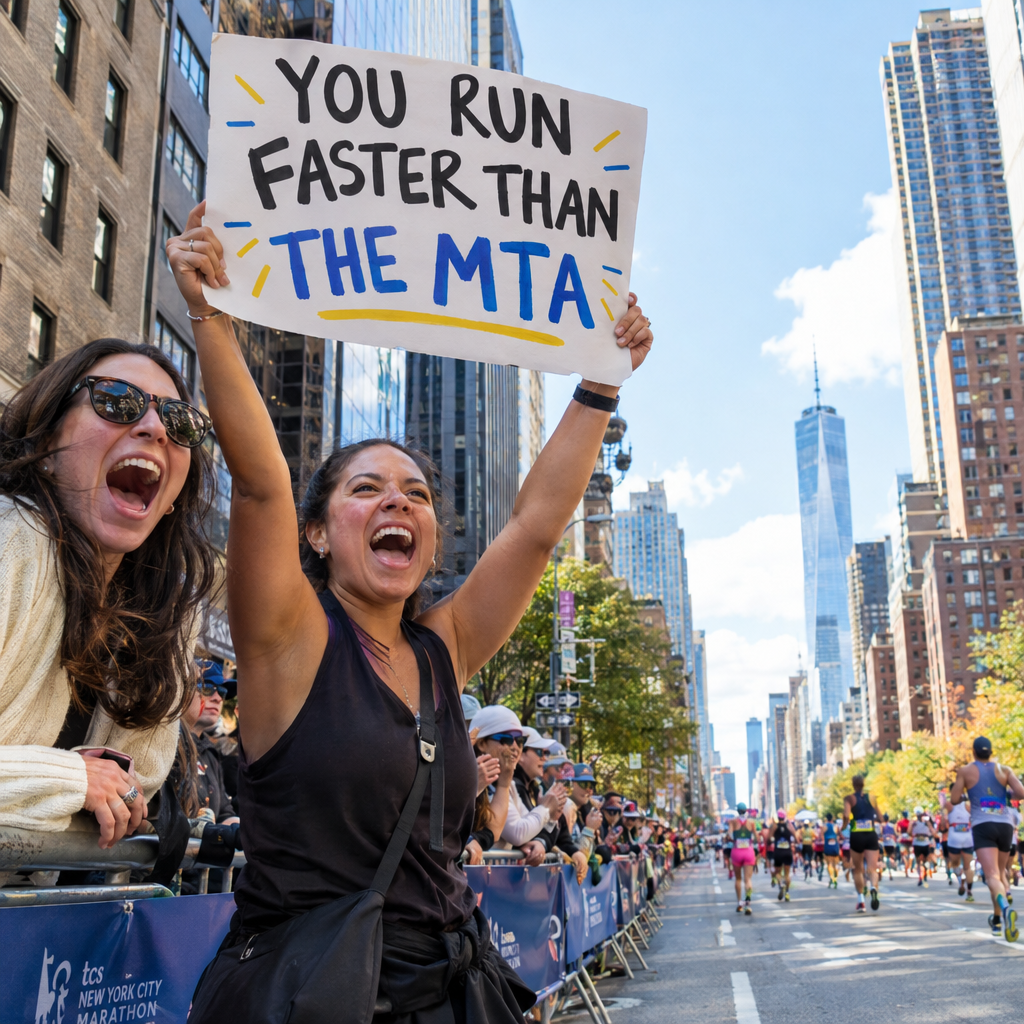
- Signs need big letters. Runners scan thousands of faces. Their name in large, bold print works better than anything clever.
After the Finish: Where to Regroup
Runners exit Central Park cold, stiff, and hungry, and every restaurant near the park will have a long wait. Walking a few blocks south into Midtown usually helps. If your runner is staying on the Upper West Side, our guide to Upper West Side hotels for the NYC Marathon covers quieter post-race bases. Runners who want a hotel gym and park access for a gentle shakeout the next morning should see boutique hotels near Central Park with a gym.
As of October 2026, Rockefeller Center was offering registered runners a $26 timed Top of the Rock ticket from October 30 to November 2, a calm way to take medal photos above the crowds (details here).
If something feels wrong after the race, such as sharp pain, swelling, or dizziness that doesn’t settle, our guide to running injury urgent care in NYC explains where to go and what it costs without U.S. insurance.
A Simple Spectator Packing List
- Phone fully charged, plus a small power bank
- Runner’s bib number, wave, and target pace saved offline
- A sign with their name in large letters
- Layers, gloves, and a hat; a foldable seat pad helps
- A MetroCard or contactless card or phone for OMNY taps
- Snacks and water; café lines spike around the busiest miles
Planning the rest of the weekend? Our NYC trip budget calculator helps you price hotel nights and meals around race day.
FAQ
Is watching the NYC Marathon free?
Yes. Anywhere along the open sections of the course, roughly mile 3 to the edge of Central Park, you can watch at no cost. Only the grandstand seating near the finish requires a ticket, sold in advance through New York Road Runners.
Where is the best place to watch the NYC Marathon for the first time?
For atmosphere, try Lafayette Avenue in Fort Greene or First Avenue on the Upper East Side. If you want your runner to actually hear you, Vernon Boulevard in Long Island City and Fifth Avenue between 110th and 90th Streets are less crowded.
Can I see the NYC Marathon finish line?
Not reliably for free. Grandstand seats are sold in advance, and standing areas inside the park close once they fill. Central Park South at mile 25 is the dependable alternative.
How many times can I see my runner?
Two is realistic for most people; three takes a slow runner and good timing. The easiest double is First Avenue followed by Central Park South, because the walk between them doesn’t cross the course.
What time should I arrive at my spot?
Aim to be in place 20–30 minutes before your runner’s estimated arrival, based on their wave start and pace. Arriving hours early mostly means standing in the cold. Use the official app’s live tracking to adjust on the day.
Final Thoughts
The marathon rewards spectators who do less, better. Pick two corners you can reach easily, know your runner’s pace, keep a café in your back pocket, and let the rest of the city roar around you. Somewhere between mile 14 and mile 25, a stranger will cheer for your person by name, and you’ll understand why New Yorkers keep coming back to the curb every November.
For the runner’s side of the day, see our New York Marathon 2026 guide.