Blog

Thanksgiving Parade View Hotel Rooms 2026: What They Really Cost (and a Calmer Way to Watch)

Thanksgiving parade view hotel rooms for the 100th Macy’s parade cost two to ten times a normal night, with multi-night minimums. Here is what a stay really totals, and the calmer options that cost far less.

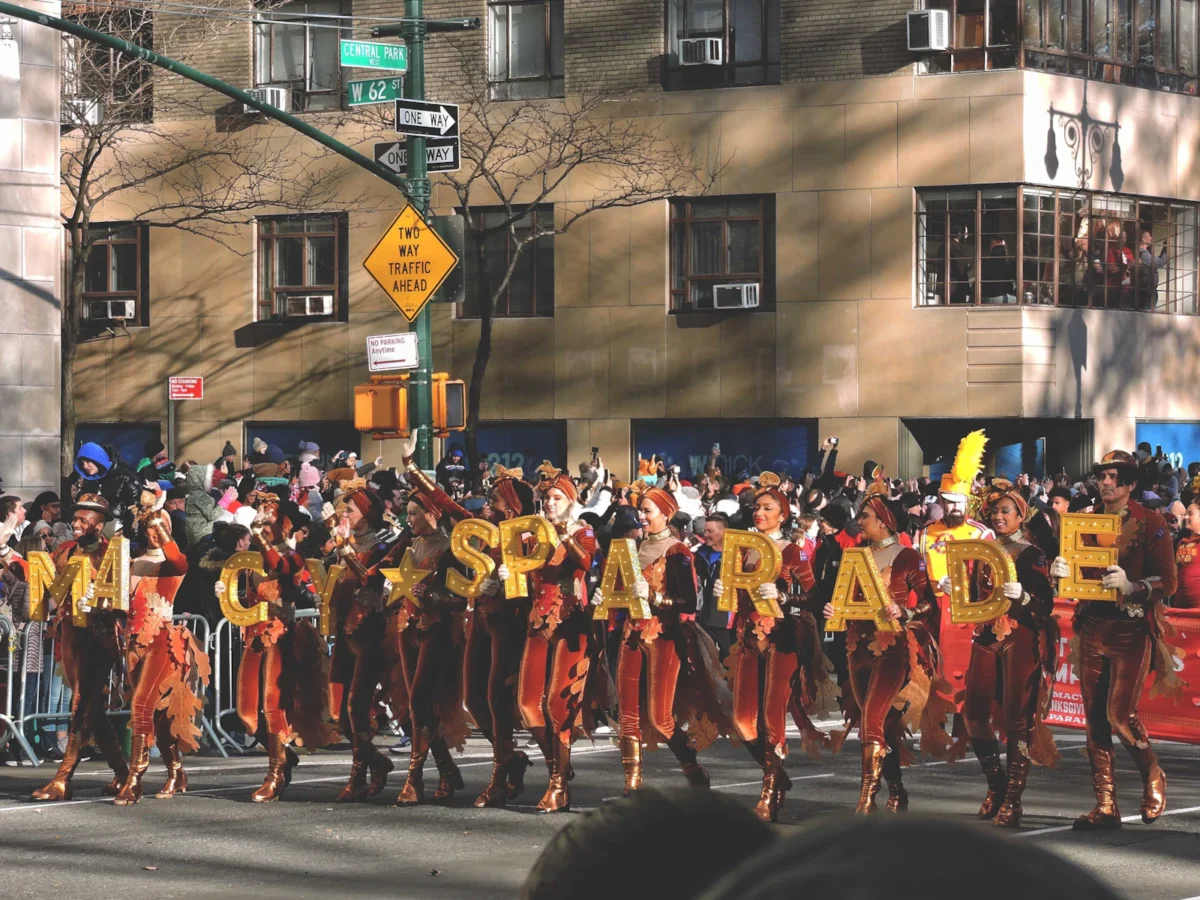
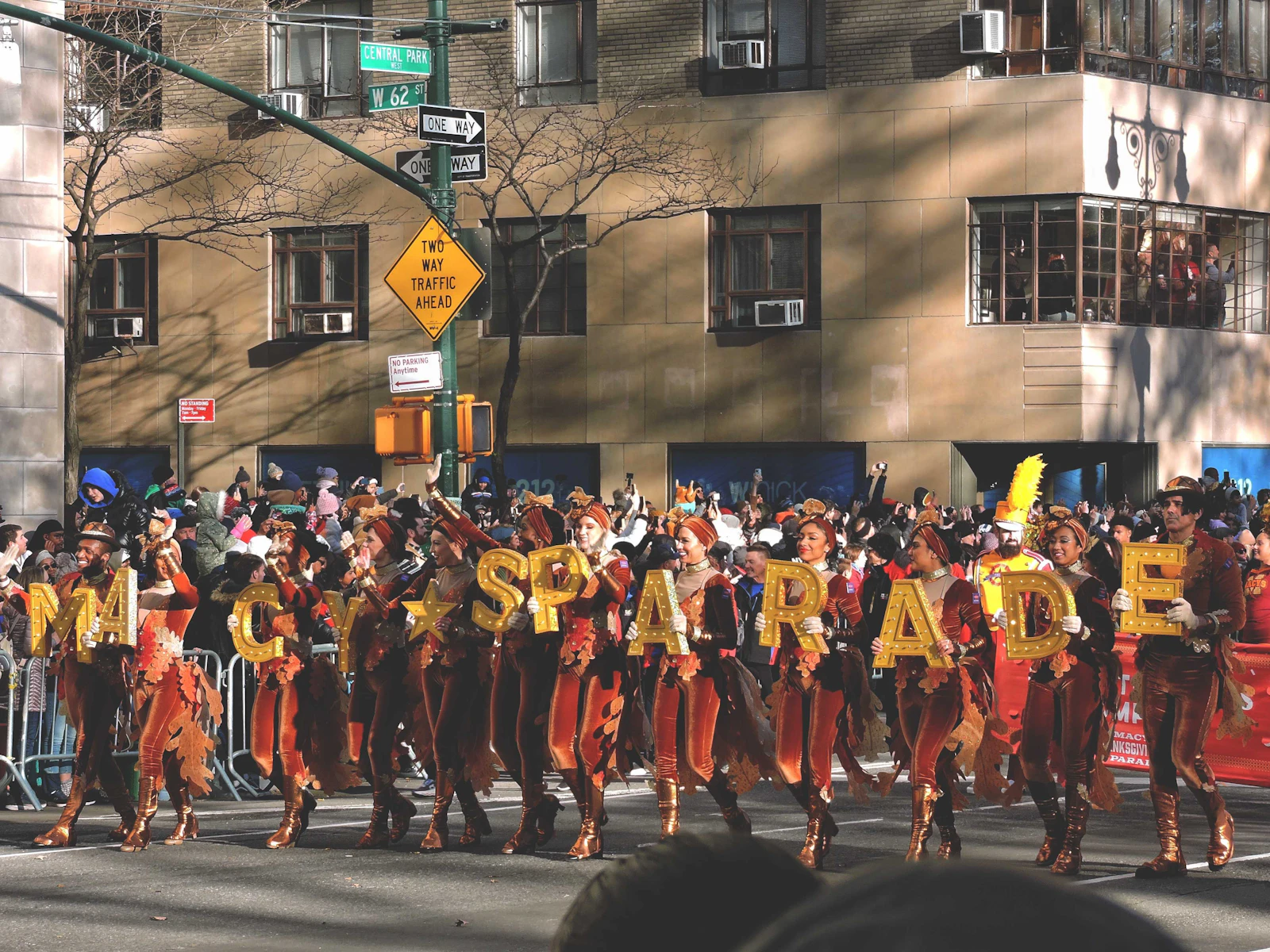
Performers in red and gold costumes march behind gold balloon letters at a Thanksgiving parade on a Manhattan street

At New York Hilton Midtown, the cheapest room with a view of Sixth Avenue on Thanksgiving week is listed at $1,095.50 a night, and you have to take it for four nights. The best corner rooms are $4,225 a night, five nights minimum. That is the starting point for anyone pricing Thanksgiving parade view hotel rooms this year, and 2026 is not an ordinary year: November 26 brings the 100th Macy’s Thanksgiving Day Parade.

I live with this parade the way most New Yorkers do: as a morning when Midtown closes, the avenues fill before sunrise, and the hotels along the route quietly become the most expensive rooms in the city. This guide looks at what those rooms really cost once tax and minimum stays are counted, whether the premium is worth it, and the calmer ways to see the balloons without paying for a window.

Disclosure: Prices and policies below are as of October 2026 and can change at any time. This is not financial advice. Some links may be affiliate links; see our disclosure page.

Quick Answer

  • Date and start: Thursday, November 26, 2026. Start time widely reported as 8:30 a.m.; confirm on the official Macy’s parade page before you go.
  • Route: About 2.5 miles, from West 77th Street and Central Park West, along Central Park South, then down Sixth Avenue to Herald Square.
  • Price range: Parade-view rooms run roughly $1,100 to $4,225 a night at the big Sixth Avenue hotels, and Lonely Planet reports up to $36,000 at the top of Columbus Circle.
  • The catch: Minimum stays of four to five nights are common, so the real bill is $5,000 to $24,000 before extras.
  • Booking window: The best rooms are often reserved close to a year out. In mid-October, expect leftovers, not choice.
  • The calmer route: A no-view room near the route, a hotel’s guest-only street area, or a lobby viewing party costs a fraction and still puts you close to the balloons.

Where the Parade Goes (and Why It Matters for Your Room)

Autumn trees and the twin towers of the Upper West Side skyline reflected in a Central Park pond

Your view depends entirely on which stretch of the route your window faces. The parade runs south on Central Park West, turns east along Central Park South, then heads down Sixth Avenue (Avenue of the Americas) to Macy’s Herald Square on 34th Street. Each section gives a different kind of view.

  • Central Park West (Upper West Side): Few hotels face the route directly. This is where the parade starts and where the street crowd is a little looser early on.
  • Columbus Circle and Central Park South: High-floor luxury hotels look down on the turn. You see the full scale of the parade, but from far above.
  • Sixth Avenue (50s and 40s): The densest cluster of parade-view rooms. Low floors put you at balloon height, which is the view most people picture.
  • Herald Square: The televised performance area. Access here is tightly controlled, so a nearby room does not mean you can see the performances.

Lonely Planet notes that crowd control and security make walking around during the parade difficult. In practice, wherever you sleep is where you will spend the morning, which is exactly why these rooms command such a premium.

What Thanksgiving Parade View Hotel Rooms Cost in 2026

Manhattan apartment towers seen through a high-floor hotel bedroom window

The table below compares the hotels with published or widely reported Thanksgiving pricing as of October 2026. Hilton figures come from the hotel’s own Thanksgiving parade page. The other figures come from Lonely Planet’s October 2026 roundup, because those hotels don’t publish full parade rate sheets.

Table 1: Parade-View Hotels Compared (As of October 2026)
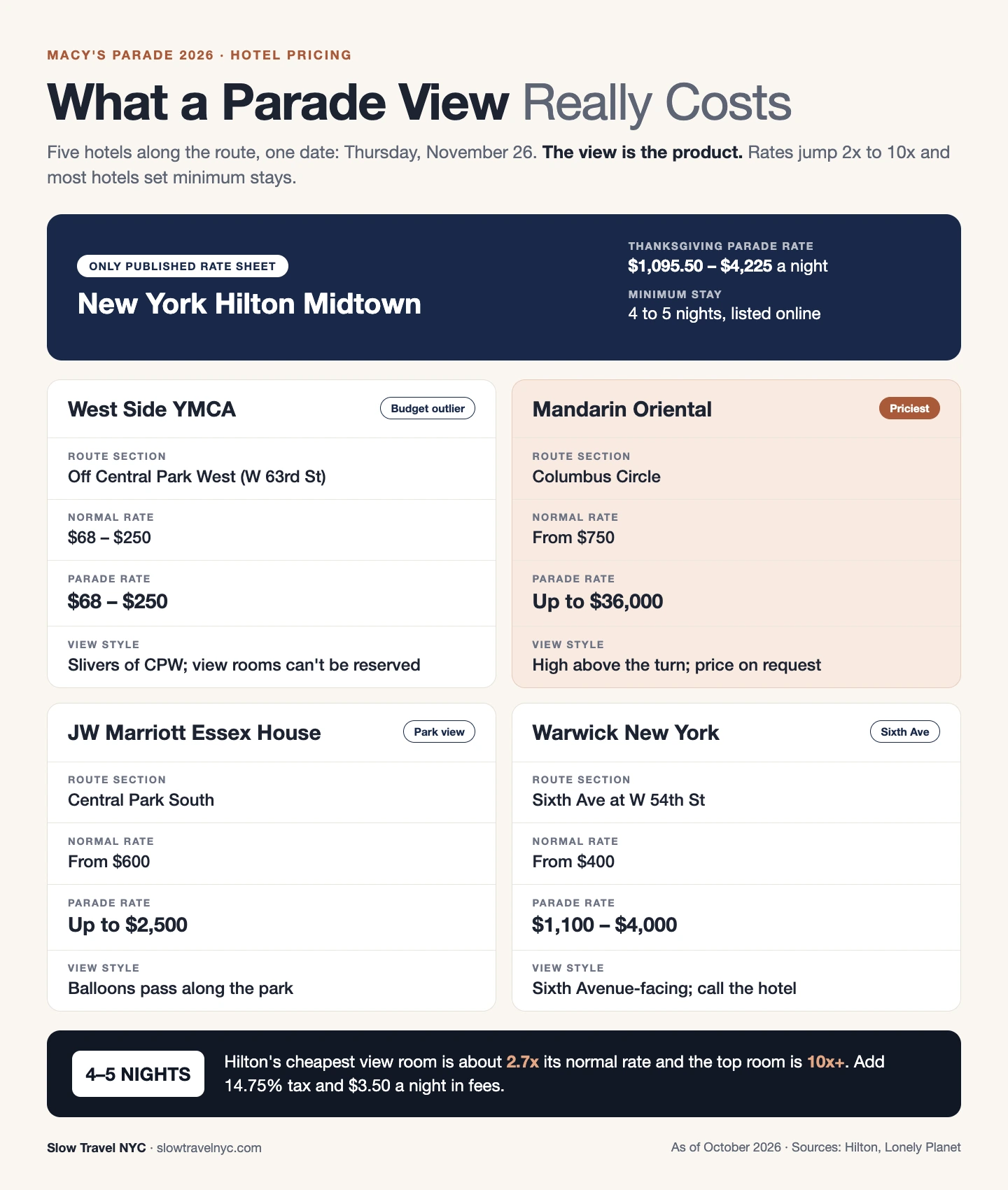
Infographic comparing five New York hotels by parade route section, normal rate and Thanksgiving parade-view rate

The pattern is easy to read. At Hilton, the cheapest view room costs about 2.7 times its normal baseline, and the top room more than ten times. The YMCA is the outlier: its price doesn’t move, because it doesn’t sell the view.

Hilton’s View Tiers, in Detail

Hilton is the most transparent option, so it is the most useful benchmark. Its 2026 parade rooms span 11 categories:

  • Ultimate Corner View (floors 7–18): $4,225/night, five-night minimum. North-facing double windows, so the balloons come straight toward you.
  • Deluxe View Low Floor (floors 6–23): $3,900/night, five-night minimum.
  • Full View Low Floor (floors 6–18): $3,250/night, four-night minimum.
  • Corner View High Floor / Passing View Low Floor: $1,950/night, four-night minimum.
  • Full View High Floor (floors 19–33): $1,560/night, four-night minimum.
  • Side View (floors 9–24): $1,095.50/night, four-night minimum. Smaller rooms facing north.
  • VIP Outdoor Viewing Area: a room with no parade view, plus access to a guest area directly on Sixth Avenue and breakfast. Rate varies, four-night minimum.

Low floors give you balloon-level drama. High floors give you the whole procession, but the balloons look smaller. Neither is objectively better; it depends on whether you want to feel the parade or see all of it.

The Real Bill: Tax, Minimum Stays and Totals

Bedside lamp, loose papers and a coffee cup on a hotel room nightstand

A nightly rate is not what you pay. New York City hotel stays carry 14.75% in combined sales and occupancy taxes, plus a $2 city fee and a $1.50 state hotel unit fee per room per night. The NYC Department of Finance has the official breakdown.

Here is what that does to Hilton’s published tiers once the minimum stay is applied.

Table 2: What a Parade-View Stay Really Costs (Hilton, As of October 2026)
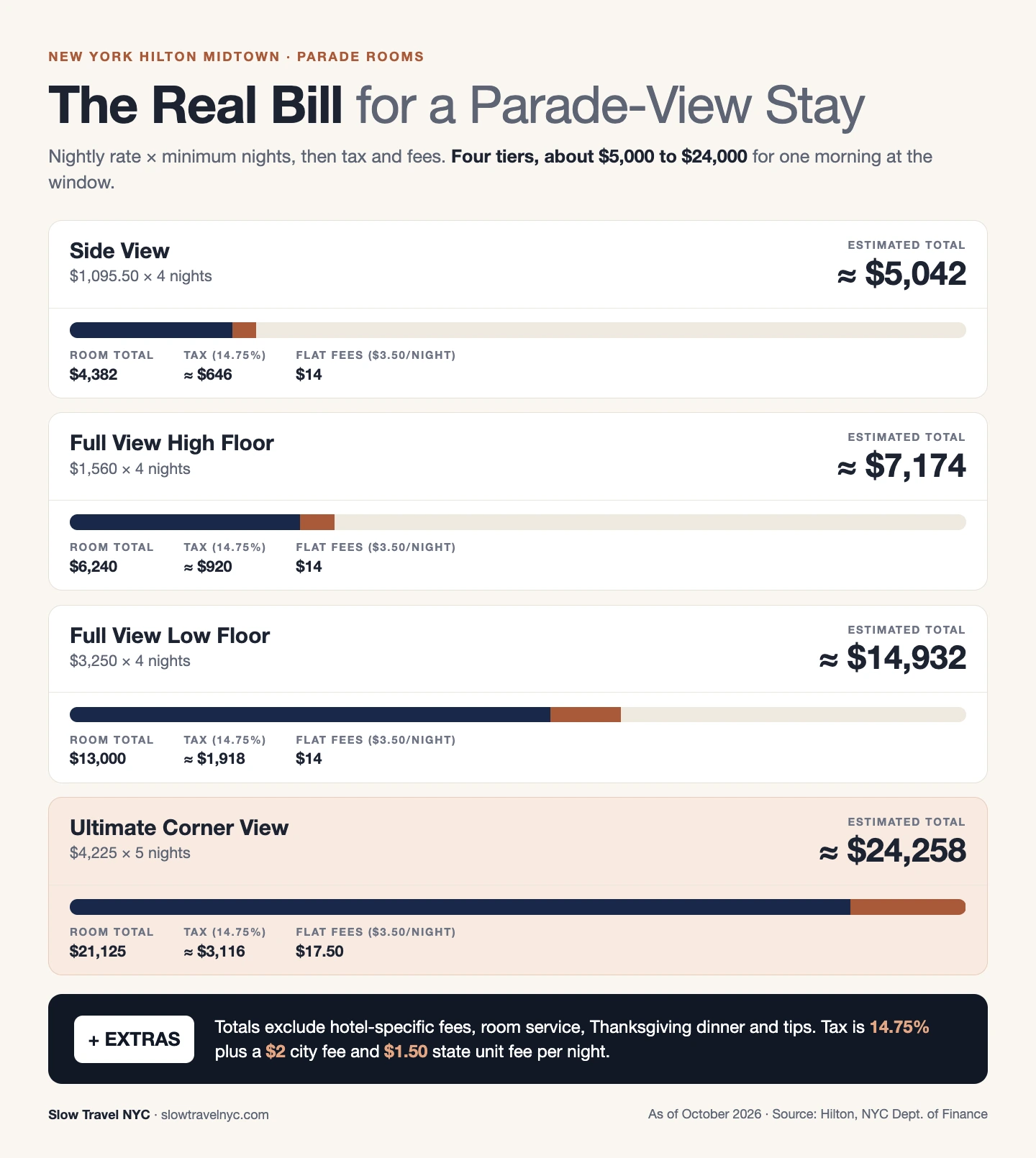
Infographic showing four Hilton parade-view room tiers stacked by total cost, from about $5,042 to about $24,258

These estimates exclude any hotel-specific fees, room service, Thanksgiving dinner and tips. Run your full trip through our NYC Trip Budget Calculator, and use the NYC Tip & Tax Calculator for parade-morning room service, which is rarely cheap on a holiday.

The quiet math is worth sitting with. Even the entry tier costs about $5,000 for a parade that passes your window in a single morning. For some families, that is a once-in-a-lifetime memory and worth every dollar. For others, it is the price of an entire week somewhere else.

Thanksgiving Parade Hotel Package Fine Print

Open lined notebook with a pen and pencils on a wooden desk

A Thanksgiving parade hotel package usually means a special rate plan, not a standard booking. Before you commit, read the terms the way you would read a contract.

  • Minimum stays are fixed. Hilton’s packages require four or five nights, often starting Tuesday or Wednesday. Shorter stays generally don’t get view rooms.
  • Arrival dates may be set. Hilton’s booking links default to specific arrival windows around November 24–25.
  • Cancellation is stricter than usual. Check the deadline and deposit rules before booking, and consider whether trip delay or cancellation coverage makes sense for a stay this size.
  • Points and elite perks are uncertain. Special event rate plans may not be bookable with points or eligible for upgrades. Ask the hotel directly (verify before relying on it).
  • “View” has grades. “Side,” “passing” and “front side” views can mean angled sightlines past neighboring buildings. Ask for the hotel’s floor diagram; Hilton publishes one.
  • Scaffolding happens. One parade-package seller warns buyers that no refunds are given if scaffolding remains on its venue. Ask any hotel whether facade work is scheduled.

Reality Check: Is a Parade-View Room Worth It?
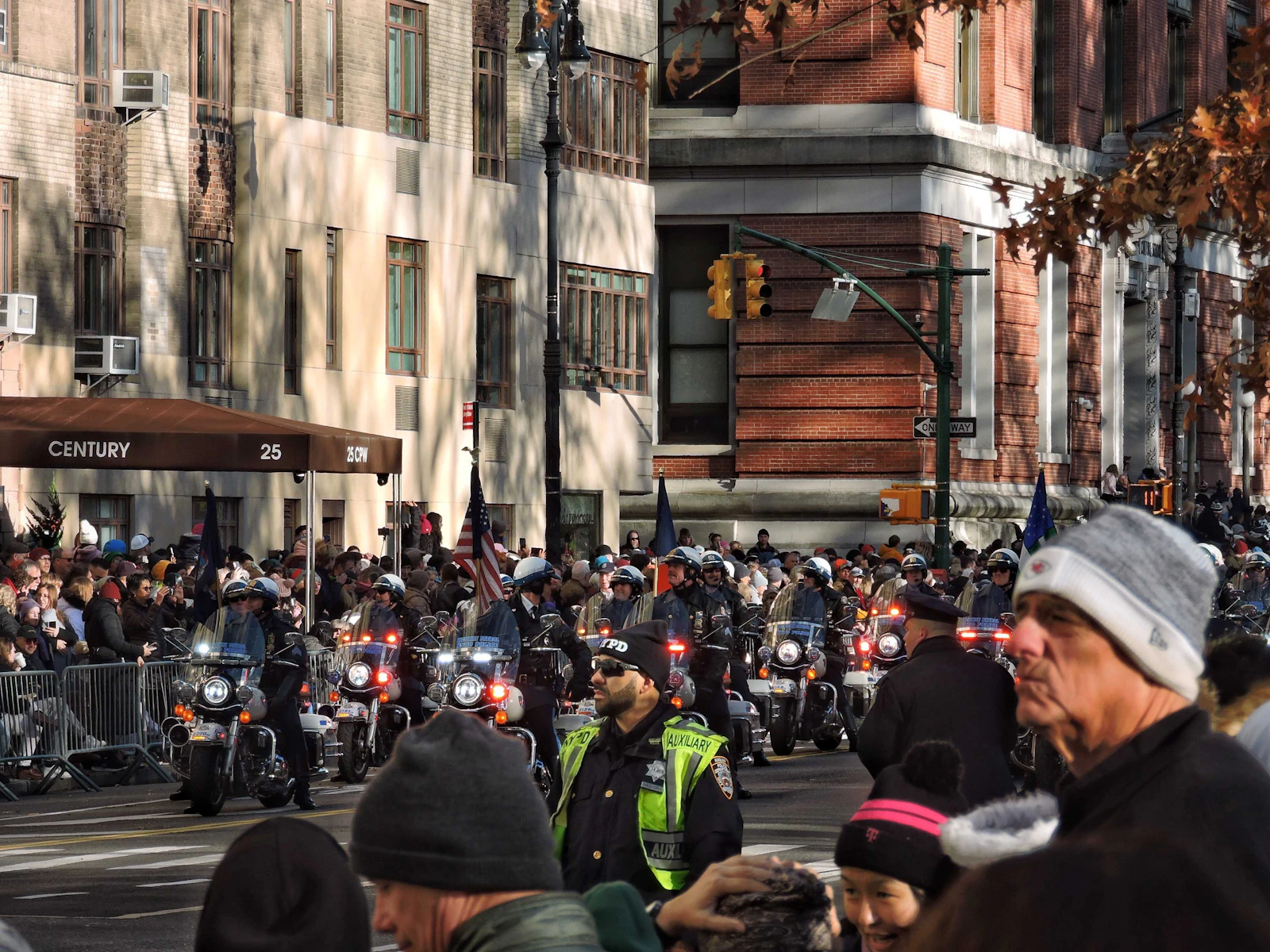
Spectators in winter coats behind barricades as police motorcycles pass on a Manhattan street

The case for the room is real. You skip a pre-dawn wait in November cold, you have a bathroom and hot coffee within ten steps, and children can watch from the windowsill instead of on a parent’s shoulders. If you are traveling with grandparents, small kids or anyone with limited mobility, the premium buys genuine comfort.

But the downsides deserve equal weight:

  • You pay for four or five nights to use one morning. The view is the product; the other nights are the cost of access.
  • Glass changes the experience. You see the balloons clearly but hear little of the bands, and you lose the shared energy of the street.
  • Weather is not on your side. Balloons can be flown lower or kept out in strong wind. A rainy year can still be wonderful from a room; a windy one can leave the view thinner than you paid for.
  • Availability is thin right now. Lonely Planet notes that the first reservations come almost a year before the parade. In October, the top tiers are often gone.
  • The surrounding days are expensive too. Thanksgiving week rates are elevated across Midtown, so the “other” nights in your minimum stay are not bargains either.

My view, offered gently: if the room is the trip, book it early and enjoy it fully. If the room is one item on a long list, the money usually goes further elsewhere.

A Calmer Way to Watch the 100th Parade
Brownstone row houses with stoops and yellow autumn leaves on a quiet New York street

Slow travel rarely means the most expensive seat. It means choosing the version of an event that leaves you present rather than exhausted. These options cost far less than Thanksgiving parade view hotel rooms and still put you close to the balloons.

Table 3: Calmer Ways to See the Parade

OptionApprox. costView qualityEffortBest for
Hilton VIP Outdoor Viewing Area (no-view room)Varies; 4-night minimumStreet level on Sixth AveLowFamilies who want the street without the scrum
West Side YMCA stay$68–$250/nightA short walk to Central Park WestMediumBudget travelers who don’t mind an early start
Hotel lobby viewing party (e.g., Refinery Hotel)Package price variesTV and atmosphere, not a direct viewLowCouples and kids who want the festive mood
Regular room off-route, walk out earlyStandard holiday ratesStreet level, depends on arrival timeHighTravelers already staying in Midtown or the UWS
Watch the broadcast, walk the route afterwardYour normal room rateBroadcast for the parade, quiet streets afterVery lowSlow travelers who prefer calm

Stay Near the Route, Not on It

A standard room a few blocks from Central Park West or Sixth Avenue costs holiday rates, not parade rates. Our Upper West Side hotel guide for the NYC Marathon covers several properties within walking distance of the northern end of the route. The early stretch along Central Park West is where spectators have historically stood on the west side of the street, roughly from the 70s down to the 60s. Confirm 2026 spectator areas once Macy’s publishes them.

Use a Hotel’s Guest-Only Space

Some route hotels sell rooms without a view but with access to a street-level area reserved for guests. At Hilton, that is the VIP Outdoor Viewing Area on Sixth Avenue, with breakfast included. You still stand outside, but with a defined space and a warm lobby behind you.

Choose the Lobby Over the Window

A few hotels near the route lean into the day without selling views. The Refinery Hotel, a few blocks from the route on West 38th Street, offers a package with a parade-watching party in its jazz bar and states plainly that its rooms don’t face the parade. It’s honest, cozy and far cheaper than a window.

Or Let the Parade Pass and Take the Afternoon

The version I find most appealing is the simplest: watch the broadcast with a slow breakfast, then walk once the barricades come down. Thanksgiving afternoon is one of the quietest stretches of the year in Midtown. If you want somewhere to sit afterward, our guide to the quietest places to sit in Midtown works especially well on a holiday.

How to Book If You Still Want the Room

Café table with a laptop, a notebook with a pen and a black coffee mug

If a parade-view room is the point of your trip, a few steps improve your odds:

  1. Book direct and ask questions. Several hotels only sell parade rooms by phone or email. Hilton takes inquiries at its Thanksgiving email address and also lists bookable tiers online.
  2. Ask for the floor and the orientation. “North-facing, Sixth Avenue, floor 10” tells you far more than “parade view.”
  3. Get the terms in writing. Minimum nights, deposit, cancellation deadline and what happens if the view is obstructed.
  4. Price the full stay, not the night. Multiply by the minimum, then add 14.75% plus $3.50 a night.
  5. If 2026 is gone, plan for 2027. Hilton’s page has previously told visitors to check back in January for the following year’s bookings. That’s a good month to set a reminder.

FAQ

How much do Thanksgiving parade view hotel rooms cost in 2026?

As of October 2026, New York Hilton Midtown lists parade-view rooms from $1,095.50 to $4,225 a night with four- to five-night minimums. Lonely Planet reports $1,100 to $4,000 at the Warwick, up to $2,500 at JW Marriott Essex House and up to $36,000 at Mandarin Oriental. With tax and minimum stays, a Hilton stay totals roughly $5,000 to $24,000.

Is there a minimum stay for a Thanksgiving parade hotel package?

Usually, yes. Hilton requires four nights for most parade tiers and five nights for its top two categories. Other hotels set their own rules, so ask before booking.

When should I book a parade-view hotel room?

As early as possible. Lonely Planet notes that the first reservations come almost a year before the parade. For 2026, check remaining availability now; for 2027, start in January.

Can I watch the parade from a hotel without paying for a view room?

Yes. Some route hotels, including New York Hilton Midtown, offer rooms without views that include access to a guest-only street viewing area. Others host lobby viewing parties. Staying a few blocks from the route and walking out early is another option.

What time does the 2026 Macy’s parade start, and where?

The 100th parade is on Thursday, November 26, 2026. The start is widely reported as 8:30 a.m. at West 77th Street and Central Park West, finishing at Herald Square around noon. Confirm the final time and route on Macy’s official parade page.

Final Thoughts

A parade-view room for the 100th Macy’s parade is a real luxury, and it can be worth it for the right family on the right trip. But it is a luxury priced by scarcity: four or five nights to keep one morning, at two to ten times the usual rate. Go in knowing the full total, not the nightly teaser.

If the number gives you pause, the calmer options are not consolation prizes. A warm lobby, a defined street space, or a slow breakfast followed by a quiet walk down an empty Sixth Avenue can be the part of Thanksgiving in New York you remember longest.

Related post you might enjoy

NYC Marathon Spectator Guide 2026: 7 Places to Watch and the Cafés Between Them

A calm NYC Marathon spectator guide for November 1, 2026: the best places to watch the NYC Marathon from Brooklyn to Central Park South, when your runner will actually pass, and where to warm up with coffee without losing the day.

NYC Marathon spectator guide

On Sunday, November 1, 2026, more than 50,000 runners will cross all five boroughs, and something like two million people will stand on curbs to watch them. Most spectators make the same mistake: they pick one famous corner, arrive too early, wait two cold hours, and miss their runner in a crowd ten deep. This NYC Marathon spectator guide is built the other way around: start with your runner’s pace, pick two realistic spots near a subway line, and plan a warm café between them.

I’ve always thought the marathon is the one day New York agrees to slow down for strangers. You don’t need to see every mile to feel it. You need the right two corners, a coffee in your hand, and a sense of when to look up.

Quick Answer

  • Date: Sunday, November 1, 2026. Daylight saving time ends the same morning, so clocks fall back an hour and sunset comes early.
  • Best first spot: Fourth Avenue or Lafayette Avenue in Brooklyn (miles 3–9). The crowds are friendly and the coffee is close.
  • Best for being heard: Vernon Boulevard in Long Island City (mile 14). Fewer people, and runners have just finished a quiet bridge.
  • Loudest: First Avenue, Upper East Side (roughly miles 16–19).
  • Where cheering matters most: Fifth Avenue, 110th to 90th Streets (miles 22–23), the long uphill.
  • Two-spot plan most people can pull off: First Avenue, then a walk west to Central Park South (mile 25).
  • Don’t plan on: the start, any bridge, or a free, guaranteed view of the finish line.

When Your Runner Will Actually Pass (Do This First)

The race doesn’t arrive as a single pack. It arrives as a long river that thickens through the middle of the day. Based on the 2025 schedule, the wheelchair divisions start around 8:00 a.m., professional women around 8:35 a.m., and professional men with the first general wave around 9:05 a.m. Later waves leave until about 11:30 a.m. (As of October 2026, NYRR had published the mass-wave times but not the final professional start times. Check the official app in race week.)

That means a runner in the last wave may reach First Avenue well after 2 p.m. So before choosing a corner, find your runner’s wave start time and target pace, then use the table below.

Course pointMile8:00/mile pace10:00/mile pace12:00/mile pace
Lafayette Ave, Fort Greene8~1:04 after start~1:20~1:36
Vernon Blvd, Long Island City14~1:52~2:20~2:48
First Ave, Upper East Side18~2:24~3:00~3:36
Fifth Ave, near 100th St23~3:04~3:50~4:36
Central Park South25~3:20~4:10~5:00
Finish26.2~3:30~4:22~5:14

These are even-pace estimates measured from the moment your runner crosses the start line, which can be 10–20 minutes after their wave’s official gun time. The bridges slow most people down, so treat the numbers as a window, not a promise.

Add your runner in the official TCS New York City Marathon app the night before, on Wi-Fi. On race day the live splits matter more than any table.

The Best Places to Watch the NYC Marathon, Borough by Borough

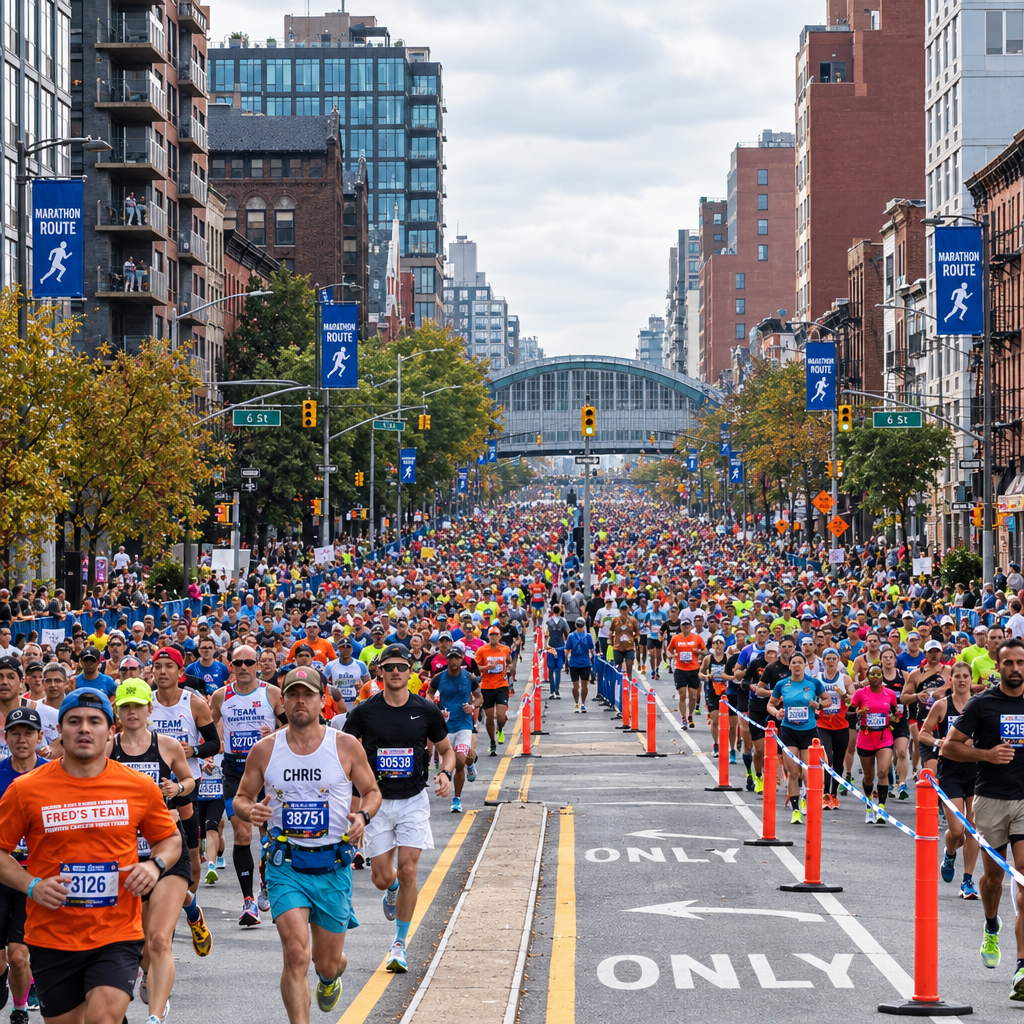
Runners streaming down a wide Brooklyn avenue lined with brownstones and cheering spectators during the New York City Marathon

The course starts in Staten Island, but spectators can’t watch the start or the Verrazzano-Narrows Bridge. In fact, every bridge on the course is closed to spectators. Here are the seven stretches that work, in race order.

1. Fourth Avenue, Brooklyn (Miles 3–7)

This is where you see the field while it’s still a field: fresh legs, tight packs, and enough sidewalk to reach the curb. It suits first-timers who want to understand the scale of the day. The R train runs right under the avenue, with stops every few blocks.

2. Lafayette Avenue, Fort Greene (Miles 8–9)

Brownstone blocks, live music, and deep but good-natured crowds. Many longtime spectators call this the best atmosphere on the course. Take the C to Lafayette Avenue or the G to Fulton Street or Clinton–Washington Avenues.

Coffee nearby: Bittersweet at 180 DeKalb Avenue, a narrow neighborhood café at the southeast corner of Fort Greene Park, a few minutes’ walk north of the course. Expect a line on race morning; it moves.

3. Bedford Avenue, Williamsburg (Miles 11–12)

Young, loud, and relentlessly festive. The street is narrower than Fourth Avenue, so the noise concentrates. The L, J, M, and G trains all bring you within walking distance.

Coffee nearby: Devoción at 148 Grand Street, a skylit Colombian roastery with a wall of plants. It’s a short walk west of the course and a good place to defrost before you move on. Weekend opening is listed around 7:30–8 a.m. (confirm before you go).

4. Vernon Boulevard, Long Island City (Mile 14)

This is the underrated choice. Runners have just crossed the Pulaski Bridge at the halfway mark, where nobody is allowed to cheer, and the Queens stretch is short. Crowds thin out noticeably, so this is the spot where your runner can actually hear their name. Take the 7 to Vernon Blvd–Jackson Ave or the G to 21st Street.

Coffee nearby: Sweetleaf at 10-93 Jackson Avenue, a longtime LIC coffee bar in the shadow of the Pulaski Bridge. It’s one of the few cafés where you can practically step out of the door and onto the course. Sunday hours have historically started around 9 a.m. (confirm before you go).

5. First Avenue, Upper East Side (Roughly Miles 16–19)

Coming off the long, quiet Queensboro Bridge, runners turn onto First Avenue and hit a wall of sound. It’s the moment most people picture when they imagine marathon day. The tradeoff is crowds: reaching the barricade takes patience. Take the Q to 72nd, 86th, or 96th Street, or the 4/5/6 along Lexington Avenue.

Coffee nearby: Le Moulin à Café at 1439 York Avenue, a French café-bistro with a small grocery and a fireplace in the back. It sits two avenues east of the course, so it’s best if you plan to stay on the east side.

One practical tip: If you plan to see your runner again later, watch from the west side of First Avenue. Crossing the course is only allowed at designated points, and you don’t want to be stuck on the wrong side.

6. The Bronx and Fifth Avenue, 110th to 90th Streets (Miles 20–23)

Runners spend only about a mile in the Bronx (6 train to 3rd Ave–138th St), then return to Manhattan and head down Fifth Avenue along the park. The stretch from 110th to 90th Street is a steady uphill at exactly the point where legs stop cooperating. Crowds are thinner and your voice counts most. Take the 6 to 96th or 103rd Street and walk west.

Coffee nearby: Bluestone Lane at 1085 Fifth Avenue (near 90th Street), where runners enter the park. Café Sabarsky inside the Neue Galerie, a block south, is a quieter Viennese option but was closed for renovation over summer 2026 with an autumn reopening planned. Check whether it has reopened before counting on it.

7. Central Park South (Mile 25)

This is the last full mile, with the finish close enough that runners can feel it. Most people are spent and elated at the same time, which makes for the best photographs of the day. Take the N/R/W to 5th Ave–59th St or the F to 57th Street.

Comparing the Spots at a Glance

SpotMilesCrowd levelBest forNearest trainsCafé to warm up
Fourth Ave, Brooklyn3–7ModerateFirst-timers, seeing the full fieldRMany on 5th Ave nearby
Lafayette Ave, Fort Greene8–9Heavy, friendlyAtmosphere, musicC, GBittersweet
Bedford Ave, Williamsburg11–12Heavy, loudParty energyL, J, M, GDevoción
Vernon Blvd, LIC14LightBeing heard by your runner7, GSweetleaf
First Ave, UES16–19Very heavyThe famous wall of soundQ, 4/5/6Le Moulin à Café
Fifth Ave, 110th–90th22–23Light to moderateSupport when it’s hardest6Bluestone Lane
Central Park South25HeavyFinal-mile emotion, photosN/R/W, FHotel lobbies, Midtown cafés

How to See Your Runner Twice (Without Sprinting Across the City)

The shape of the course makes one double easy, and it’s the one most experienced spectators use.

The Manhattan double (recommended): Watch on the west side of First Avenue somewhere in the 70s or 80s. Once your runner passes, walk west and south toward Central Park South. Runners are inside the park from 90th Street down, so you won’t need to cross the course on that walk. With roughly eight miles between the two points, you’ll have about an hour or more, depending on pace.

The Brooklyn double (tight): Fourth Avenue, then Bedford Avenue. It only works if you leave the moment your runner passes and your runner isn’t fast. The subway connection between south and north Brooklyn is slow, so I’d only try it for a runner pacing 10:00/mile or slower.

The calm double: Lafayette Avenue, then Vernon Boulevard. Take the G north to 21st Street. You trade some atmosphere for a much better chance of a face-to-face moment at mile 14.

In every version, walking is often faster than any vehicle once you’re near the course. Marathon Sunday closes a long list of streets, so check the MTA service updates the morning of the race.

Reality Check: What Nobody Mentions

  • The finish line isn’t a free walk-up. Grandstand seats near the finish are sold in advance through New York Road Runners, and standing areas inside the park fill and close. Central Park South is the reliable free version of the finale.
  • Cell service drops in big crowds. Agree on a meeting point (a specific street corner, not “near the finish”) before race day.
  • Restrooms are scarce. In practice, buying a coffee is how you get access to one. That’s another reason to plan your café stops.
  • It’s cold to stand still. Early November mornings in New York can be near freezing, and you’ll be motionless for hours. Bring layers, gloves, and something warm to hold.
  • The clocks change that morning. Daylight saving time ends November 1, so double-check your phone and your runner’s start time. Light fades by late afternoon, which matters if your runner is in a late wave.
  • Crossing the course is limited. Choose your side of the street on purpose, especially on First Avenue.
  • Signs need big letters. Runners scan thousands of faces. Their name in large, bold print works better than anything clever.

After the Finish: Where to Regroup

Runners exit Central Park cold, stiff, and hungry, and every restaurant near the park will have a long wait. Walking a few blocks south into Midtown usually helps. If your runner is staying on the Upper West Side, our guide to Upper West Side hotels for the NYC Marathon covers quieter post-race bases. Runners who want a hotel gym and park access for a gentle shakeout the next morning should see boutique hotels near Central Park with a gym.

As of October 2026, Rockefeller Center was offering registered runners a $26 timed Top of the Rock ticket from October 30 to November 2, a calm way to take medal photos above the crowds (details here).

If something feels wrong after the race, such as sharp pain, swelling, or dizziness that doesn’t settle, our guide to running injury urgent care in NYC explains where to go and what it costs without U.S. insurance.

A Simple Spectator Packing List

  • Phone fully charged, plus a small power bank
  • Runner’s bib number, wave, and target pace saved offline
  • A sign with their name in large letters
  • Layers, gloves, and a hat; a foldable seat pad helps
  • A MetroCard or contactless card or phone for OMNY taps
  • Snacks and water; café lines spike around the busiest miles

Planning the rest of the weekend? Our NYC trip budget calculator helps you price hotel nights and meals around race day.

FAQ

Is watching the NYC Marathon free?

Yes. Anywhere along the open sections of the course, roughly mile 3 to the edge of Central Park, you can watch at no cost. Only the grandstand seating near the finish requires a ticket, sold in advance through New York Road Runners.

Where is the best place to watch the NYC Marathon for the first time?

For atmosphere, try Lafayette Avenue in Fort Greene or First Avenue on the Upper East Side. If you want your runner to actually hear you, Vernon Boulevard in Long Island City and Fifth Avenue between 110th and 90th Streets are less crowded.

Can I see the NYC Marathon finish line?

Not reliably for free. Grandstand seats are sold in advance, and standing areas inside the park close once they fill. Central Park South at mile 25 is the dependable alternative.

How many times can I see my runner?

Two is realistic for most people; three takes a slow runner and good timing. The easiest double is First Avenue followed by Central Park South, because the walk between them doesn’t cross the course.

What time should I arrive at my spot?

Aim to be in place 20–30 minutes before your runner’s estimated arrival, based on their wave start and pace. Arriving hours early mostly means standing in the cold. Use the official app’s live tracking to adjust on the day.

Final Thoughts

The marathon rewards spectators who do less, better. Pick two corners you can reach easily, know your runner’s pace, keep a café in your back pocket, and let the rest of the city roar around you. Somewhere between mile 14 and mile 25, a stranger will cheer for your person by name, and you’ll understand why New Yorkers keep coming back to the curb every November.

For the runner’s side of the day, see our New York Marathon 2026 guide.

Related Reading

Boutique Hotels Near Central Park With Gym: 4 Top Picks for Runners

Planning a running trip to Manhattan? These four boutique hotels near Central Park combine round-the-clock fitness centers with a short walk to the park’s best running loops, plus practical tips for marathon season.

    Runner jogging in Central Park at sunrise near boutique hotels with gym access in Manhattan

    If you’re a runner or lifter heading to Manhattan, location and amenities decide everything. The best boutique hotels near Central Park with gym access put you a few minutes from the park’s running loops, then give you a proper fitness center for strength sessions, late-night workouts and rainy-day training.

    This guide covers four of the best hotels near Central Park for runners. I compared each hotel’s own pages, travel listings and Central Park Conservancy route data, so you know what to expect before you book.

    Quick Comparison: Boutique Hotels Near Central Park With Gym

    Central Park South entrance with Manhattan hotels in the background
    HotelAreaWalk to Central ParkGym HighlightsVibe
    1 Hotel Central ParkCentral Park SouthAbout 1 block24-hour Field House, Peloton bikes, rowers, kettlebellsEco-luxury
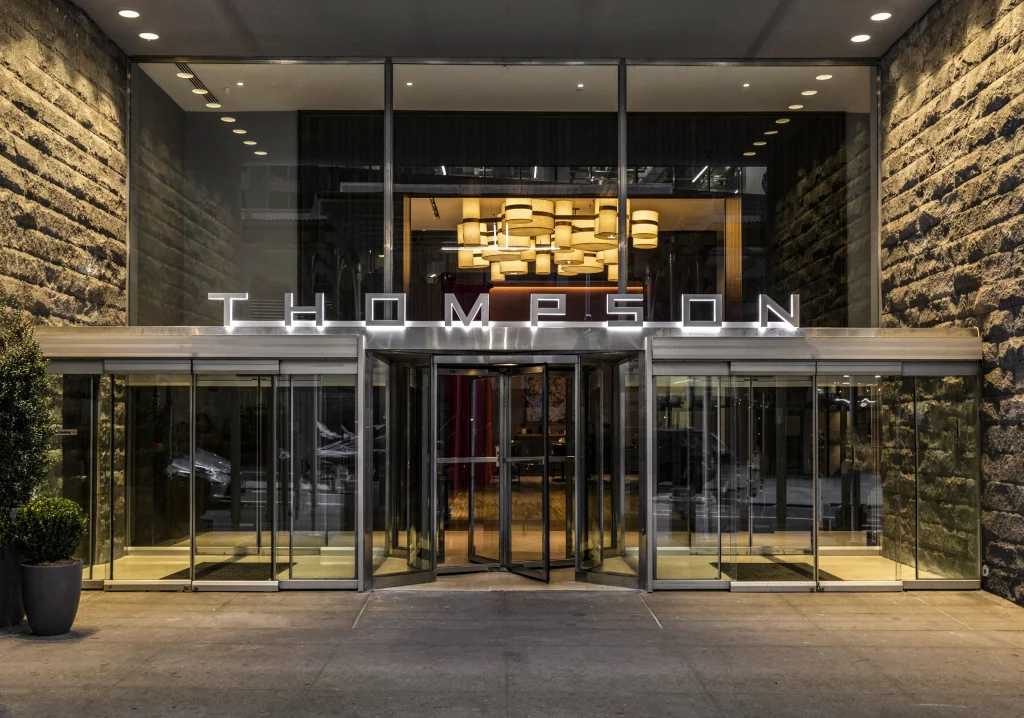
    Thompson Central ParkMidtownAbout 5 minutesSubterranean gym (“The Underground”), Peloton bikesSleek, mid-century
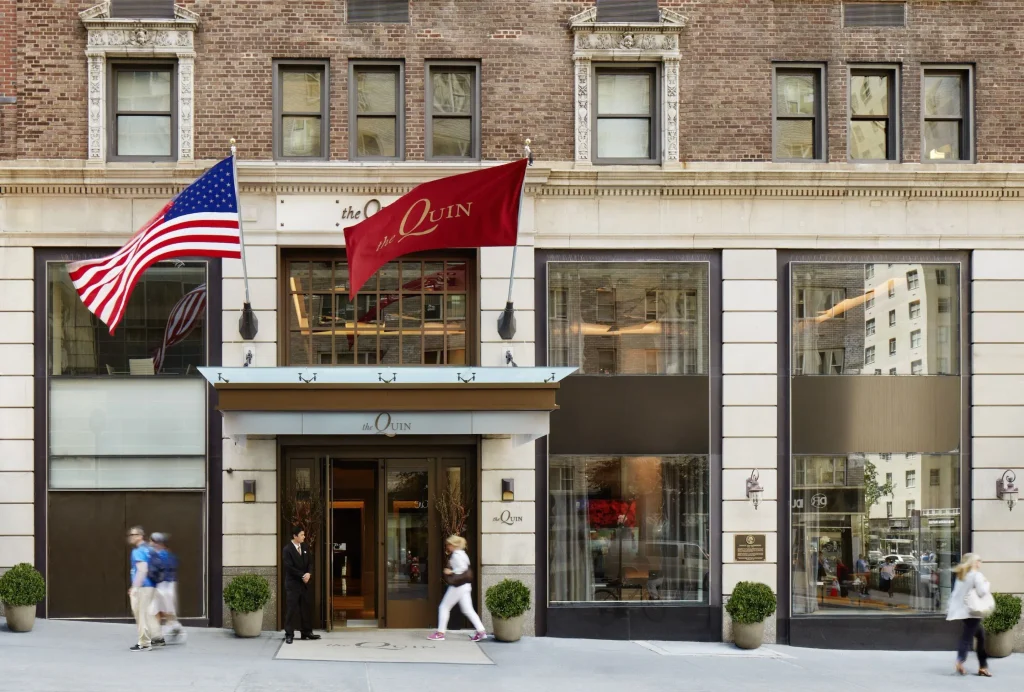
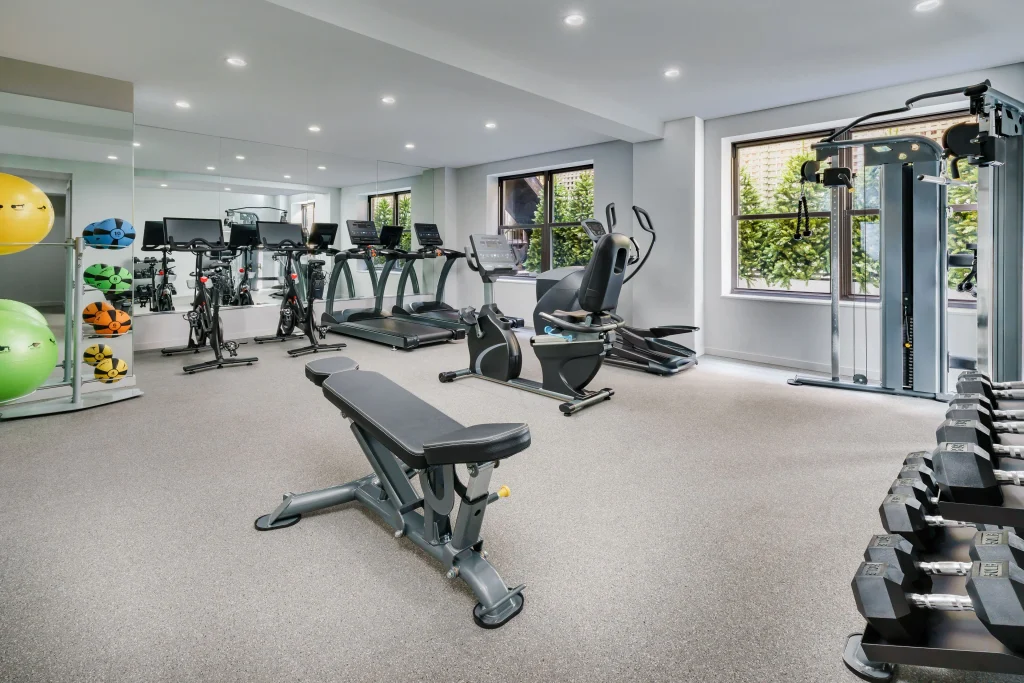
    The Quin (Hilton Club)MidtownAbout 2 blocks24-hour gym, Peloton bikes, personal training and private yogaArt-inspired, refined
    The WallaceUpper West SideAbout 10–15 minutes24-hour gym, 2 Peloton bikes, free weightsResidential, upscale

    Equipment and hours change often, so confirm with the hotel before you book.

    Why Choose Boutique Hotels Near Central Park With a Gym?

    Cozy boutique hotel room in Manhattan with natural light and modern decor

    Large chain hotels often have cramped basement gyms and slow elevators. Boutique properties are smaller, quieter and usually more thoughtful about wellness. Guests also tend to like the personal touches, such as running maps at the front desk and trainer referrals.

    Staying within a few blocks of the park matters too. You can start a run from the lobby without battling Midtown crosswalks, and you can still hit the gym at 5 a.m. or midnight if your schedule is off.

    4 Best Hotels Near Central Park for Runners

    1. 1 Hotel Central Park: Best for Wellness and Sustainability

    Sitting at 1414 6th Avenue, 1 Hotel Central Park is the strongest all-round choice if you want eco-conscious design and serious fitness. Its Field House gym is on the second floor and open 24 hours daily. It has Peloton bikes, rowers, kettlebells, a resistance treadmill, and a stretching area with a reclaimed wooden floor.

    24-hour Field House gym at 1 Hotel Central Park with Peloton bikes and reclaimed wood floor
    boutique hotels near Central Park with gym

    Runner’s perk: The hotel offers a Central Park running map with loops from about 1.5 to 6 miles, and complimentary group classes for guests. Note that the hotel charges an amenity fee that covers wellness extras, so factor it into your budget.

    For the running routes, see the guide to running routes in Central Park.

    2. Thompson Central Park New York: Best for Peloton Fans

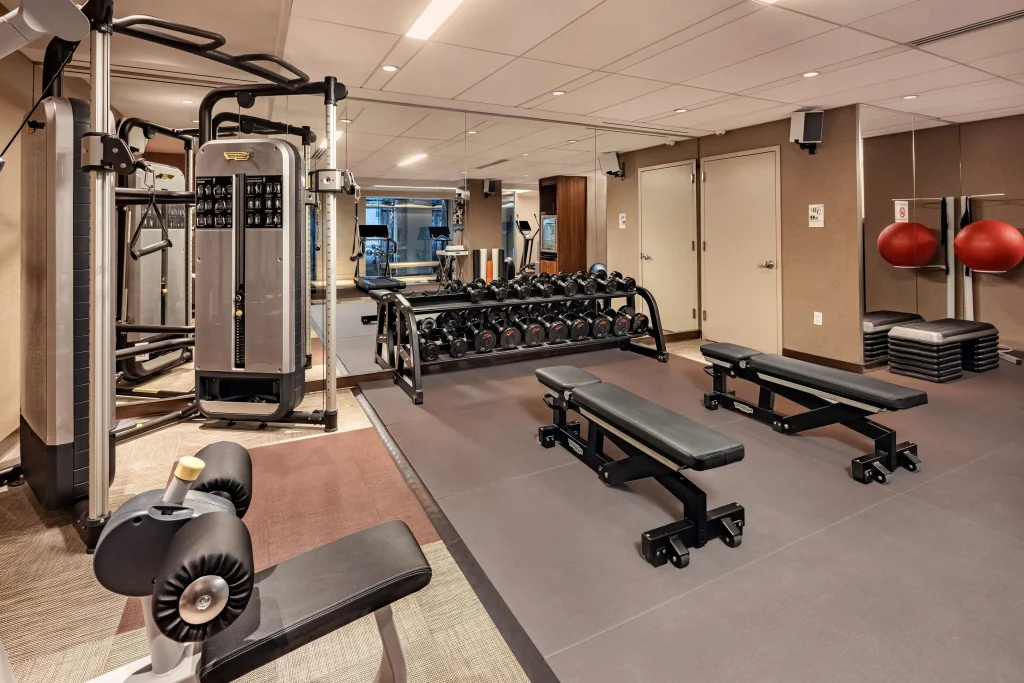
    Located at 119 West 56th Street, on the same block as Carnegie Hall, the Thompson is about a five-minute walk from the park. Its gym is underground and packed with modern equipment. The hotel has offered Peloton bikes since opening in 2021, and it encourages guests to take Peloton app classes in their rooms or on guided walks in the park, as described in Peloton’s hospitality case study.

    Peloton bikes in the underground fitness center at Thompson Central Park New York
    Peloton bikes in the underground fitness center at Thompson Central Park New York

    Runner’s perk: A straight shot up to the park’s southern entrance, which makes it a great base for tempo runs. Confirm current gym hours when you book if you plan on very early or late sessions.

    3. The Quin Central Park by Hilton Club: Best for Personal Training

    The 208-room Quin sits at 57th Street and Sixth Avenue, about two blocks from the park. Travel listings consistently describe a 24-hour fitness center that includes a Peloton bike and can arrange personal training and private yoga sessions. You can see the equipment details on Pelo Buddy’s listing.

    Fitness center at The Quin Central Park by Hilton Club, two blocks from the park

    Runner’s perk: It’s next to a subway station and close to the New York Road Runners RUNCENTER on 57th Street, which makes it easy to join group runs or use lockers.

    4. The Wallace Hotel: Best for a Quiet Upper West Side Stay

    At 242 West 76th Street, The Wallace trades Midtown bustle for tree-lined residential streets. Its 124 rooms are paired with a complimentary 24-hour fitness center featuring cardio equipment, free weights and 2 Peloton bikes, according to Haute Living.

    The Wallace Hotel gym on the Upper West Side with cardio equipment and Peloton bikes
    The Wallace Hotel gym on the Upper West Side with cardio equipment and Peloton bikes

    Runner’s perk: You’re a reasonable walk from the park’s west side and the Reservoir track, and you’ll avoid most tourist crowds. Some guest reviews mention occasional equipment downtime, so don’t count on a specific bike being available.

    Where to Run Once You’re Out the Door

    Whichever hotel you choose, these Central Park Conservancy routes are the ones to know:

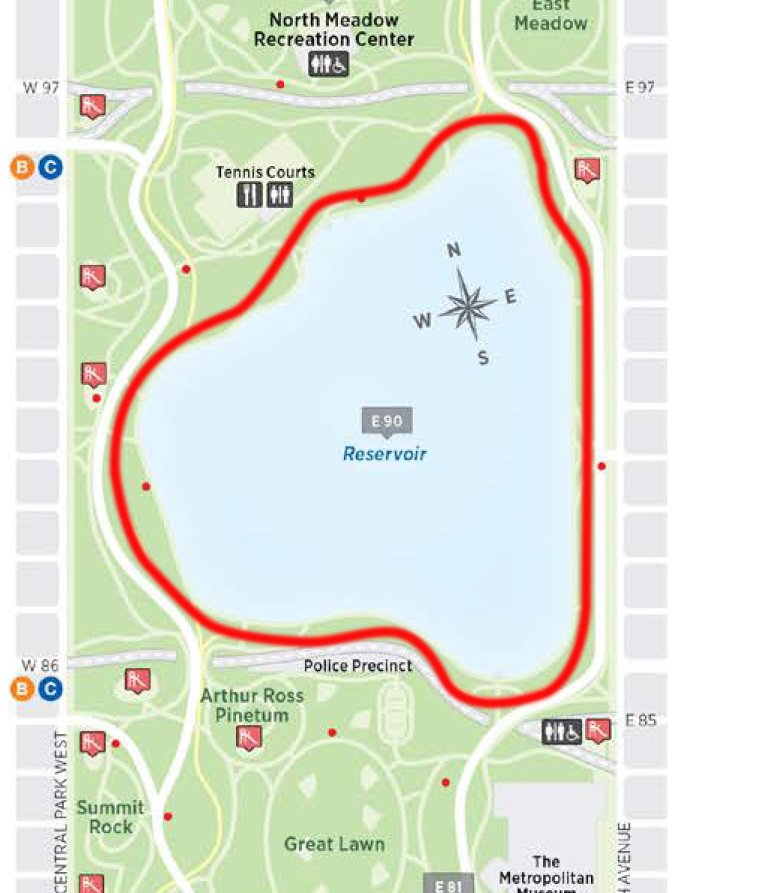
    Runners on the 1.58-mile Central Park Reservoir track with the Manhattan skyline
    Reservoir running track
    • Reservoir running track: a 1.58-mile loop with some of the best skyline views, and a softer surface than pavement.
    • Full park loop: 6.1 miles on the paved drive, with transverse roads for shorter options.
    • Bridle path: a 1.66-mile soft-surface loop around the Reservoir track.

    The park roads can open to traffic at certain times, so weekends and mid-day weekdays are safest. Official running maps also mark water fountains and restrooms.

    What to Look for in Hotels Near Central Park for Runners

    Before you book, run through this checklist:

    1. True 24-hour access. Confirm the gym is open overnight, not just “extended hours.”
    2. The exact equipment you need. Peloton, treadmills and free weights vary by property and can change.
    3. Distance in walking minutes, not blocks. The difference between 1 block and 15 minutes matters at 6 a.m.
    4. Late checkout or bag storage. Essential if you’re running a race and want a post-race shower.
    5. Hidden fees. Amenity and resort fees can change the real price.

    Staying Near the Finish Line: NYC Marathon 2026

    The TCS New York City Marathon takes place on Sunday, November 1, 2026, and it finishes in Central Park. If you’re racing or spectating, book early. Hotels near the park fill up fast, and staying close means a shorter walk back after 26.2 miles.

    FAQ

    Are there boutique hotels near Central Park with a gym that’s open 24 hours?
    Yes. 1 Hotel Central Park, The Quin and The Wallace all advertise 24-hour fitness centers. Check the Thompson’s hours directly.

    Which hotel is closest to the Reservoir track?
    The Wallace on the Upper West Side is generally closest to the park’s western side. The Midtown hotels are better for the southern end and the 6.1-mile loop.

    Do these hotels have Peloton bikes?
    All four are reported to have Peloton bikes, but availability varies, so call ahead if it’s a dealbreaker.

    Final Recommendation

    For the most complete experience among boutique hotels near Central Park with gym access, 1 Hotel Central Park combines park proximity, a 24-hour gym and wellness programming. If you prefer a quieter neighborhood, The Wallace is a strong pick. And if Peloton or personal training is your priority, look closely at the Thompson and The Quin.

    Whichever you pick, confirm gym hours and equipment directly with the hotel.

    Related posts you might enjoy:

    Manhattan Rent Rewards: Turn $10,000/Month Rent into Bilt First Class Flights (2026 Guide)

    Paying $5,000 to $15,000 a month for a Manhattan apartment? Here is how Bilt 2.0 turns that rent into points for Park Hyatt stays and Bilt first class flights, with the 2026 rules, real point math, and the mistakes to avoid.

    Luxury high-rise apartment towers in Manhattan where Manhattan rent rewards can earn travel points

    Paying $10,000 a month to a landlord in Tribeca, Hudson Yards, or the Upper East Side adds up to $120,000 a year, and for most renters that money earns nothing. Manhattan rent rewards change that. With Bilt, you can pay rent with no transaction fee and collect transferable points that can become Bilt first class flights and nights at Park Hyatt hotels.

    There is a catch, though. Bilt overhauled its program in 2026, so many older guides (including the “5 transactions a month” rule) are out of date. This guide covers how it works now, what $10,000 in rent can realistically earn, and how to turn those points into premium travel.

    How Manhattan Rent Rewards Work with Bilt 2.0

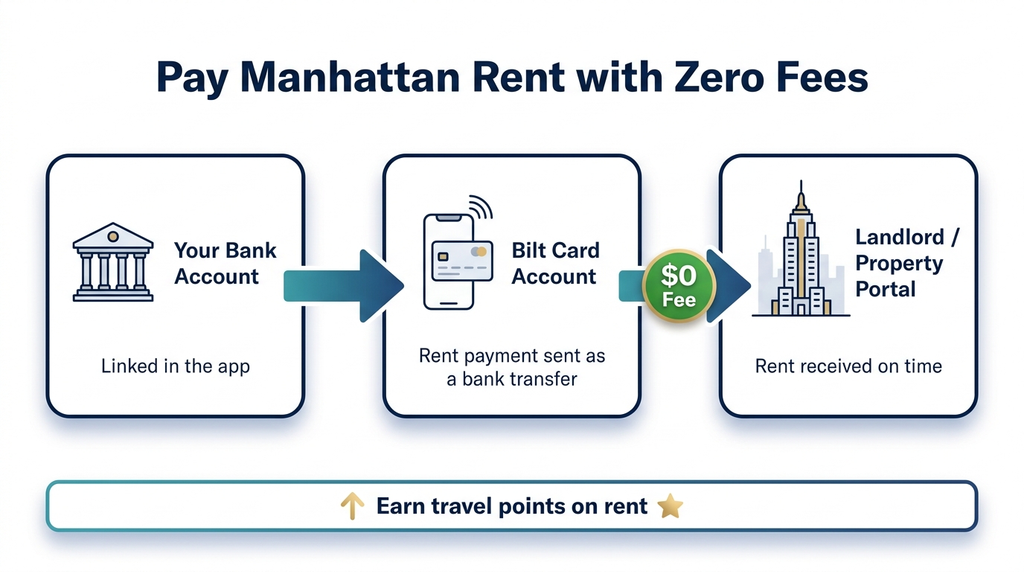
    Diagram showing a Manhattan rent payment flowing from a Bilt card account to the landlord with no fee

    Historically, paying rent by credit card meant a 2.5% to 3% processing fee, which on a $10,000 lease is $3,000 to $3,600 a year. That fee wiped out any rewards. Bilt removed the fee: you link your bank account, and your rent is sent to your landlord as a standard bank transfer. Bilt says rent and mortgage payments carry no transaction fee on any of its cards.

    Here is what changed with Bilt Card 2.0, which launched in early 2026:

    • Three cards: Bilt Blue ($0 annual fee), Bilt Obsidian ($95), and Bilt Palladium ($495), according to Bilt’s offer terms.
    • No credit line used: Rent is pulled from your linked bank account, so it doesn’t eat into your card limit, per Bilt’s program overview.
    • No annual cap: The old 100,000-point yearly limit on rent points is gone.
    • Points never expire.
    • Everyday spend now drives your rent points. The old rule of five card transactions a month no longer applies. Instead, you choose how to earn.

    If your landlord doesn’t accept electronic payments, Bilt also says it can send a check on your behalf. Confirm the current details in the app before relying on it.

    How Many Points Does $10,000 Rent Earn?

    Japan Airlines first class suite, a popular award for Bilt first class flights

    Bilt gives you two ways to earn on housing:

    1. Housing-only rewards: Your rent points depend on how much you spend on the card that month, as a share of your rent. The Points Guy’s breakdown shows 0.5x at 25% of rent, 0.75x at 50%, and 1x at 75%. Bilt says you can reach up to 1.25x with higher everyday spend.
    2. Flexible Bilt Cash: You earn 4% back in Bilt Cash on everyday spend, then convert it to rent points at $30 of Bilt Cash per 1,000 points, up to 1x your rent.

    For Manhattan rent rewards on a $10,000 lease, the housing-only math looks like this:

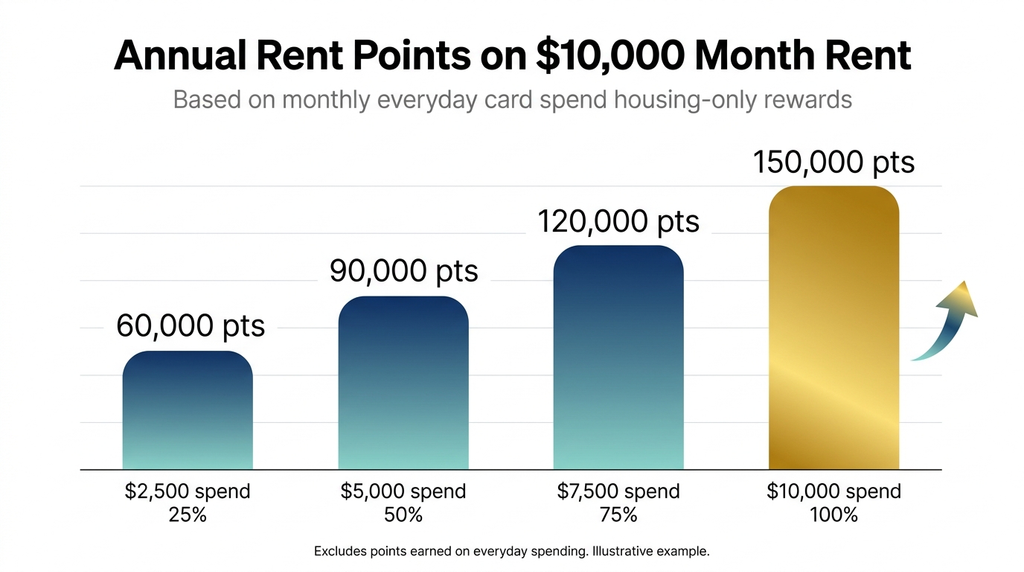
    Monthly card spend (non-rent)% of rentRent points per monthRent points per year
    $2,50025%5,00060,000
    $5,00050%7,50090,000
    $7,50075%10,000120,000
    $10,000100%12,500 (1.25x)150,000

    Those rent points come on top of what you earn on the everyday spend itself. Here are three illustrative annual totals (not including welcome bonuses or Rent Day promos):

    ScenarioRent points/yrEveryday points/yrTotal
    Blue card, $7,500/mo spend (1x)120,00090,000210,000
    Palladium, $7,500/mo spend (2x)120,000180,000300,000
    Palladium, $10,000/mo spend (2x)150,000240,000390,000
    Bar chart of Bilt points earned on $10,000 Manhattan rent at 25, 50, 75 and 100 percent card spend

    Reality check: Hitting the top tiers means putting $7,500 to $10,000 of real spending on the card each month. Only do that if you’d spend it anyway and pay the balance in full every month. Interest would erase the rewards. Without any card spending, third-party reviewers report you would earn only a small minimum on rent, so the card really does need to become your main card.

    Based on The Points Guy’s January 2026 valuation of roughly 2.2 cents per Bilt point, 150,000 points is worth about $3,300 in travel. That is a more honest range than the “free” first-class pitch you may see elsewhere.

    Turning Points into Bilt First Class Flights

    Points are only as good as where you send them. Bilt transfers to roughly 25 airline and hotel programs, mostly at a 1:1 ratio, according to Supapoints’ 2026 partner guide. Two partners stand out for luxury travel:

    • Alaska Airlines Atmos Rewards: Point.me notes that Bilt is the only major card issuer that transfers to Atmos. That gives you access to oneworld partners like Japan Airlines and Cathay Pacific.
    • World of Hyatt: Bilt is one of only two major issuers, along with Chase, that transfers to Hyatt.

    For Bilt first class flights, a headline example is Japan Airlines. The Points Guy reports that first-class awards to Japan through Atmos run about 90,000 to 110,000 points one way, depending on where you start. Business class from the East Coast starts around 75,000. So a round-trip first-class ticket takes roughly 180,000 to 220,000 points, which is within reach of the Palladium scenarios above. Rewards seats in first class are scarce, so search early and be flexible, and keep business class as a fallback.

    Also worth knowing: Atmos prices partner awards by distance, so always check the price for your exact route before you transfer. Transfers are one-way, and you can’t move points back.

    Park Hyatt Stays in New York and Beyond

    Park Hyatt New York suite, a top redemption for Bilt Hyatt transfers

    Older articles say Park Hyatt hotels cost 30,000 to 45,000 points a night. That changed. Since May 20, 2026, Hyatt uses a five-tier award chart, and NerdWallet explains that a top Category 8 hotel can now reach 75,000 points a night. Park Hyatt New York is a Category 8 property.

    The Points Guy’s early review of the new calendar found plenty of 35,000-point nights, with far fewer at 75,000. That means 150,000 Bilt points covers roughly two to four nights, depending on dates. Flexible travelers who book low-demand dates get the best value.

    Bilt Rent Day: The Monthly Bonus Most Renters Miss

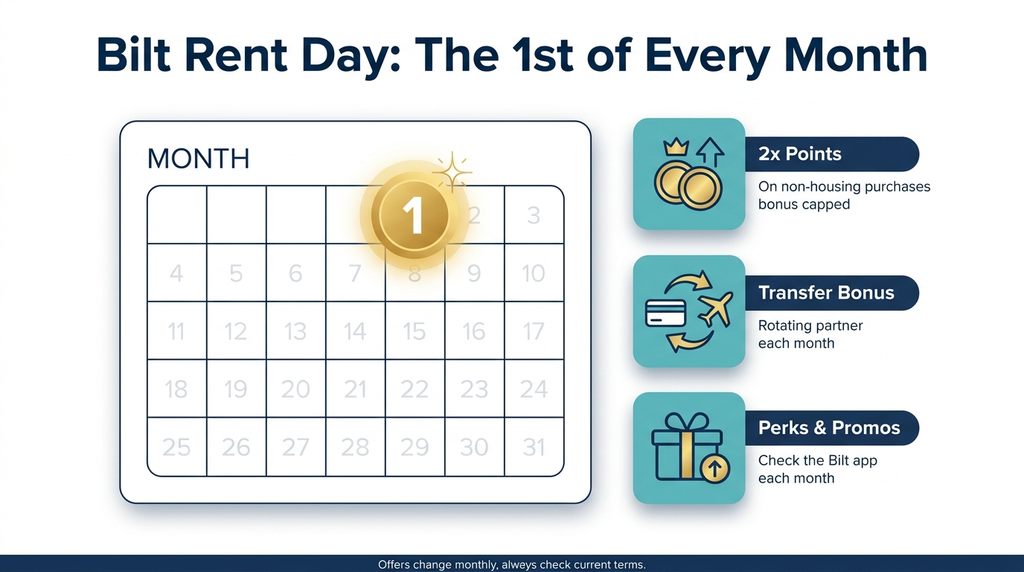
    Calendar graphic showing a Bilt Rent Day transfer bonus on the first of the month

    On the first of every month, Bilt runs Rent Day. Upgraded Points reports that members earn double points on non-housing purchases, capped at 1,000 bonus points, and the program regularly adds a transfer bonus to a rotating partner.

    Typical bonuses scale with your status tier, and recent months show how much they vary. Frequent Miler covered October 2026: up to 200% to Hilton Honors and up to 125% to Amtrak, with transfers capped at 100,000 points per program. Earlier months offered bonuses to Wyndham, the Avios programs, and Virgin. Don’t chase a bonus just because it’s big. A 100% bonus on a partner you don’t need isn’t worth moving points for.

    Status Tiers Can Help Your Bonuses

    Higher status means bigger transfer bonuses. According to Doctor of Credit’s launch breakdown, Silver comes from $10,000 in eligible card spend or 50,000 points earned, Gold from $25,000 or 125,000 points, and Platinum from $50,000 or 200,000 points. A tenant who earns 150,000 points a year from rent and everyday spend can reach Gold. Thresholds can change, so confirm them in the Bilt app.

    Smart Tips for High-Rise Renters

    • Check your landlord’s setup first. Confirm how your building collects rent and that Bilt can reach it before you switch.
    • Pick the card to match your spending. The Blue card has no annual fee, while the Palladium’s 2x everyday earning pays off only at higher spend.
    • Roommates: If you collect your roommates’ shares by Zelle or Venmo and pay the whole rent through Bilt, read Bilt’s terms on eligible payments first.
    • Pay the balance in full. Everyday spend that revolves at interest cancels the benefit.
    • Plan the redemption before you transfer. Look at award availability, then move points.

    Is It Worth It? The Honest Verdict

    For a Manhattan renter, rent is the single biggest expense, so earning rewards on it is a clear opportunity. Done well, Manhattan rent rewards can produce 150,000 to 390,000 points a year, enough for Bilt first class flights or several nights at a flagship Park Hyatt. The key is that the 2026 version rewards people who put their everyday spending on the card too.

    If you would rather keep spending on a different card, the rent-only route earns much less. Run the numbers for your own lease and spending before you commit.

    FAQ

    Does Bilt charge a fee to pay rent?
    Per Bilt, there is no transaction fee on rent or mortgage payments with any Bilt card.

    Do I still need 5 transactions a month?
    No. Under Bilt 2.0, your rent points depend on how much you spend on the card compared with your rent.

    Is there a limit on rent points?
    Bilt says the old 100,000-point annual cap no longer applies.

    What is the best use of Bilt points?
    For many people it’s World of Hyatt for hotels and Alaska Atmos Rewards for premium-cabin flights, but compare options for your own trip.

    This article is for general information only and isn’t financial advice. Card terms, award prices, and promotions change often, so confirm current details with Bilt, Hyatt, and Atmos before you apply or transfer points.

    Related posts you might enjoy:

    Running Injury Urgent Care NYC: A Tourist’s Guide to Costs, Clinics & Insurance Claims

    Rolled your ankle in Central Park or felt a sharp pain mid-marathon training? Here’s how visiting runners can find fast, affordable urgent care in NYC, what it costs without U.S. insurance, and how to get reimbursed by your travel insurer.

    Runner on a Central Park path in New York City, where a running injury may call for urgent care in NYC

    Running a loop around the Central Park Reservoir is a bucket-list moment for many travelers. But one awkward step on a root, a curb, or a wet leaf can turn it into a trip to the clinic. If you’re dealing with a running injury, urgent care in NYC is usually the fastest and cheapest place to start, and knowing that before you get hurt can save you hundreds, even thousands, of dollars.

    This guide explains where to go, what you’ll likely pay without U.S. insurance, and how to get your money back through travel insurance. If you’re searching for NYC urgent care for tourists, you’re in the right place.

    Medical disclaimer: This article is for general information only and isn’t medical advice. If you think your injury is serious or life-threatening, call 911 or go to the nearest emergency room.

    Why Running Injuries Happen to Visitors in New York

    Runner holding a sprained ankle on a city sidewalk after a running injury

    Running injuries are common everywhere, and travelers are often at higher risk. A review in Physical Medicine and Rehabilitation Clinics of North America notes that foot and ankle problems account for nearly one-third of running injuries. Ankle sprains, plantar fasciitis, and Achilles tendinopathy lead the list.

    Visitors tend to get hurt for predictable reasons:

    • Sudden mileage jumps. Sightseeing plus daily runs adds up quickly.
    • New surfaces. Switching from a treadmill or trail to hard pavement can trigger bone stress injuries, according to Healthline’s overview of ankle pain in runners.
    • Uneven ground. Park paths, subway stairs, and crowded sidewalks make sprains easy.
    • Race-week excitement. Visitors often run more than usual before events like those organized by New York Road Runners.

    Running Injury Urgent Care NYC vs. ER vs. Physical Therapy

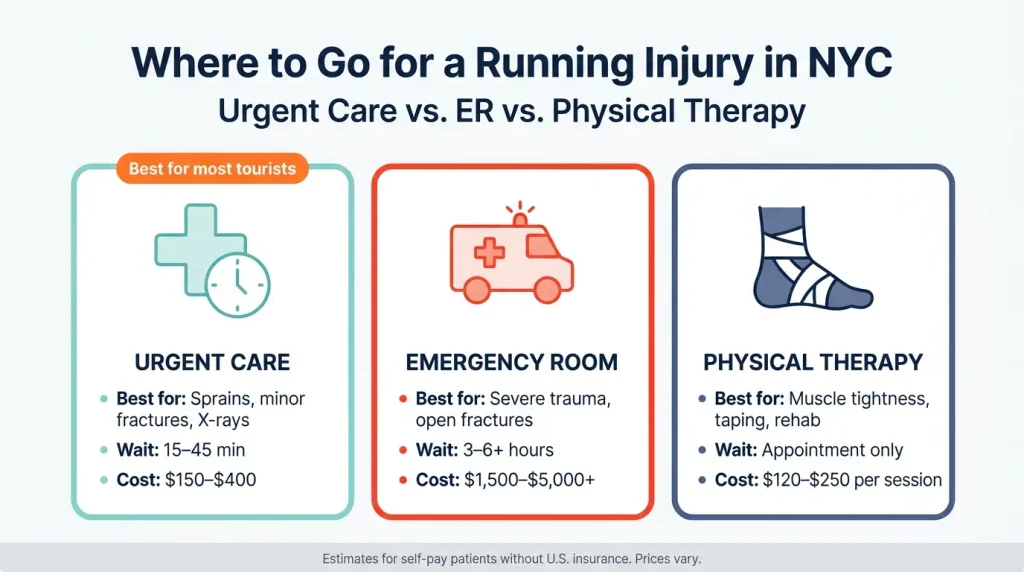
    Choosing the wrong facility is the most expensive mistake an injured tourist can make. Here’s a quick comparison:

    Infographic comparing urgent care, ER and physical therapy costs and wait times in NYC

    FacilityBest ForTypical WaitEstimated Cash Cost
    Urgent CareSprains, suspected minor fractures, X-rays15–45 minutes$150–$400
    Emergency RoomSevere trauma, open fractures, uncontrolled pain3–6+ hours$1,500–$5,000+
    Sports Physical TherapyMuscle tightness, taping, rehab (by appointment)Appointment only$120–$250 per session

    Costs are estimates and vary by clinic, imaging, and treatment.

    Urgent Care: The Best First Stop for Most Runners

    For acute ankle sprains, muscle pulls, or a suspected stress fracture, urgent care is usually the right call. Clinics are walk-in friendly, most have on-site X-ray, and the bill is a fraction of an ER visit. CityMD, for example, lists sprains, strains, and X-rays among its services.

    When to Go to the ER Instead

    Go to the emergency room (or call 911) if you have exposed bone, an obviously deformed limb, severe uncontrolled pain, numbness, or any non-running medical emergency such as chest pain or fainting. In New York, hospitals provide emergency care regardless of immigration status or ability to pay. However, as one visitor-insurance guide points out, emergency treatment isn’t free just because it can’t be refused. You’ll still receive a bill.

    Sports Physical Therapy for Non-Urgent Recovery

    If you don’t need imaging but want taping, soft-tissue work, or a return-to-running plan, book a session with a sports PT near Central Park or Midtown. Many practices accept self-pay patients.

    How Much Does a Running Injury Cost Without U.S. Insurance?

    Without a U.S. plan, you’ll pay the self-pay (cash) rate, usually at the time of service. Typical ranges:

    • Urgent care consultation: $150–$300
    • On-site X-ray: $100–$250 extra
    • Splint, brace, or crutches: $50–$150
    • Prescription or OTC medication: $20–$80 at pharmacies like CVS, Walgreens, or Duane Reade

    Typical total for a sprain at urgent care: about $250–$600. The same visit in an ER can easily exceed $2,000.

    For a reality check, price-comparison site Solv lists a self-pay base visit at CityMD of around $225, before any X-ray or supplies. Another visitor-insurance resource puts a simple U.S. doctor’s visit at roughly $250 to $350. Prices change, so call ahead or check the clinic’s self-pay page.

    Money-saving tip: Ask for the self-pay price before you’re examined, and ask whether the X-ray is included or billed separately.

    Best NYC Urgent Care for Tourists Near Central Park and Midtown

    CityMD is the largest walk-in urgent care network in the city, and it lists Manhattan locations across Midtown, the Upper West Side, and the Upper East Side. It advertises being open 365 days a year with no appointment needed. A few convenient options for runners:

    Other networks, including Northwell Health GoHealth Urgent Care, also operate in Manhattan. Always confirm the address, hours, and X-ray availability on the clinic’s website before you go, as locations and hours change.

    Using NYC Urgent Care for Tourists: What to Bring

    Make the visit smoother with a short checklist:

    1. Passport or photo ID
    2. A credit card (most clinics collect payment upfront)
    3. Your travel insurance policy number and the 24-hour assistance phone line
    4. A list of medications and allergies
    5. Your running shoes, since the doctor may want to check wear patterns

    How to Claim a Running Injury on Travel Insurance

    Most international travel policies cover emergency medical care, but U.S. clinics generally won’t bill your overseas insurer directly. Expect to pay first and claim later. Insurers commonly request itemized bills, medical records, and a doctor’s statement. Without proper documentation, a claim may be denied.

    Steps to protect your claim:

    • Get an itemized bill, not just a card receipt. Insurers typically require itemized bills and claim forms.
    • Request a visit summary with a written diagnosis (for example, “acute lateral ankle sprain”).
    • Keep pharmacy receipts and prescription labels.
    • Call your insurer early. Some policies require notice within 24–48 hours, and your insurer may arrange direct payment or approve care in advance.
    • Photograph and copy everything, and keep originals.
    • Check for other coverage. If you hold more than one policy, list both on your claim.

    No travel insurance yet? Visitor medical plans in the U.S. range from about $19 to $172 per month, depending on age, coverage, and deductible. That’s often far less than a single ER bill.

    First Aid for a Running Injury Before You See a Doctor

    For mild pain and swelling, you can start self-care right away with items from any NYC pharmacy:

    • R.I.C.E.: Rest, Ice, Compression, Elevation. Ask your hotel front desk for ice bags.
    • Topical relief: Biofreeze, Voltaren gel (a topical NSAID), or Tiger Balm.
    • Oral anti-inflammatories: Ibuprofen (Advil, Motrin) or naproxen (Aleve), if safe for you. Check with a pharmacist if you take other medications.
    • Compression wraps: ACE-brand bandages are sold over the counter.

    Red Flags: Don’t Wait

    Healthline advises seeing a doctor if you can’t bear weight on the ankle, or it feels numb or unstable. Pain that persists or worsens after several days of rest may signal a stress fracture rather than a simple sprain, and those can take weeks or months to heal.

    Frequently Asked Questions

    Do I need an appointment for urgent care in NYC?

    Usually not. Most walk-in clinics accept patients without an appointment, though many offer online check-in to shorten the wait.

    Can tourists use urgent care without insurance?

    Yes. Clinics offer self-pay pricing. Expect to pay at the time of your visit.

    Will my travel insurance pay the clinic directly?

    Sometimes, but don’t count on it. Call your insurer’s assistance line first, and keep itemized receipts in case you need to claim a refund.

    Is physical therapy worth it during a short trip?

    For minor tightness, a single session can help you decide whether to keep running. For anything that hurts when you put weight on it, get examined first.

    Final Thoughts: Skip the ER, Keep the Trip

    A running injury doesn’t have to ruin your New York visit. For most sprains and strains, running injury urgent care in NYC gets you examined, imaged, and splinted in about an hour for a few hundred dollars, while an ER visit for the same problem can cost several times more. Save the nearest clinic’s address in your phone, keep your travel insurance details handy, and always request an itemized bill.

    Staying active in the city? Browse the Central Park Conservancy for safer running routes, and consider NYC Health + Hospitals for hospital locations should you ever need a true emergency room.

    Safe running, and enjoy New York!

    Pricing and clinic details were researched in October 2026 and may change. Verify with each provider.

    Related posts you might enjoy:

    Teterboro Empty Leg Flights & Jet Card Guide: How to Fly Private for Less (2026)

    Teterboro is the gateway to private flying in New York, but you don’t have to pay full charter rates. Learn how Teterboro empty leg flights work, what a Teterboro jet card really costs, and which option fits your travel style in 2026.

    Private jet on the ramp at Teterboro Airport at sunrise with the Manhattan skyline behind it

    Teterboro empty leg flights are the closest thing private aviation has to a secret discount. Add a well-chosen Teterboro jet card to the mix, and flying private from New York can look a lot less like a billionaire’s habit and a lot more like a calculated travel upgrade.

    Teterboro Airport (TEB) sits about 12 miles from Midtown Manhattan, and it is the busiest hub for business jets in the New York area. Standard charters can run thousands of dollars per flight hour, but flexible travelers rarely pay that sticker price. In this guide you’ll learn how empty legs work, what they really cost, when a jet card makes sense, and how to book smartly.

    Why Teterboro Is the Smart Way to Fly Private from New York

    Private FBO terminal at Teterboro Airport in New Jersey, 12 miles from Midtown Manhattan
    @www.signatureaviation.com

    Teterboro is owned and operated by the Port Authority of New York and New Jersey and is classified as a general aviation “reliever” airport. That means no scheduled airline service, no crowded gates, and a design that exists to pull private traffic away from JFK and Newark.

    A few facts that matter to passengers:

    • Location: Bergen County, New Jersey, roughly 25 to 45 minutes from Manhattan by car depending on traffic, according to Jettly’s TEB guide.
    • Runways: The longer runway is 7,000 feet, which handles everything from turboprops to large business jets. Aircraft over 100,000 pounds are not permitted.
    • Hours: Operations run around the clock for general aviation.
    • Terminals (FBOs): You don’t walk into a terminal building; you arrive at a private Fixed-Base Operator. Signature Aviation runs multiple Teterboro facilities, and Atlantic Aviation and Jet Aviation are also on the field. In a 2024 deal, Signature bought Meridian, the last independent FBO there, so older guides listing Meridian separately may be out of date.

    Ground transfers are part of the budget, too. One local guide puts black car service from Teterboro to Manhattan at roughly $150 to $350.

    How Teterboro Empty Leg Flights Work

    An empty leg (also called a repositioning or deadhead flight) happens when a jet drops off passengers and must fly back without anyone aboard. Because customers choose their own routes, the operator earns nothing on that return trip, so many sell it at a steep discount to recover costs.

    Client trip:   Teterboro (TEB)  ──►  Miami/Opa-locka (OPF)   [full fare paid]
    Empty return:  Miami/Opa-locka (OPF) ──► Teterboro (TEB)     [sold at a discount]
    

    Teterboro empty leg flights are especially common on high-traffic leisure and business corridors. A Florida empty leg guide notes that aircraft shuttle between South Florida and the New York area almost daily, with Teterboro a favored arrival point. Other frequent routes include West Palm Beach, Scottsdale, and Van Nuys.

    How Much Do Empty Legs Really Cost?

    Discount claims vary by source, which is itself a lesson. Most operators and guides cite savings of about 30% to 75% off the standard charter price, while others quote up to 90%. A 2026 marketplace snapshot recorded a median all-in empty leg price of about $7,691 across thousands of live listings.

    For New York to Miami specifically, published estimates range widely. One guide puts them at around $15,000 to $20,000, while another cites a lower band for smaller aircraft. The aircraft size, the date, and how close to departure you book all move the number.

    Two things to understand before you get excited:

    1. You pay for the whole aircraft, not a seat. A $12,000 empty leg on an 8-seat midsize jet works out to about $1,500 per person.
    2. It is still a bargain mainly for groups. Empty legs can cost several times a first-class ticket for a solo traveler, but the math flips quickly when four to eight people split the bill.

    The most-quoted “as little as $300 per person” figure comes from a Wheels Up executive and is best treated as a rare best case, not a typical price.

    Teterboro Jet Card Basics: Predictable Private Flying

    If spontaneity isn’t your thing, a Teterboro jet card trades flexibility-for-price for certainty. A jet card is a prepaid block of flight hours at a fixed hourly rate. It protects you from surge pricing around holidays and big events and typically guarantees an aircraft on short notice.

    What to know before you buy:

    • Deposits are large. Industry comparisons put typical deposits at $100,000 to $500,000 or more, and one provider estimates entry-level light jet cards from the big names at around $200,000 for 25 hours.
    • The 25-hour rule of thumb. Below roughly 25 flight hours a year, on-demand charter is usually the cheaper route; above it, a card starts to make financial sense.
    • There is a premium. Cards often carry a price 5% to 10% above market charter rates in exchange for guaranteed availability.
    • Terms differ. Some programs advertise no repositioning fees or peak-day surcharges, while others have blackout dates and surcharges. Jet Linx is one provider that markets those perks, so read the contract rather than assuming.
    • Empty leg access is limited. Many card programs don’t offer discounted empty legs, which is a real trade-off for bargain hunters.

    Credit Card Perks for a Teterboro Jet Card

    Premium cards can soften the entry price. American Express routes its Premium Private Jet Program for Platinum and Centurion members through Wheels Up, with perks that have included discounted membership fees, first-flight credits, and waived marketplace transaction fees. Terms change often, so verify current benefits with Amex and Wheels Up before counting on them.

    Cost Comparison: Commercial vs. Empty Leg vs. Jet Card

    Here is an illustrative one-way trip for a party of six from Teterboro to Opa-locka (about 2.5 to 2.75 hours in the air). Figures are rounded estimates based on the sources above, not quotes.

    OptionTotal (aircraft / group)Per person (6 travelers)Main benefit
    Commercial first class (peak)~$7,800~$1,300Scheduled service
    Teterboro empty leg~$10,500 – $20,000~$1,750 – $3,300Private jet at a discount, flexible timing required
    Jet card or on-demand charter (super midsize)~$26,000 – $35,000~$4,300 – $5,800Guaranteed time and aircraft

    One charter operator lists a super midsize one-way from Teterboro to Opa-locka at about $26,000, which helps anchor the top row.

    5 Pro Tips for Booking Teterboro Empty Leg Flights

    1. Set alerts. Marketplaces and broker sites list repositioning flights. Search “TEB” or “New York area” and turn on notifications. Jettly and the Wheels Up marketplace are two places to start, and some brokers publish live TEB empty leg boards.
    2. Be flexible by a day or two. Listings often carry a window of plus or minus a day, because the flight follows the main charterer’s schedule.
    3. Book late, not early. Many legs are posted 24 to 72 hours before departure, since an operator only confirms a repositioning flight once the main trip is set.
    4. Plan for cancellations. The empty leg exists only because of another booking, so if that trip changes, yours can too. One guide estimates 20% to 30% cancellation risk. Never lock in non-refundable hotels or events until the flight is confirmed, and keep a commercial backup.
    5. Check the operator. Confirm the flight is run by an FAA-certified Part 135 charter operator, and ask whether you’re booking direct or through a broker, plus what fees apply.

    Which Option Is Right for You?

    • Choose Teterboro empty leg flights if you travel in a group, have flexible dates, and enjoy hunting for a deal.
    • Choose a Teterboro jet card if you fly more than about 25 hours a year, need guaranteed departure times, and can comfortably tie up a six-figure deposit.
    • Choose standard on-demand charter if you fly occasionally and need fixed dates. It’s also the way to pair an empty leg on one direction with a normal charter on the other, which a broker can help arrange.

    What the Teterboro Experience Looks Like

    At a Teterboro FBO there is no terminal maze. You drive to the private facility, handle ID checks with the crew or FBO staff, and walk to the aircraft. Boarding is dramatically faster than at a commercial airport, but arriving 30 minutes early is still a sensible habit in case of customs, catering, or crew questions. Pets can generally travel in the cabin, though policies vary by operator, so confirm in advance.

    FAQ

    Are Teterboro empty leg flights safe? Empty legs use the same aircraft, crews, and terminals as regular charters when operated by a certified Part 135 carrier. Verify the operator before paying.

    Can I book a single seat on an empty leg? Generally no. Empty legs are sold as whole-aircraft charters, not individual seats.

    Is a Teterboro jet card worth it for occasional travelers? Usually not. Below about 25 hours a year, on-demand charter tends to be cheaper.

    Does a jet card include empty legs? Often not, or only in limited form. Ask the provider directly.

    How far in advance should I book? For empty legs, watch listings a few days out. For a jet card, expect to give roughly 24 to 72 hours’ notice, depending on the program.

    Final Verdict

    Flying private from Teterboro doesn’t have to mean paying peak retail prices. Teterboro empty leg flights reward flexible groups with real savings, while a Teterboro jet card rewards frequent flyers with certainty and price protection. Prices swing widely by aircraft, route, and season, so always compare at least two or three quotes and read cancellation terms carefully before you commit.

    Pricing and program details in this article are estimates compiled from public sources in 2026 and may change. This is general information, not financial advice.

    Sources:

    Related posts you might enjoy:

    Business Class to NYC With Points: 2026 Transfer Partners for Beginners

    Lie-flat seat in business class to NYC with points on a transatlantic flight

    Cash fares for lie-flat seats across the Atlantic routinely run well over $1,500 each way, and they climb much higher at peak times. Yet plenty of ordinary travelers fly business class to NYC with points for a fraction of that, paying mostly taxes and fees. The trick is not a secret credit card. It is knowing how to move your points to the right airline program.

    If you have ever wondered how transfer partners for beginners actually work, this guide walks you through it using current 2026 prices, not the outdated numbers still floating around the internet. You will see three real sweet spots, the hidden fees that catch newcomers, and a step-by-step booking order that protects your points.

    Prices below were checked on October 2, 2026. Award charts change often, so always confirm on the airline’s site before you transfer anything.

    Manhattan skyline at dusk, the destination for award flights from Europe

    Quick Answer

    • The best-value way to book business class to NYC with points in 2026 is usually Iberia Avios (from Madrid) or Air Canada Aeroplan (on Star Alliance partners).

    • Transfers from Chase, Amex and Capital One are one-way and mostly 1:1, so confirm seats first.
    • The famous “$5.60” figure is a real US security fee, but it only applies to certain US-departing awards and says nothing about the fees on the way back.

    Why Transfers Beat the Card Portal for Business Class to NYC With Points

    Passport, laptop and credit cards laid out for planning an award flight

    Most cardholders redeem points inside the bank’s travel portal, where each point is worth a fixed amount, roughly 1 to 1.5 cents. At that rate, a $1,500 business fare costs 100,000 to 150,000 points.

    Transfer partners work differently. You move points into an airline’s loyalty program, usually at a 1:1 ratio, and pay the airline’s award price instead of a cash-based price. Here is a simple, hypothetical example:

    • Cash fare: $1,500 one-way
    • Award price: 40,500 points + about $125 in taxes
    • Value per point: ($1,500 − $125) ÷ 40,500 ≈ 3.4 cents

    That is more than double the typical portal value, and the gap gets bigger when cash fares spike.

    Transfer Partners for Beginners: How the Points Actually Move

    Three bank programs dominate the beginner scene:

    • Chase Ultimate Rewards transfers 1:1 to Aeroplan, British Airways, Iberia and Virgin Atlantic, and the transfers are usually instant.
    • American Express Membership Rewards also reaches those four programs at 1:1, though Iberia transfers can take a day or two.
    • Capital One Miles reaches British Airways and Virgin Atlantic at 1:1. It does not list Iberia directly, but you can move Avios between your British Airways and Iberia accounts. Check the ratio for Aeroplan before you move anything.

    Partner lists change. Amex, for example, dropped Qantas and Etihad as transfer partners in mid-2026 (AwardWallet on Etihad). Check your issuer’s current list, and compare it against The Points Guy’s transfer partner guide.

    3 Sweet Spots for Business Class to NYC With Points in 2026
    Route / CabinPartnerPoints (one-way)Typical fees
    Madrid ↔ New York, BusinessIberia Plus (Avios)40,500 off-peak / 59,000 peakroughly $125 from the US
    East Coast ↔ Western Europe, BusinessAir Canada Aeroplanfrom about 60,000taxes + CA$39 booking fee, no fuel surcharges
    US ↔ Europe, Delta OneVirgin Atlantic47,500–57,500+over $1,000 each way in reported surcharges

    1. Iberia Avios: Still a Strong Pick, Just Pricier

    Madrid cityscape, gateway for Iberia Avios business class awards to New York

    For years, Iberia’s 34,000-Avios business award was the star of the points world. Iberia introduced a new award chart that raised off-peak East Coast-to-Spain business to 40,500 Avios and peak dates to 59,000 (AwardWallet). British Airways charges the same Avios rates, but Iberia’s cash fees are lower, so book through Iberia.

    Even after the increase, this is a good deal compared with dynamic-pricing programs. The catch is availability: bookable business seats are far scarcer than the published prices suggest, so search flexible dates.

    2. Air Canada Aeroplan: Star Alliance Business Class Without Fuel Surcharges

    Aeroplan lets you book Lufthansa, Swiss, Austrian and other Star Alliance partners, and it does not pass on fuel surcharges. Business class from the US East Coast to Western Europe has been priced from about 60,000 points, plus taxes and a CA$39 partner booking fee (Points Path). Aeroplan also lets you add a stopover on most one-way awards for 5,000 points.

    Aeroplan raised prices on non-Air Canada partners as of June 1, 2026, with first class hit hardest (Milesopedia). It also uses dynamic pricing on some partner flights (AwardWallet), so treat “from 60,000” as a starting point. Search at Aeroplan.com before you transfer.

    3. Virgin Atlantic: Delta One Looks Great Until You Check the Fees

    Airport departures board while checking Delta One award fees on Virgin Atlantic

    Booking Delta One through Virgin Atlantic used to be a legendary trick. Virgin later added a large carrier surcharge that pushed total fees above $1,000 per person each way, and seats are very hard to find (The Points Guy). Delta One via Virgin Atlantic is therefore a “check, but don’t count on it” option. Delta economy awards on Virgin do not carry that surcharge, and Air France-KLM Flying Blue can price the same Delta flights with lower fees.

    The Truth About the “$5.60” Fare and First Class

    The $5.60 number is the US September 11 security fee, which applies to flights departing the United States. Flights into New York usually add other government and airport charges, and some carriers add surcharges on top. Plan on $5.60 to $150 or more per segment depending on the airline and direction, not a flat nickel-and-dime amount.

    First class to New York on points exists, but it is rare and expensive. Lufthansa First through Aeroplan, for example, prices far above business. If you are new to this, treat business class as the realistic goal and first class as a bonus if it shows up.

    Step-by-Step: Booking Business Class to NYC With Points

    Follow this order every time you book business class to NYC with points:

    1. Search first. Create free accounts with Iberia, Aeroplan and Virgin Atlantic, and look for award seats on your dates before touching your bank account.
    2. Check the total cost. Compare the points price and the cash fees, in both directions.
    3. Link your accounts. Add your airline loyalty number in your Chase, Amex or Capital One dashboard.
    4. Transfer only what you need. Transfers cannot be reversed. If seats vanish after you transfer, the points stay with the airline.
    5. Book right away. Refresh the airline site, confirm the miles have arrived, and complete the reservation.

    Transfer Partners for Beginners: Mistakes to Avoid

    • Transferring speculatively. Never move points “just in case.” Confirm live availability first.
    • Ignoring transfer bonuses. Issuers regularly run 20% to 30% bonuses. Chase, for instance, ran a 20% bonus to British Airways, Iberia and Aer Lingus in March 2026. With a 30% bonus, a 40,500-Avios award costs about 31,150 bank points. Track live offers at NerdWallet or The Points Guy.
    • Chasing stale charts. Many blog posts still quote pre-devaluation prices. Always check the airline’s own search results.
    • Forgetting fees. A cheap points price with $1,000 in surcharges is not a bargain.

    Which Card Should You Start With?

    Beginners usually start with a mid-fee card that earns transferable points, then add a premium card later if the travel credits and lounges make sense. Welcome bonuses change often and vary a lot by offer, so compare the current offer on the issuer’s website rather than relying on a number you saw months ago. Also remember that most welcome bonuses require meeting a minimum spend in the first few months, so only apply if you can do that comfortably.

    FAQ

    Can I really fly business class to NYC with points for under $100?

    Sometimes, on certain US-departing routes with no surcharges. For flights into New York, plan on more in taxes and fees. Iberia and Aeroplan are the most reliable for low fees.

    Are transfer partners for beginners worth it if I only fly once a year?

    Usually yes, if you can get a good welcome bonus and book a premium cabin. One well-timed redemption can be worth several thousand dollars in cash fares.

    Do credit card points expire after I transfer them?

    Airline miles have their own expiration rules, so read the program terms. In many programs, any account activity keeps miles alive.

    Final Verdict

    Booking business class to NYC with points is still one of the best uses of credit card rewards in 2026, but the easy 34,000-Avios and $5.60 stories are out of date. Start with Iberia and Aeroplan, check fees before you transfer, and use this guide to learn transfer partners for beginners the safe way: search first, transfer second, book immediately.

    Disclosure: This post is for information only and is not financial advice. Some links may be affiliate links. Award prices, fees and partner lists change often, so verify them on the airline’s and issuer’s websites before you act.

    Related posts you might enjoy:

    No Foreign Transaction Fee Card for NYC: Complete 2026 Spending & Money Transfer Guide
    From Soho coffee runs to Manhattan lease deposits, here’s how to pick the right no foreign transaction fee card for NYC and the smartest way to arrange a money transfer for your NYC apartment deposit — without losing 3–10% to hidden bank fees.

    no foreign transaction fee card for NYC

    New York City moves fast, and so does your money. Between $10 artisan coffees in Soho, boutique shopping on Fifth Avenue, and dinner in Tribeca, every swipe is an opportunity for hidden bank charges to quietly eat into your budget. If you’re an international traveler, digital nomad, or expat, choosing the right no foreign transaction fee card for NYC — and knowing how to arrange a money transfer for your NYC apartment deposit — can be the difference between a smooth trip and a $300+ surprise on your statement.

    This 2026 guide breaks down exactly which cards to carry, which transfer platforms to use for larger payments like rent or tuition, and how to combine both for maximum savings.
    Why You Need a No Foreign Transaction Fee Card for NYC

    Why You Need a No Foreign Transaction Fee Card for NYC

    Most standard international debit and credit cards charge 2.5–3% on every purchase made outside your home currency. On a $10,000 trip, that’s roughly $300 handed straight to your bank for doing nothing but converting currency.

    There are three fee traps to watch for in Manhattan specifically:

    • Foreign transaction fees (avg. 3%) — charged on every non-domestic swipe.
    • Dynamic Currency Conversion (DCC) — when a terminal asks “charge in USD or your home currency?”, always choose USD. Paying in your home currency lets the merchant’s bank apply an inflated exchange rate with markups as high as 5–12%.
    • SWIFT wire markups — sending money the traditional way often means outgoing fees ($30–$50), receiving fees ($15–$30), and a spread of up to 4% baked into the exchange rate.

    A card with zero foreign transaction fees eliminates the first two problems instantly, which is why finding the right no foreign transaction fee card for NYC should be step one before you land.

    Best No Foreign Transaction Fee Cards for NYC in 2026

    Best No Foreign Transaction Fee Cards for NYC

    The market for these cards is large, but a few consistently stand out for international spenders in the city.

    Top Credit Cards

    • Capital One Venture X / Venture Rewards — Capital One’s Venture card lineup earns rewards on everyday purchases with no foreign transaction fees, making it a strong daily-spend option for NYC dining and shopping.
    • Chase Sapphire Preferred / Reserve — Chase Sapphire Preferred pairs a mix of high rewards rates with a modest annual fee, and it earns bonus points on dining and travel worldwide with no FX fees.
    • American Express Platinum — Offers 0% FX fees plus lounge access and concierge perks, though it’s worth carrying a Visa or Mastercard backup since Amex isn’t accepted everywhere in smaller boutiques.
    • No-annual-fee options — If you don’t want to pay a yearly fee, a no-annual-fee Visa like Bank of America Travel Rewards or Wells Fargo Autograph removes the standard 3% penalty without creating a yearly cost to recover.

    Best Debit Card for ATM Cash

    Charles Schwab Bank High Yield Investor Checking remains the gold standard for travelers who need cash — it charges no foreign transaction fees and automatically rebates ATM fees worldwide at the end of each month, which is hard to beat if you want walking-around cash for tips or street vendors.

    (Tip: always confirm current terms directly with the issuer — rates-and-fees disclosures change, and some card families include both fee-free and fee-charging versions of the same product.)

    When a Card Isn’t Enough: Money Transfer for NYC Apartment Deposit

    money transfer for NYC apartment deposit

    Cards are perfect for daily spending, but they fall apart the moment you need to pay something big — a security deposit on a Manhattan lease, a semester’s tuition, or an extended-stay rental prepayment. Landlords and universities rarely accept credit cards without a steep processing surcharge (often 2–3% tacked on separately), so a money transfer for your NYC apartment deposit needs a different tool entirely.

    Wise and Revolut vs. Traditional Bank Wires

    Transfer MethodFX Rate TypeTypical FeesSpeed
    Traditional SWIFT wireBank rate + 2–4% markup$30–$60 + receiving bank fee2–5 business days
    WiseReal mid-market rateLow, transparent % feeInstant to 24 hours
    RevolutReal mid-market rateFree up to a monthly limitInstant to 24 hours

    Traditional bank wires route money through several intermediary banks, each applying its own fees and exchange rate, while Wise instead uses a network of local bank accounts so funds never actually cross borders — which is what keeps costs down. Wise applies the real mid-market conversion rate to every currency and shows you the fee upfront before you confirm the transfer, so there’s no guessing what lands on the other side.

    This is especially useful for a money transfer for an NYC apartment deposit, since many providers let you generate local US account and routing details — effectively letting you pay a landlord or property manager as if you already had a US bank account, without opening one.

    Students and long-term renters report similar savings: paying tuition or housing costs by credit card from abroad often adds 2–3% in fees, and a standard bank wire brings a poor exchange rate on top of extra charges, which is why services like Wise have become the default for larger one-time NYC payments.

    Strategy Matrix: Cards vs. Transfers

    ParameterNo Foreign Transaction Fee CardWise / Revolut Transfer
    Best forDaily purchases, restaurants, hotels, transitRent deposits, tuition, large one-off payments
    FX surcharge0% (on qualifying travel cards)~0.3–0.7% real mid-market fee
    Consumer protectionHigh — fraud protection, chargebacksLimited — direct bank-to-bank
    Rewards earnedYesNo

    The winning approach for most people combining short-term travel with a longer NYC stay: carry a no foreign transaction fee card for NYC for everything you swipe day-to-day, and reserve a Wise or Revolut transfer for anything landlord-, tuition-, or lease-sized.

    Practical Tips for Spending Smart in Manhattan

    • Use Apple Pay / Google Pay wherever possible. Manhattan is close to cashless — subway turnstiles run on the OMNY contactless system, and the vast majority of taxis, kiosks, and stores accept tap-to-pay.
    • Keep a small cash buffer. $50–$100 in small bills covers coat checks, bellhops, and cash-only bagel carts.
    • Always request a digital receipt. It’s the easiest way to confirm no accidental currency conversion or merchant markup slipped into your bill.
    • Double-check card acceptance before relying on Amex alone. Carry a Visa or Mastercard backup for smaller independent businesses.
    • Verify fees before you fly. Foreign transaction fee terms can change between card products from the same issuer, so check the current rates-and-fees disclosure rather than relying on older reviews.

    Final Verdict

    Getting the most out of a New York trip or move comes down to a simple two-part system: a no foreign transaction fee card for NYC for everyday spending, dining, and transit, paired with a mid-market platform like Wise or Revolut whenever you need a money transfer for your NYC apartment deposit, tuition, or another large payment. Get that pairing right, and every dollar goes toward the city itself — not toward bank fees.


    This post is for general informational purposes and isn’t financial advice. Card terms, fees, and exchange rates change frequently — confirm current details directly with the issuer or provider before applying or transferring funds.

    Amex Fine Hotels + Resorts NYC: Unlock $1,000+ Perks at The Plaza & Carlyle

      mex Fine Hotels + Resorts NYC — The Plaza Hotel Fifth Avenue exterior

      Booking a room at one of Manhattan’s iconic heritage hotels — The Plaza Hotel on Fifth Avenue or The Carlyle, A Rosewood Hotel on the Upper East Side — is a bucket-list luxury experience. But with room rates in New York City routinely starting between $900 and $1,500 a night, knowing how to get the absolute maximum value out of your stay matters just as much as the destination itself.

      While most guests pay full price for a standard room and then spend hundreds more on breakfast, valet, and cocktails, savvy travelers book through Amex Fine Hotels + Resorts NYC properties to unlock more than $1,000 in complimentary perks per stay. This guide breaks down exactly how Amex Platinum Plaza Hotel perks — and the equivalent benefits at The Carlyle — work, what they’re actually worth, and how to stack them for maximum savings in 2026.

      What Is Amex Fine Hotels + Resorts, and Why Does It Matter in NYC?

      www.americanexpress.com

      American Express Fine Hotels + Resorts (FHR) is a curated booking program open to Platinum Card, Business Platinum Card, and Centurion cardholders. It grants VIP-style treatment — similar to hotel elite status — at more than 1,800 luxury properties worldwide, without requiring any brand loyalty points or nights. Amex itself values the standard FHR benefit package at roughly $550 per stay, and at flagship Manhattan properties like The Plaza and The Carlyle, the real-world value often runs even higher.

      This is exactly why Amex Fine Hotels + Resorts NYC bookings have become a favorite trick among frequent New York travelers: the city’s room rates are so high that the same fixed perks (breakfast, credits, late checkout) represent a much larger percentage discount than they would at a mid-tier resort elsewhere.

      The Anatomy of a $1,000+ Luxury Hotel Perks Package

      When you book an eligible property through FHR, every stay automatically includes a suite of hard-value benefits:

      • Daily complimentary breakfast for two ($120–$160/day value in NYC) — served in the hotel’s signature dining room or via in-room dining.
      • $100 property experience credit, applied directly to your final bill and typically usable at the hotel’s spa, restaurants, or bars.
      • Guaranteed 4 PM late checkout — versus the standard 11 AM or 12 PM checkout most NYC hotels enforce, this alone can be worth $300+ if it saves you a day-use room or lets you skip a hotel’s storage fees.
      • Room upgrade at check-in, subject to availability — a one- or two-category bump can move you from a standard interior room to a Central Park–view room or a suite, a swing that’s frequently worth $400–$800 or more per night.
      • Noon early check-in, when available, plus complimentary Wi-Fi.

      For a deeper dive into how the program works across its full hotel portfolio, AwardWallet’s Fine Hotels + Resorts guide is a useful reference.

      Amex Platinum Plaza Hotel Perks: What to Expect at The Plaza

      The Plaza Hotel is one of FHR’s most recognizable New York bookings, and the Amex Platinum Plaza Hotel perks here are tailored to the property’s old-world glamour:

      • Breakfast for two daily at The Palm Court, the hotel’s landmark restaurant beneath its stained-glass dome — a meal that can easily run $50+ per person à la carte.
      • $100 property experience credit, which guests often apply toward treatments at the on-site 111SKIN Spa/Clinic or a round of drinks at the Champagne Bar.
      • Room upgrade potential from a standard Deluxe Room to a Central Park–view room or one of the hotel’s Louis XV–style suites — a jump that can add $500 or more in nightly value.

      Combine the guaranteed 4 PM checkout with a spa appointment on departure day, and you can turn a one-night stay into a nearly full-day Manhattan experience before ever needing to think about your flight home.

      Amex Fine Hotels + Resorts NYC at The Carlyle: A Different Kind of Luxury

      Bemelmans Bar

      Just a few miles north on the Upper East Side, The Carlyle, A Rosewood Hotel offers its own take on the same FHR framework, with perks that lean into the hotel’s literary, jazz-age reputation:

      • Daily breakfast for two, typically served at Dowling’s or via in-room dining.
      • $100 food & beverage credit, a favorite redemption at Bemelmans Bar, the hotel’s famed piano lounge known for its Ludwig Bemelmans murals and live jazz.
      • Guaranteed 4 PM late checkout, which pairs well with the hotel’s noon early check-in benefit — together giving you up to 28 continuous hours in your room on a single overnight booking.

      Because The Carlyle skews slightly quieter and more residential than The Plaza’s Fifth Avenue bustle, its FHR perks tend to be redeemed more for food and drink than for spa services — worth keeping in mind when you decide where your $100 credit will go furthest.

      Financial Leverage: Stacking Your Amex Platinum Plaza Hotel Perks With Card Credits

      Fine Hotels + Resorts NYC

      The daily FHR perks are only part of the equation. Amex Platinum cardholders can now stack these benefits with the card’s revamped hotel statement credit, which was significantly expanded as part of Amex’s late-2025 Platinum refresh:

      • $600 annual hotel credit (up from the previous $200), split into two $300 semi-annual increments, applicable toward prepaid Fine Hotels + Resorts or The Hotel Collection bookings made through Amex Travel. Coverage of the change from Business Traveller and The Points Guy confirms this is now one of the card’s headline benefits.
      • 5x Membership Rewards points on prepaid FHR bookings made through Amex Travel.
      • Seasonal “3rd or 4th night free” promotions, which occasionally appear on Plaza and Carlyle listings and can lower your average nightly rate by roughly a third while you keep every dollar of the standard FHR perks.

      Note that the Amex Platinum annual fee rose to $895 alongside this refresh, so the math only works in your favor if you’re actually booking one or two qualifying hotel stays a year to capture the $600 credit — which, for anyone planning even a single trip to Manhattan, is easy to justify against a $900+ nightly rate at The Plaza or The Carlyle.

      Pro Tips for Maximizing Your Amex Fine Hotels + Resorts NYC Stay

      1. Note any special occasion when booking. Add a birthday or anniversary note through your Amex Travel portal — FHR properties frequently match upgrade availability with a welcome gift like champagne or a handwritten card.
      2. Link your hotel loyalty profile first. If the property also participates in a brand loyalty program, attach your account so you earn points and night credits on top of the FHR perks.
      3. Schedule your $100 credit strategically. At The Plaza, book a 1 PM spa treatment on departure day, then use the guaranteed 4 PM checkout to shower, pack, and leave without rushing. At The Carlyle, save the credit for an evening at Bemelmans Bar rather than splitting it across small charges.
      4. Book directly through Amex Travel, not a third-party site. FHR perks are only guaranteed when the reservation is made through the official Amex Travel portal — a booking made elsewhere, even at the same hotel, won’t qualify.

      Final Verdict

      Paying full retail for a Manhattan luxury hotel stay without using your card’s status means leaving real money on the table in the form of skipped breakfasts, missed room upgrades, and an early checkout you didn’t need to accept. By booking through Amex Fine Hotels + Resorts NYC and understanding exactly how the Amex Platinum Plaza Hotel perks (and their Carlyle equivalents) stack against the card’s $600 hotel credit, a single well-planned stay at The Plaza or The Carlyle can easily return $1,000 or more in tangible value — turning an already special trip into one of the best redemptions in your entire card portfolio.

      This post is for informational purposes only. Hotel benefits, credit amounts, and card terms are set by American Express and the respective properties and are subject to change; confirm current details on Amex’s official Fine Hotels + Resorts page before booking.

      Related posts you might enjoy: