
If there’s one place in New York City that every runner needs to experience, it’s Central Park. Stretching 2.5 miles from 59th Street to 110th Street and covering over 840 acres of greenery in the heart of Manhattan, Central Park is widely regarded as one of the greatest running destinations in the world. Locals and travelers alike lace up their shoes here every morning and evening, chasing skyline views, fresh air, and that unmistakable New York energy.
Whether you’re visiting NYC for the first time or you’re a regular on the pavement, this guide to Central Park running routes will help you choose the perfect loop for your fitness level, time, and goals.

Why Running in Central Park Is a Bucket-List Experience
Running in Central Park isn’t just exercise — it’s a full sensory experience. You’ll find yourself weaving past the Bethesda Fountain, glancing up at the Manhattan skyline reflected over the Reservoir, and pushing through iconic hills that serious marathoners train on year-round. With an estimated 42 million visitors annually, Central Park is the most frequented urban park in the United States — and for runners, it’s nothing short of a paradise.
The park is open daily from 6:00 AM to 1:00 AM, with the main drives closed to vehicle traffic on weekends (Friday 7 PM through Monday 6 AM) and on weekdays from 10 AM–3 PM and 7–10 PM. That means more room for runners, more peace, and a safer experience overall.
Central Park Running Routes: The Complete Breakdown
1. The Full Loop — 6.1 Miles (~10K): The Crown Jewel of Central Park Running Routes
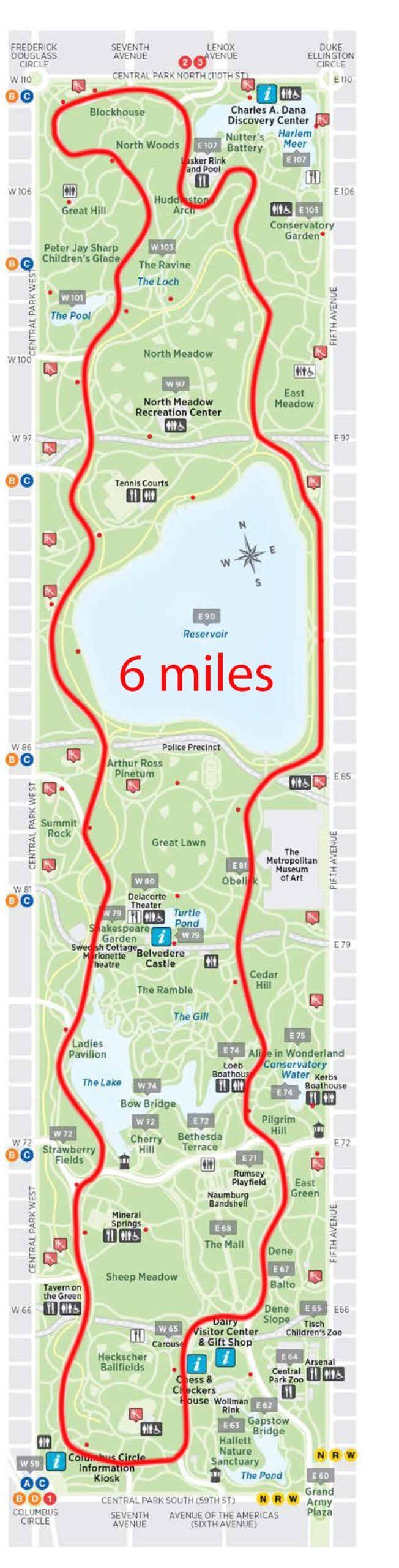
Distance: 6.1 miles (~9.7–10 km) Surface: Paved Difficulty: Moderate to High
The Full Loop is the quintessential Central Park running route. Circling the entire park along East Drive, West Drive, Center Drive, and Terrace Drive, this is the route that serious runners live for. It overlaps with portions of the TCS New York City Marathon course, making it a genuine bucket-list run for endurance athletes around the globe.
The total elevation gain on the full loop is approximately +300 feet, with two notable climbs to watch for:
- Cat Hill (near the Loeb Boathouse) — a ~50-foot gain, named for the bronze cat sculpture nearby
- Harlem Hill (above 102nd Street) — the toughest section, with a ~100-foot gain on the west side
If you want to skip Harlem Hill, you can cut across the 102nd Street Transverse and shave the route down to about 4 miles (6.5 km) — a popular “middle loop” among locals.
Best for: Experienced runners, marathon training, those who want the full New York running experience
2. The Lower Loop — 1.8 miles (~2.9K): Perfect for Running in Central Park as a Beginner
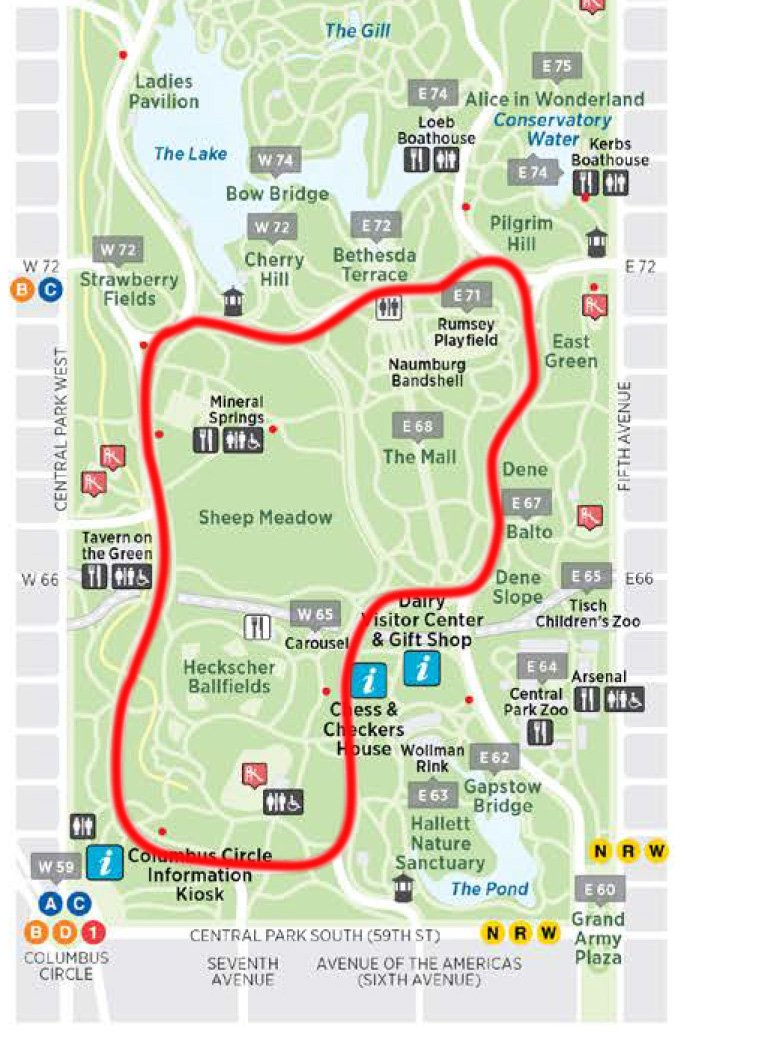
Distance: 1.8 miles (~2.9 km) Surface: Paved Difficulty: Easy to Moderate
The Half Loop follows Central Park Drive south of the 72nd Street Transverse, looping through the most scenic and landmark-dense section of the park. This route passes some of Central Park’s most beloved spots:
- Bethesda Terrace & Fountain — one of NYC’s most iconic gathering places
- The Mall & Literary Walk — a grand promenade lined with towering American elm trees
- Sheep Meadow — a wide-open lawn perfect for a post-run stretch
- Strawberry Fields — the memorial to John Lennon just off Central Park West
This route is a favorite for before-work or after-work runs, and it’s ideal for tourists who want to combine sightseeing with a workout. Note that this southern section is also where the NYC Marathon finishes — while it looks flat, anyone who has run it at mile 26 will tell you otherwise.
Best for: Beginners, sightseeing runners, quick morning or evening jogs
3. The Reservoir Loop — 1.58 Miles: Scenic Running in Central Park Without the Crowds
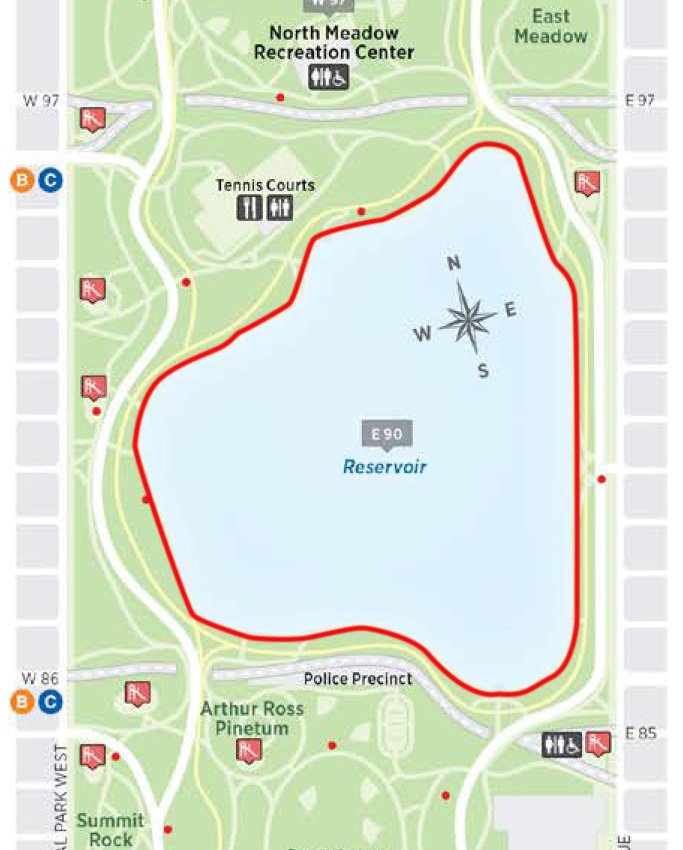
Distance: 1.58 miles (~2.54 km) Surface: Crushed gravel (soft) Difficulty: Easy
The Jacqueline Kennedy Onassis Reservoir Running Track is one of the most beloved short loops in all of New York City — and for good reason. At 1.58 miles around, this soft-surface crushed gravel path is completely car-free and bike-free, making it a peaceful refuge in the middle of one of the world’s busiest cities.
The track spans from 86th to 96th Street and stretches nearly the full width of the park. Every 100 yards is marked, making it easy to track your distance. The views are spectacular: open water on one side, the Manhattan skyline rising on the other.
Key rules for the Reservoir:
- Run counterclockwise — this is strictly observed
- No dogs, strollers, or bikes allowed on the track
- The most direct access point is the Engineer’s Gate on East 90th Street
The Central Park Conservancy regularly maintains and upgrades the gravel surface, a testament to just how popular this loop is with daily runners.
Best for: Joint-conscious runners, beginners, anyone who wants skyline views with minimal traffic
4. The Bridle Path — 1.6 to 4.2 Miles: Running in Central Park Off the Beaten Track

Distance: 1.66 miles (short loop) or 4.2 miles (full loop) Surface: Dirt / soft soil Difficulty: Easy to Moderate
Once used for horseback riding (and still shared with occasional equestrians — horses have the right of way!), the Bridle Path is now a beloved dirt running trail that winds through the park. The softer surface makes it significantly easier on joints compared to the paved drives.
There are two options:
- The shorter loop (1.66 miles) circles the Reservoir
- The full Bridle Path (4.2 miles) extends north to the North Meadow fields, crossing the 102nd Street Transverse before reconnecting near West 93rd
The canopy of trees along the path makes it one of the coolest routes in summer, and the changing foliage makes it particularly beautiful in autumn. If you’re combining the Bridle Path with the main loop, you can build out a longer long-distance training run.
Best for: Injury-prone runners, trail running fans, summer heat escapes
5. North Woods & Harlem Meadow — 3 to 5 Miles: The Hidden Gem of Central Park Running Routes

Distance: 3–5 km (customizable) Surface: Mixed trail and dirt Difficulty: Moderate
Head to the northern reaches of Central Park and you’ll find a completely different world. The North Woods is a secluded, forested area with winding paths that feel worlds away from the bustle of Midtown. Combined with the open expanse of Harlem Meadow, this section of the park offers a trail-running experience unlike anything else in Manhattan.
There are fewer tourists, more birdsong, and a sense of quiet that’s rare in New York. The terrain is varied — expect gentle hills, forested trails, and open meadows — and the seasonal changes here are especially dramatic, from spring wildflowers to brilliant autumn color to winter snow.
Best for: Solitude seekers, trail runners, anyone who wants to escape the crowds
Central Park Running Tips: What You Need to Know Before You Go
Direction & Etiquette
- The recommended running direction on the main loop is counterclockwise
- On the Reservoir, counterclockwise is mandatory
- Stay in the designated running lane on paved roads; the innermost lane is for runners going counterclockwise
- Watch for cyclists in the bike lane — always look both ways before crossing
Hydration
- Water fountains are located throughout the park but are not operational in winter
- In colder months, bring water or cash to buy from vendor carts
- Summer runners should plan hydration carefully — heat can be intense on exposed sections
Safety
- Morning runs are the most comfortable and crowded — great for energy and safety
- Evening runs on the main loop are generally fine as it is well-lit
- Avoid running alone in the interior trails at night
- If you get lost, check lamppost numbers: the first two digits indicate the nearest cross street, and the last two digits tell you east (even) or west (odd)
Gear Storage
- The NYRR RUNCENTER on 57th Street (between 8th and 9th Avenues) offers lockers for runners
- New York Running Company at Columbus Circle also provides locker facilities
Seasonal Notes
- Spring and fall are peak seasons — the park is at its most beautiful and the weather is ideal
- Winter brings icy patches, especially on hills — use caution and consider trail shoes
- Summer mornings are best; avoid midday heat on exposed paved routes
Best Starting Points for Central Park Running Routes
| Route | Suggested Start |
|---|---|
| Full Loop | 59th St & 7th Ave (Columbus Circle) |
| Half Loop | 59th St & 5th Ave (SE entrance) |
| Reservoir Loop | Engineer’s Gate, East 90th St |
| Bridle Path | West 90th St entrance or East 90th St |
| North Woods | 110th St entrances (north side) |
Running in Central Park: The NYC Marathon Connection
For runners with a competitive streak, Central Park holds deep significance in the world of road racing. The park is the finish line of the TCS New York City Marathon, one of the six World Marathon Majors, which draws roughly 50,000 runners every November. The final miles of the race wind through Central Park’s East Drive and onto the famous finish on West Drive near Tavern on the Green.
Training on the Full Loop is one of the best ways to prepare for the marathon’s final miles — and a statue of Fred Lebow, the late founder of the NYC Marathon, stands watch near the Reservoir entrance on East 90th Street as an enduring tribute to the race’s history.
Final Thoughts
Central Park’s running routes are more than a workout — they’re an experience of New York City at its most alive. Whether you’re chasing a personal best on the Full Loop, soaking in skyline views on the Reservoir track, or escaping into the quiet of the North Woods, every run here tells a different story.
Start with the route that matches your fitness level, mix and match loops as you build endurance, and don’t forget to look up from your watch once in a while. New York’s greatest park deserves your full attention.
Happy running — and welcome to the most famous stretch of pavement in the world.
Running Central Park for the first time? Save this guide and download the official Central Park running map from the Central Park Conservancy before you head out.