
This guide covers laws, fees and market data as of November 2026. It is general information, not legal or financial advice, and some links may be affiliate links. See our disclosure.
Picture two checks on a kitchen counter: one for the first month’s rent, one for the security deposit. At September 2026’s Manhattan median of $4,900, that is $9,800 before a single box moves. That is the honest starting point for any moving to NYC cost estimate, and it is smaller than it used to be. Since June 2025, the broker fee that once sat on top of those two checks is, in most cases, no longer yours to pay.
But “no broker fee” is not the same as “cheap,” and it is not the same as “no surprises.” This guide walks through every line on the bill, what the law now allows a landlord to ask for, and where the money quietly shifted instead of disappearing.
Quick Answer: Key Takeaways
- At signing, plan for about two months’ rent plus $20. New York caps the security deposit at one month’s rent and the application/background check fee at $20 or its actual cost, whichever is less.
- You don’t pay the landlord’s broker. The FARE Act took effect June 11, 2025. A broker who represents the landlord, including the agent who posted the listing, cannot charge you.
- You may still pay a broker you hire yourself. That is legal and is your choice.
- A guarantor can add close to another month. If you don’t meet a landlord’s income test, an institutional guarantor commonly costs 70% to 110% of one month’s rent for a one-year lease.
- Rents, not fees, are now the pressure point. Manhattan’s median rent rose 7.7% year over year in September 2026.
What the FARE Act Changed (and What It Didn’t)
The Fairness in Apartment Rental Expenses Act, Local Law 119 of 2024, is the reason a “moving to NYC cost” breakdown looks different in 2026 than it did two years ago. According to the city’s Department of Consumer and Worker Protection FARE Act FAQ, the law took effect on June 11, 2025, and does three main things:
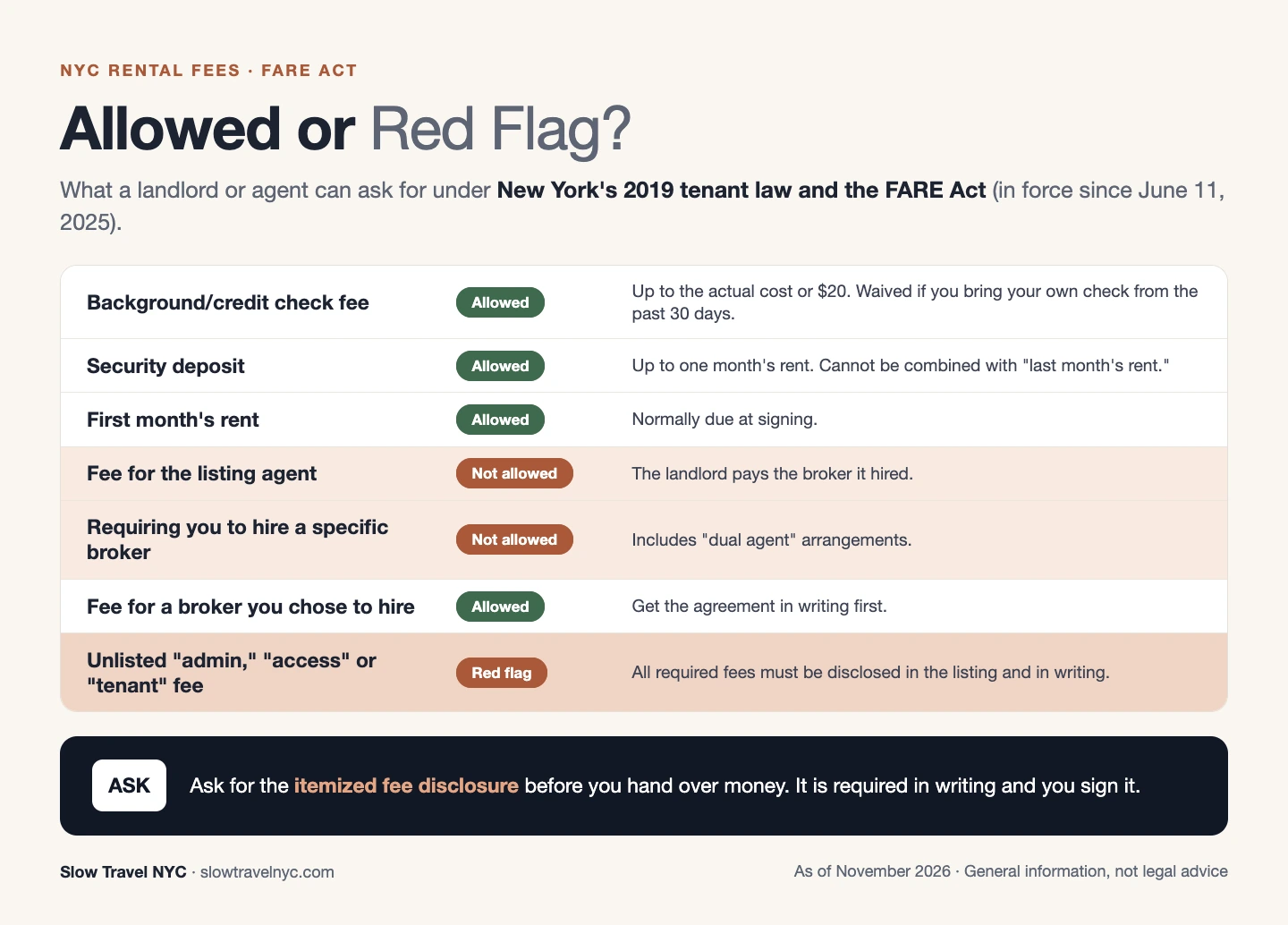
- It stops landlords from passing their broker’s fee to you. A landlord’s agent cannot charge a prospective tenant. That includes listing agents, and the law presumes that anyone who publishes a listing is doing so with the landlord’s permission.
- It bans forcing you to hire anyone. No one can make renting a specific apartment conditional on you hiring a broker, including a “dual agent” who claims to represent both sides.
- It requires fee transparency. Every listing must clearly show the fees you must pay. Before you sign a lease, the landlord or agent must give you an itemized written list of fees, which you sign. They keep it for three years and give you a copy.
What it didn’t change: you can still hire your own broker and pay them, and tenant-side brokers can still advertise their services. Landlords can also still charge for background and credit checks under state law.
The legal fight is mostly settled. On July 13, 2026, the U.S. Court of Appeals for the Second Circuit affirmed the dismissal of the real estate industry’s First Amendment and state preemption claims. A narrower contracts claim, tied to certain agreements signed before the law passed, remains in the lower court. For a renter signing a new lease today, the rule is in force.
What Moving to NYC Costs Up Front, Line by Line
Here is every line you are likely to see, in the order you’ll meet them. Figures are as of November 2026.

1. Application and background check: $20 or less
Under New York’s 2019 tenant protection law, a landlord can charge only for a background and credit check, and the total cannot exceed the actual cost or $20, whichever is less. If you bring your own background or credit check from the past 30 days, the fee must be waived. The landlord also has to give you a copy of the report and the receipt. The New York State Bar Association’s summary lays this out clearly.
One exception worth knowing: condos and co-ops follow their own board rules and can charge higher application and processing fees. If you’re renting a condo unit from an individual owner, ask for the board package costs in writing early.
2. Security deposit: one month’s rent, maximum
The same 2019 law caps the security deposit at one month’s rent. A landlord who takes a full month’s deposit cannot also ask for “last month’s rent” in advance. When you move out, the landlord has 14 days to return the deposit or give you an itemized statement of deductions. The NYC Comptroller’s Tenants’ Bill of Rights lists both the deposit cap and the $20 fee limit.
3. First month’s rent
This is the largest single line, and it depends entirely on where and what you rent. As of September 2026, the Elliman Report by Miller Samuel, via Brick Underground, put Manhattan’s median rent at $4,900 and Brooklyn’s at roughly $4,000. Corcoran, which tracks market-rate buildings, reported a record $5,395 Manhattan median for September. The two numbers measure different slices of the market, so treat them as a range, not a contradiction.
4. Broker fee: $0, unless you hire one
If you found the apartment through a listing, the landlord’s broker is the landlord’s cost. If you choose to hire your own agent to search for you, you will pay what you agree to in writing. Ask for that agreement up front and read who the broker says they represent.
5. Guarantor fee: often 70% to 110% of a month
Many NYC landlords use a rule of thumb that your annual income should be about 40 times the monthly rent. On a $4,900 apartment, that is $196,000. If you fall short, have no U.S. credit history, or are newly employed, the landlord may ask for a guarantor.
Institutional guarantors fill that gap for a one-time fee. Insurent’s renter page states that U.S. applicants pay roughly 70% to 90% of one month’s rent for a one-year lease guaranty. For applicants without U.S. credit, its broker FAQ puts the range at about 98% to 110%. The fee is per lease, so roommates can split it. Not every building accepts every guarantor company, so confirm before you apply.
6. Movers: from a few hundred dollars to a few thousand
Moving costs are less regulated and more variable. One NYC mover’s 2026 price guide puts a typical local one-bedroom move at $900 to $1,800, and often $1,500 to $2,500 within Manhattan, where walk-ups, freight elevator bookings and parking add hours. Get a written quote and ask whether your building requires a certificate of insurance from the mover.
7. The costs nobody itemizes
The lease disclosure only covers what the landlord charges. It won’t show:
- Utility setup and the first electricity and internet bills
- Furniture, a mattress, and anything a small kitchen needs
- Renters insurance, which some buildings require before move-in
- Overlapping rent if your old lease and new lease don’t line up
- A few nights in a hotel or corporate housing if your move-in date slips
If you’re transferring a deposit from abroad, wire and conversion fees add up fast. Our guide to the no foreign transaction fee card for NYC covers ways to reduce that friction.
NYC Apartment Upfront Cost by Rent Level
The table below shows the NYC apartment upfront cost at three common rent levels, as of November 2026. “At signing” means first month’s rent, a one-month security deposit and one $20 application fee. Guarantor and mover ranges use the sources above.
The low end of “Possible total” assumes no guarantor and the low mover quote. The high end assumes a guarantor without U.S. credit and the high mover quote. Each additional applicant may pay their own background check fee.
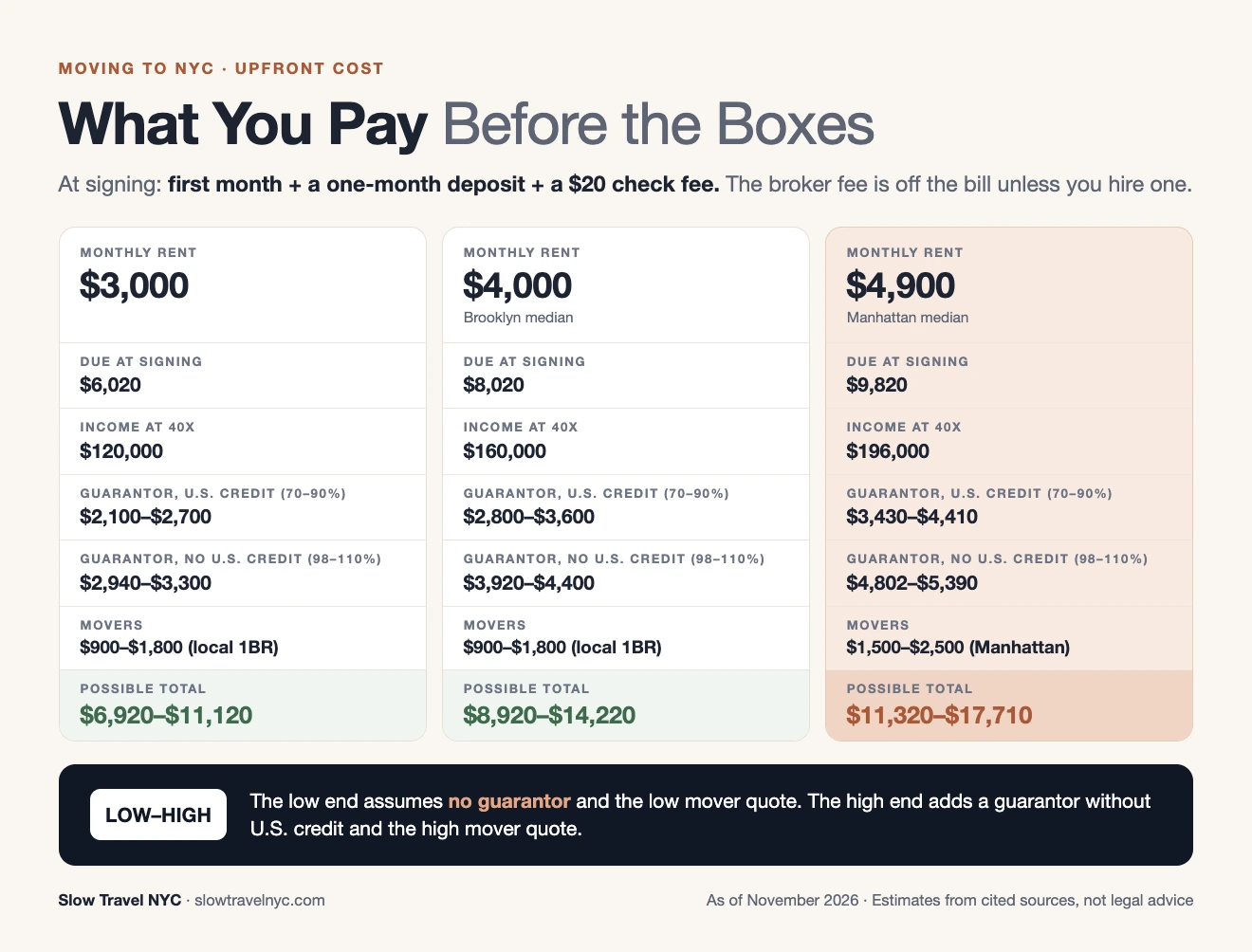
For context, StreetEasy projected before the law took effect that removing broker fees would cut the average upfront cost of a new lease by 41.8%, from $12,942 to $7,537. That gap is roughly what the old fee used to add.
If you’re planning a scouting trip before the move, our NYC Trip Budget Calculator helps estimate hotel and daily costs while you view apartments.
Reality Check: The Fee Moved, It Didn’t Vanish
The FARE Act did what it said: most renters no longer pay a broker they never hired. But the costs of a tight market found other routes.

Rent absorbed part of it. StreetEasy found in the law’s first month that listings which previously carried a broker fee saw average annualized rent increases of 5.3%, less than a percentage point above other listings. Over a full year, that is smaller than a one-time fee, but you pay it every month, and it can carry into renewals.
Public inventory shrank. By June 2026, public rental listings were down 31% year over year, while the share of renters paying a broker fee fell from 31% to 15%, according to data compiled by CRE Daily from Miller Samuel, The Real Deal and Openigloo. Some apartments now rent through tenant-side brokers without ever appearing on major sites.
Competition is still real. Lease signings in Manhattan fell 15.3% year over year in September 2026, and about 16% of new leases involved bidding wars. A lower fee does not help if you lose the apartment to a faster applicant.
Watch for disguised fees. Early reports described landlords’ brokers offering one price with an upfront fee and a higher monthly rent without it, as Gothamist reported. If a “consulting fee,” “access fee” or “tenant fee” appears on a listing you found yourself, treat it as a broker fee under another name.
A Slower Way to Sign a Lease

NYC renting rewards speed, and that is exactly why a little deliberate slowness protects you. A few habits I’d recommend to anyone moving here:
- Visit the block twice. Once at 8 a.m. on a weekday, once after 9 p.m. Morning shows you the commute, delivery trucks and school drop-off. Night shows you noise, lighting and whether the corner bar spills onto your stoop. Our early-morning West Village walk is a good example of how different a street feels before the city wakes up.
- Bring your documents, not your checkbook. Have pay stubs, an offer letter, bank statements, ID and a recent credit report ready. Speed comes from preparation, not from paying first.
- Ask for the itemized fee disclosure before you hand over money. It’s required. If an agent hesitates, that tells you something.
- Consider a soft landing. A month in a furnished stay lets you learn a neighborhood before committing to 12 months. Our guide to the best luxury neighborhoods in Manhattan and Brooklyn can narrow the map.
- Think about how you’ll pay rent. If you plan to pay by card, our Bilt rent rewards guide explains what that does and doesn’t earn.
What’s legal to ask vs. what’s a red flag (as of November 2026)
If Someone Asks for a Fee You Didn’t Agree To
Keep the listing screenshot, texts, emails and any receipts. The city’s DCWP accepts broker fee complaints online, and you can also call 311. If DCWP’s case is sustained at the city’s Office of Administrative Trials and Hearings, the violator can face a civil penalty and may be ordered to repay illegal fees. The law also lets individuals sue in civil court.
If you signed a contract to pay a broker before June 11, 2025, DCWP says the ban may not apply, depending on the circumstances. That is a question for a tenant attorney, not a blog post.
Frequently Asked Questions
How much money do I need to move to NYC in 2026?
At signing, budget about two months’ rent plus a $20 background check fee: $9,820 on a $4,900 Manhattan median apartment, or $8,020 on a $4,000 Brooklyn median apartment, as of November 2026. Add movers, a possible guarantor fee and setup costs, and a realistic range is roughly $11,000 to $18,000 for a median-priced Manhattan apartment.
Do tenants still pay broker fees in NYC?
Only if you hire your own broker. Since June 11, 2025, a broker who represents the landlord, including the agent who posted the listing, cannot charge you. You also cannot be required to hire a broker to rent a specific apartment.
Can a landlord ask for first month, last month and a security deposit?
No. New York caps the security deposit at one month’s rent, and a landlord who collects that deposit cannot also collect another month’s rent in advance.
What is the 40x rule in NYC?
It is a common landlord benchmark, not a law: your annual income should be about 40 times the monthly rent. On a $3,000 apartment, that means $120,000. If you don’t meet it, landlords often ask for a guarantor.
Is the FARE Act still being challenged in court?
Mostly no. The Second Circuit affirmed the dismissal of the main constitutional claims on July 13, 2026. A narrower claim about certain pre-law contracts is still pending, but the broker fee rule applies to new rentals today.
The Bottom Line
The moving to NYC cost picture in 2026 is simpler than it used to be: two months’ rent, a $20 check fee, and the broker fee off your plate unless you choose one. The harder part is the rent itself, and the competition to secure it.
So move with the same pace you’d bring to a good walk through a new neighborhood. Prepare your documents early, read every fee in writing, and see the block at more than one hour of the day. The apartment you rush into is the one you’ll live in for at least a year.