NYC Helicopter Tour Safety Tips & Central Park Bike Rental Rules: Your 2026 Adventure Guid

From NYC helicopter tour safety tips to Central Park bike rental rules, here’s everything thrill-seekers need to know before booking helicopter flights, bike rides, ice skating, and sky-deck adventures in New York City this year.

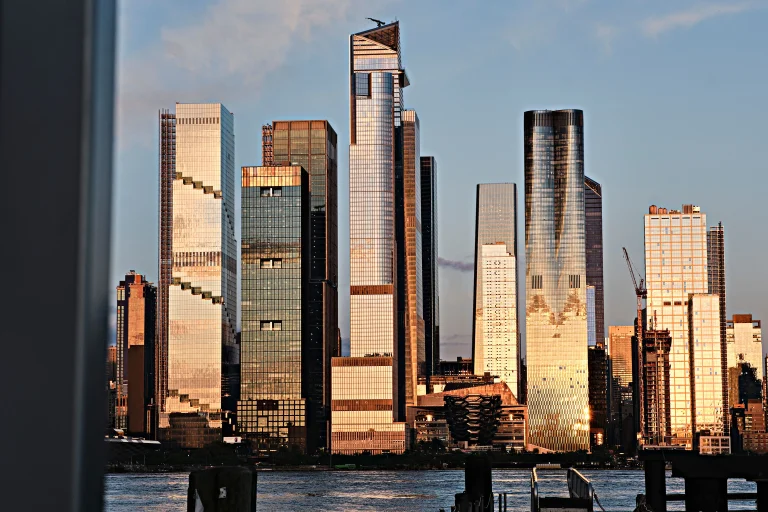
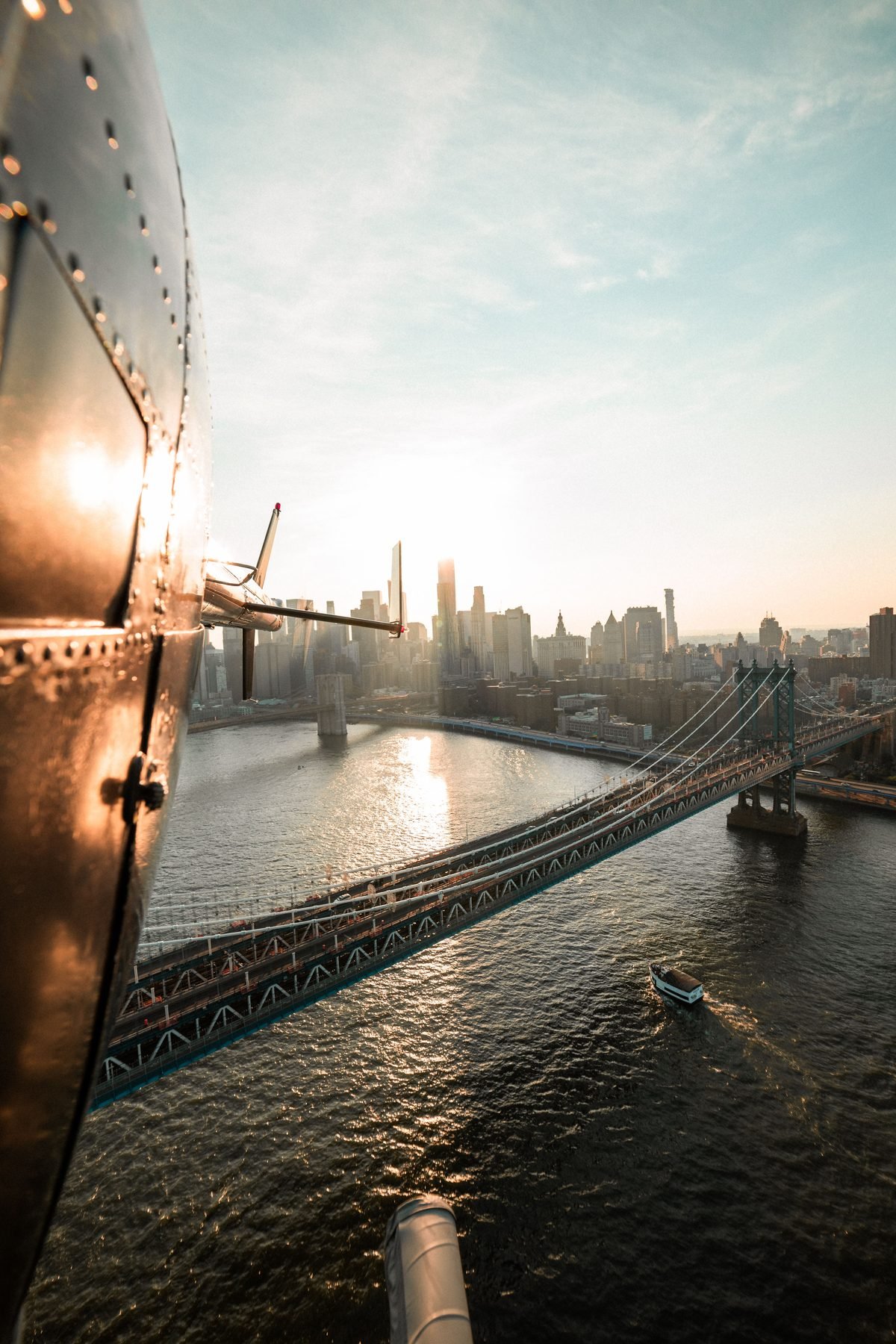
NYC helicopter tour view of Manhattan skyline

New York City isn’t just museums and window shopping — it’s an action-packed playground for adventure seekers. From soaring above the Manhattan skyline in a helicopter to ice skating under the Rockefeller Center Christmas tree or pedaling through Central Park, outdoor adventures create some of the most memorable moments of any NYC trip.

But before you book anything, it pays to know the rules. This guide walks through NYC helicopter tour safety tips, Central Park bike rental rules, and what to know about ice rinks, sky decks, and travel insurance so your 2026 New York adventure goes off without a hitch.

1. NYC Helicopter Tour Safety Tips: What Every Flyer Should Know
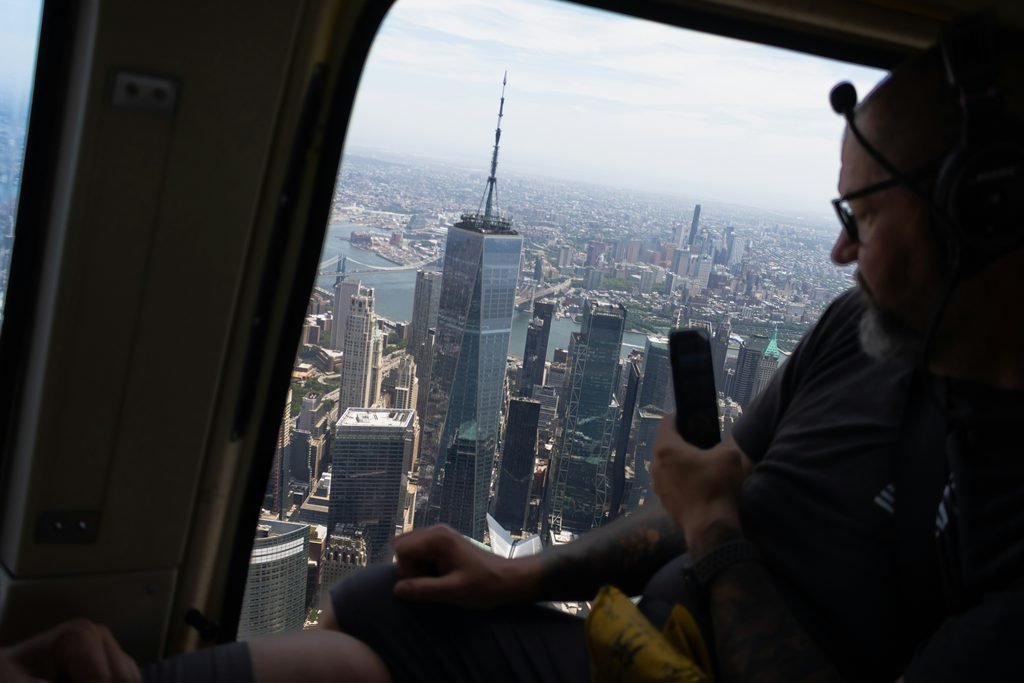
doors-off NYC helicopter tour safety

A helicopter flight over the Hudson River delivers unbeatable views of the Statue of Liberty, Brooklyn Bridge, and Empire State Building. But before you book, these are the NYC helicopter tour safety tips worth knowing.

ID, Age, and Weight Requirements

Under FAA rules, anyone 18 or older needs a valid government-issued photo ID at check-in. Weight limits matter more than people expect: most operators cap individual passengers at around 275 lbs (125 kg), though some, like HeliNY, set stricter limits (around 250 lbs) on certain aircraft. Passengers over the limit are usually required to book an additional “comfort seat,” with surcharges typically running $99–$250 depending on the operator. If your group is on the heavier side, call ahead — operators reserve the right to reassign seating or add passengers to balance the aircraft.

Doors-Off Tours: Know Where They Actually Fly From

Here’s something many first-time visitors get wrong: doors-off helicopter tours are not permitted from Manhattan’s Downtown Heliport. Following a fatal 2018 crash into the East River, New York City banned doors-off flights departing from within city limits. If you want the open-door photography experience, you’ll need to book with an operator like FlyNYON, which departs from Kearny, New Jersey — outside the city’s jurisdiction. Always confirm your departure airport before booking, since the “New York helicopter tour” you find online may actually take off from New Jersey and include a 30–45 minute travel window each way.

Weather Cancellations and Prohibited Items

Helicopter flights are highly weather-dependent, and canceled flights due to fog, wind, or low visibility are common. Many tickets are non-refundable unless you buy a flexible cancellation add-on, so check the fine print before paying. Loose scarves, oversized bags, and unsecured cameras are banned on open-door flights because anything not strapped down becomes a hazard mid-air.

Learn more about FAA helicopter tour regulations

2. Central Park Bike Rental Rules Every Rider Should Follow
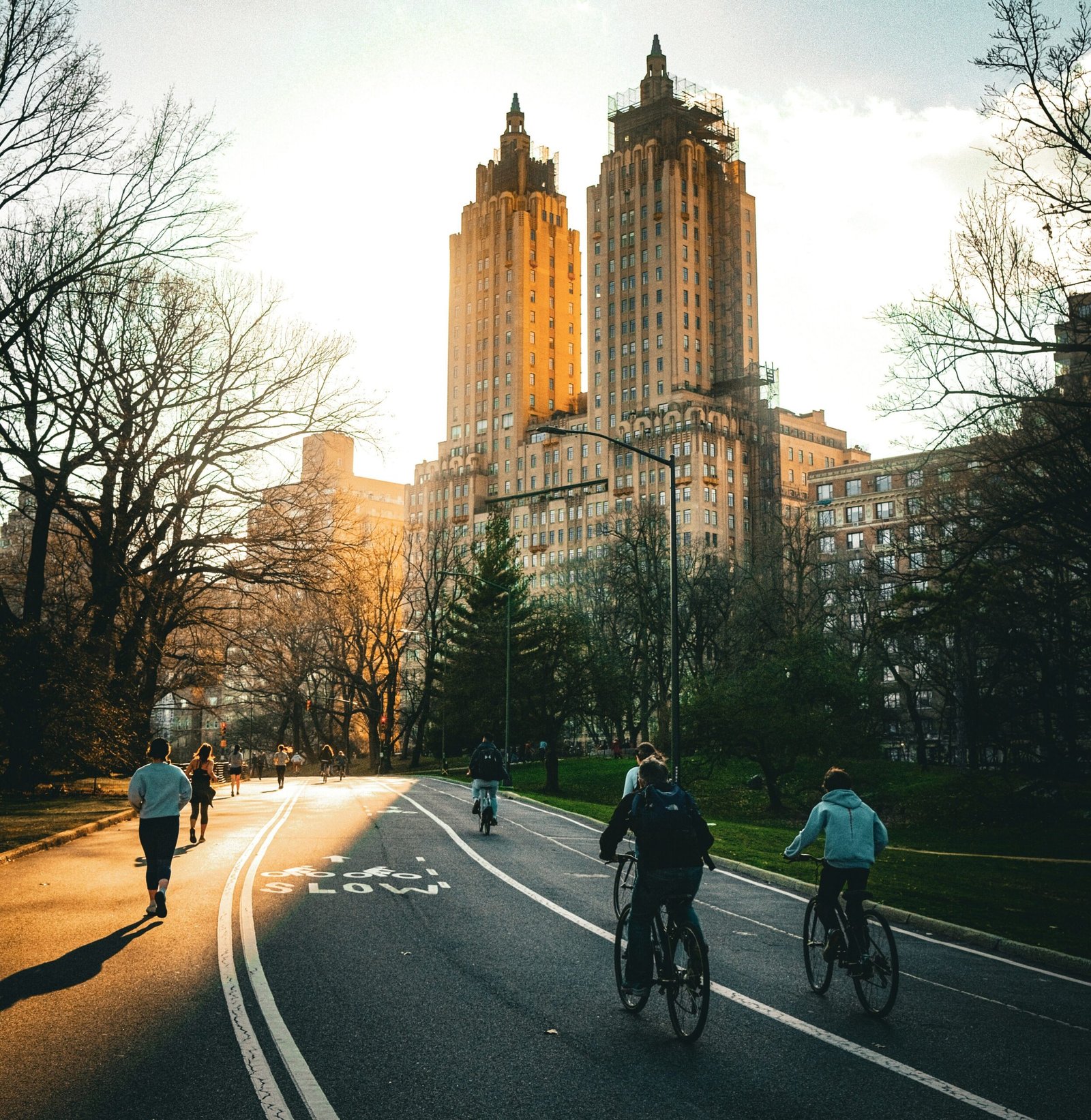
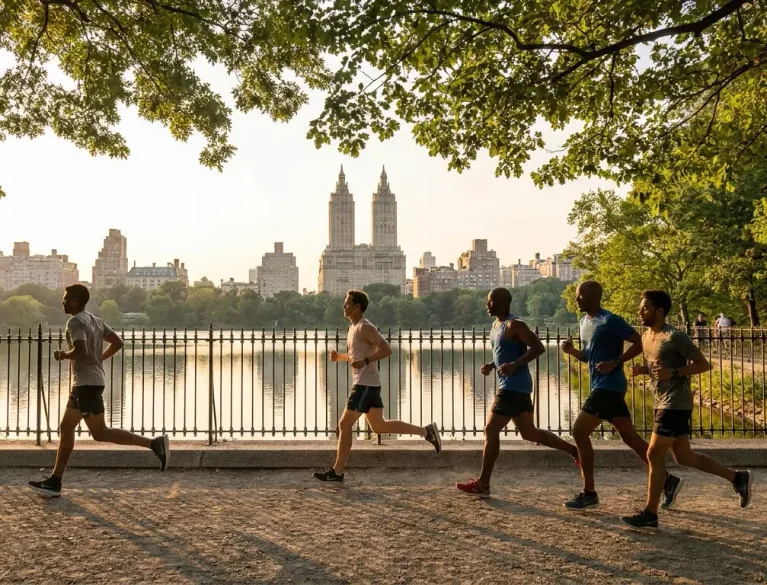
Central Park bike rental rules cyclists on loop road

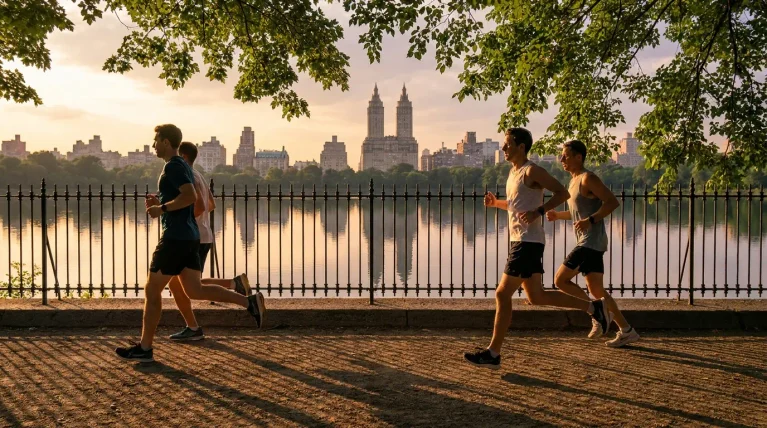
Renting a bike to explore Central Park’s 843 acres is a classic New York experience — but sharing the park’s loop roads with runners, horse-drawn carriages, and pedicabs means the Central Park bike rental rules are worth learning before you clip in.

Ride Counterclockwise, Stay Off the Paths

The park’s main drives always flow counterclockwise, and cycling is prohibited on pedestrian-only paths, lawns, and the Park’s dirt trails. The Central Park Conservancy notes that cycling is only allowed on marked shared paths in a couple of specific spots, so stick to the drives unless a path is clearly marked for bikes.

Helmet Laws and Speed Limits

New York law requires cyclists under 14 to wear a helmet, though it’s smart for riders of any age given how congested the loop gets, especially near crosswalks and popular photo spots like Bethesda Fountain. Speed inside the park is generally capped around 20 mph. If you rent an e-bike, Class 3 e-bikes require a helmet by law regardless of the rider’s age.

Route Options for Every Fitness Level

Most rental shops offer three main loop options: a 1.7-mile Southern Loop for casual riders, a roughly 5-mile Lower Loop that skips the steep northern hills, and the full 6-mile loop including Harlem Hill for more experienced cyclists. If you head out of the park onto Manhattan streets, stay in marked bike lanes and skip the headphones — situational awareness matters more in city traffic than in the park.

3. Winter Ice Skating & Summer Rooftop Safety
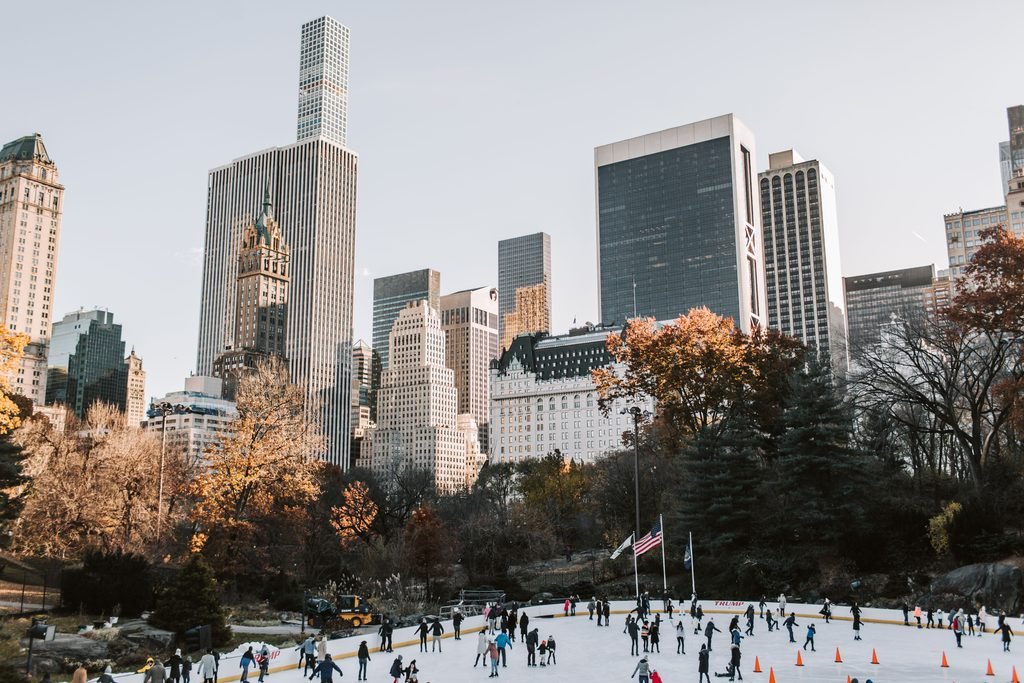
Wollman Rink ice skating Central Park skyline

From Wollman Rink and Bryant Park’s winter ice to sky-high observation decks in the warmer months, New York’s seasonal adventures come with their own physical demands.

Ice Rink Safety

Central Park’s Wollman Rink now runs under new management (Wollman Park Partners) and typically opens in late October, running through mid-March. General admission runs roughly $15–$38 for adults with $10–$12 skate rentals, and the rink gets extremely crowded during the holidays — which is exactly when wrist and ankle injuries spike among beginner skaters. Wrist guards are a smart, inexpensive addition if you’re new to the ice.

Observation Decks and Glass Floors

Sky decks like Edge at Hudson Yards (home to the CityClimb experience) and Summit One Vanderbilt require sturdy, non-slip footwear, and both encourage securing your phone with a lanyard before leaning out over a glass floor or open-air ledge. These attractions are generally very safe when visitors follow posted guidance, but rushing for a photo on a windy day is where most minor incidents happen.
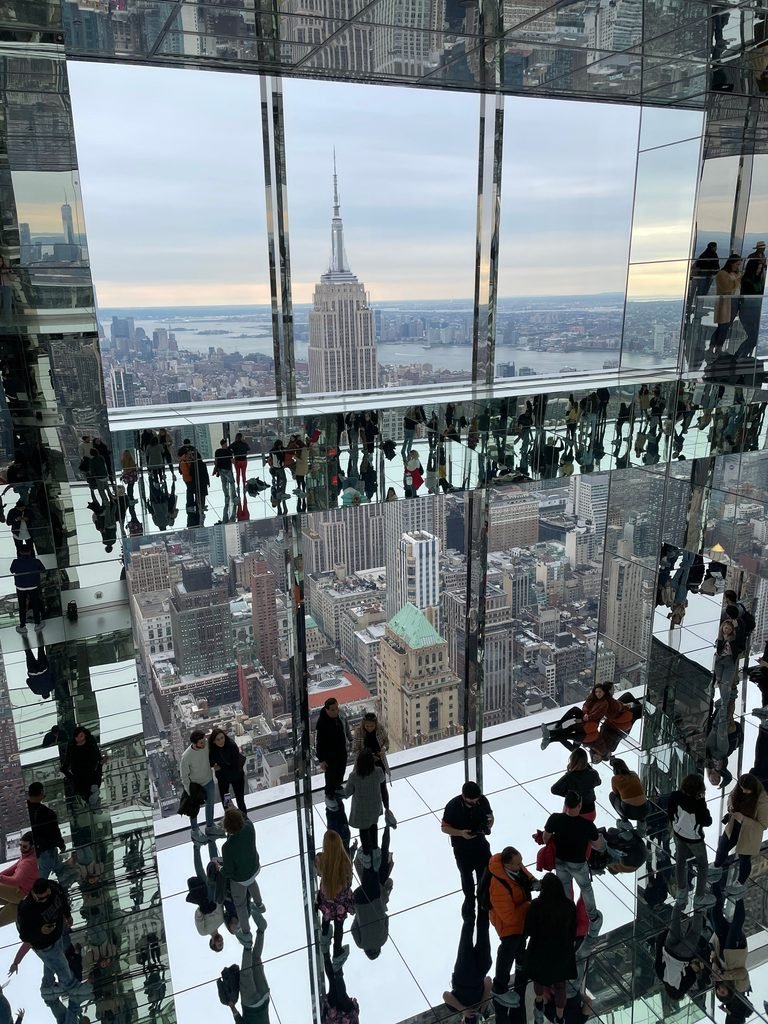
Edge Hudson Yards glass floor observation deck safety

4. Why Your Travel Insurance Needs to Cover “Adventure Activities”

Many travelers assume standard travel insurance covers any accident on vacation — that’s a costly misconception. Standard policies frequently exclude high-risk or “extreme sports” activities, which can include helicopter tours, sky-deck climbing experiences, and even some bike rentals in insurers’ fine print.

Before you book your NYC adventure, check for:

  • An extreme sports rider or add-on that specifically names helicopter flights, climbing experiences, or similar activities.
  • Emergency medical evacuation coverage of at least $100,000, in case you need transfer to a specialized trauma facility.
  • Equipment and activity-fee protection, so non-refundable tickets are reimbursed if weather or illness forces a cancellation.

Reading the exclusions section of your policy — not just the marketing summary — is the single best way to avoid a surprise bill after an accident.

Final Thoughts

Helicopter flights, Central Park bike rides, ice skating, and sky-deck adventures make a trip to New York City unforgettable. By following the NYC helicopter tour safety tips above, sticking to the Central Park bike rental rules, and confirming your travel insurance actually covers adventure activities, you can dive into everything the city offers with real peace of mind.

This guide is for general informational purposes only. Always confirm current rules, pricing, and safety requirements directly with tour operators, NYC Parks, and your insurance provider before booking.

Related posts you might enjoy
How to Experience NYFW Without an Invite: A Local’s Guide to Public NYFW Tickets (2026)

You don’t need an industry credential to feel New York Fashion Week. This local’s guide shows you exactly how to experience NYFW without an invite — from spotting street style outside Spring Studios to buying real public NYFW tickets for runway shows anyone can attend.

Think New York Fashion Week (NYFW) is only for A-list celebrities, top editors, and influencers with a million followers? Think again. Learning how to experience NYFW without an invite is actually easier than most people assume — you just need to know where to stand, what to book, and when to show up.

According to the CFDA’s preliminary September 2026 schedule, the official Spring/Summer 2027 season runs from September 10 to September 15, 2026, opening with Diane von Furstenberg’s runway show and closing with Thom Browne. That’s more than 70 runway shows and presentations packed into six days — and while most of them are strictly invite-only, the energy of the week spills out across Manhattan for anyone willing to chase it.

As a New York local, here’s the real insider guide to catching the buzz, the outfits, and even a few real runway shows — no editor credential required.


1. Catch the Glamour at Street Style Hotspots

NYFW without an invite

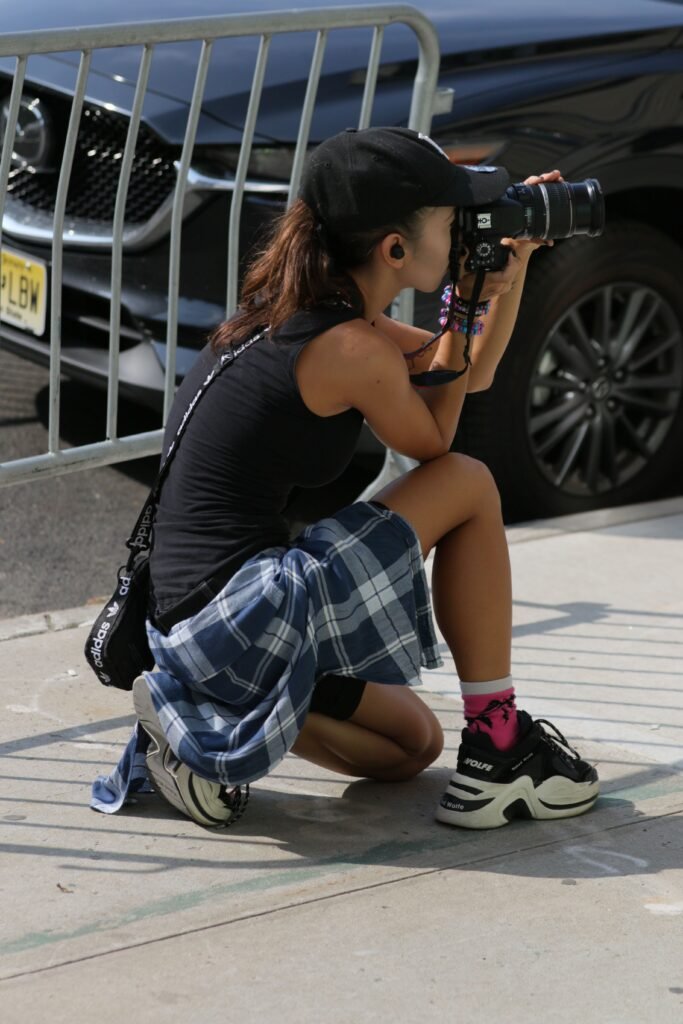
The sidewalks during Fashion Week are often more exciting than the shows themselves. Photographers, models, and stylish New Yorkers gather outside major venues, making street style spotting one of the best (and free) ways to experience NYFW without an invite.

  • Spring Studios (SoHo/TriBeCa, 50 Varick St): For years this has been a primary hub for major shows and presentations. Arrive 30–45 minutes before a scheduled show time to watch attendees arrive in showstopping outfits — this is peak street-style-photography hour.
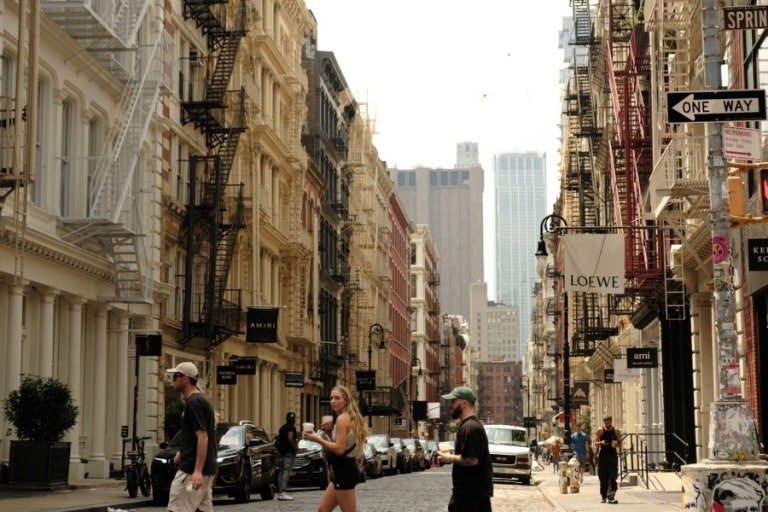
  • SoHo’s Cobblestone Streets (Greene St & Prince St): The neighborhood’s cast-iron architecture is the favorite backdrop of street style photographers. Walk through mid-day and you’ll naturally run into live photoshoots and content creators filming.
  • Meatpacking District (Gansevoort St & the High Line): This chic, industrial pocket of the city becomes a magnet for off-duty models and fashion insiders grabbing coffee between calls.
NYFW without an invite

Because show venues shift slightly each season, it’s worth checking the CFDA’s official schedule page a few days out to confirm which venues are active that year.


2. Visit Brand Pop-Ups and Public Installations

Major fashion and beauty brands love capitalizing on the NYFW crowd by launching public pop-up shops, immersive installations, and photo booths — most completely free to enter.

NYFW without an invite
  • SoHo Pop-Up Corridors: Keep an eye on Broadway and West Broadway, where brands take over vacant storefronts for multi-day immersive experiences with free product samples and branded giveaways.
  • Meatpacking District & Hudson Yards Activations: Several retail hubs run outdoor screen viewings, live DJ sets, and open-to-the-public installations timed to the week.

Following NYFW-related hashtags in the days leading up to September is the easiest way to catch pop-up announcements before they happen.


Scrollable


3. Buy Real Public NYFW Tickets to Runway Shows

If you want the full runway experience — the lights, the front row, the actual show — you don’t need an industry invite. Several officially calendared production companies sell public NYFW tickets directly to anyone:

  • The Bureau at Gotham Hall (Broadway/Midtown): Running September 11–13, 2026, The Bureau produces 11 runway shows across 100+ designers, with general admission tickets starting around $125. Only press, buyers, and influencers working professionally need separate credentials — everyone else just needs a ticket.
  • Runway 7 at Sony Hall (235 W. 46th St): Runway 7’s September 2026 shows run roughly September 8–13, spotlighting emerging international designers with a strong focus on Latin American, Japanese, UK, and Portuguese talent. General admission tickets typically start around $150.
  • hiTechMODA at The Edison Ballroom (Times Square): A tech-forward showcase of independent global designers, with public shows scheduled for September 11–12, 2026. This is one of the most accessible entry points if you want a Times Square-adjacent NYFW moment.
NYFW without an invite

Because exact dates and lineups can shift as the season approaches, always confirm current details directly through each producer’s official ticketing page before booking.


4. Where Fashion Insiders Refuel: A Local Cafe & Dining Guide

Looking to grab a matcha or a glass of natural wine next to fashion insiders during show week? Skip the tourist chains and head to these neighborhood spots instead:

NYFW without an invite
  • Felix Roasting Co. (SoHo): An elaborate, plant-filled interior that makes for a naturally photogenic coffee break.
  • Balthazar (SoHo): The classic spot for fashion week power breakfasts and celebrity sightings.
  • Sant Ambroeus (SoHo/West Village): A Milanese cafe long favored by the fashion crowd for a quick espresso between shows.
  • Gilligan’s at Soho Grand Hotel: An open-air, tropical-leaning rooftop ideal for late-afternoon cocktails and people-watching.

Local Tips for Experiencing NYFW Without an Invite

  1. Dress the part. If you want to be photographed by street style photographers, lean into bold colors, unique textures, or a strong vintage statement piece.
  2. Timing is everything. Arrivals at major venues typically peak 30–45 minutes before a show’s scheduled start.
  3. Wear comfortable footwear. You’ll be walking miles on SoHo’s cobblestone streets — sleek sneakers or chunky boots hold up far better than stilettos.
  4. Book public NYFW tickets early. The most accessible shows (Gotham Hall, Sony Hall, Edison Ballroom) tend to sell out their better seating tiers first, especially closer to opening night.

NYFW is no longer a closed-door event — it’s a city-wide celebration of creative culture that anyone in New York can tap into. Pick a neighborhood, put on your favorite outfit, and step into the energy of New York City this September.


Dates and ticket details reflect the preliminary September 2026 schedule as of publication and are subject to change — always verify directly through the CFDA and each production company’s official site before finalizing plans.

Related posts you might enjoy:

Philip Johnson Glass House Architecture: A New Canaan Day Trip Guide from NYC

A deep dive into Philip Johnson Glass House architecture — proportion, materials, and the furniture-only floor plan — plus a complete New Canaan day trip itinerary from Grand Central, no car required.

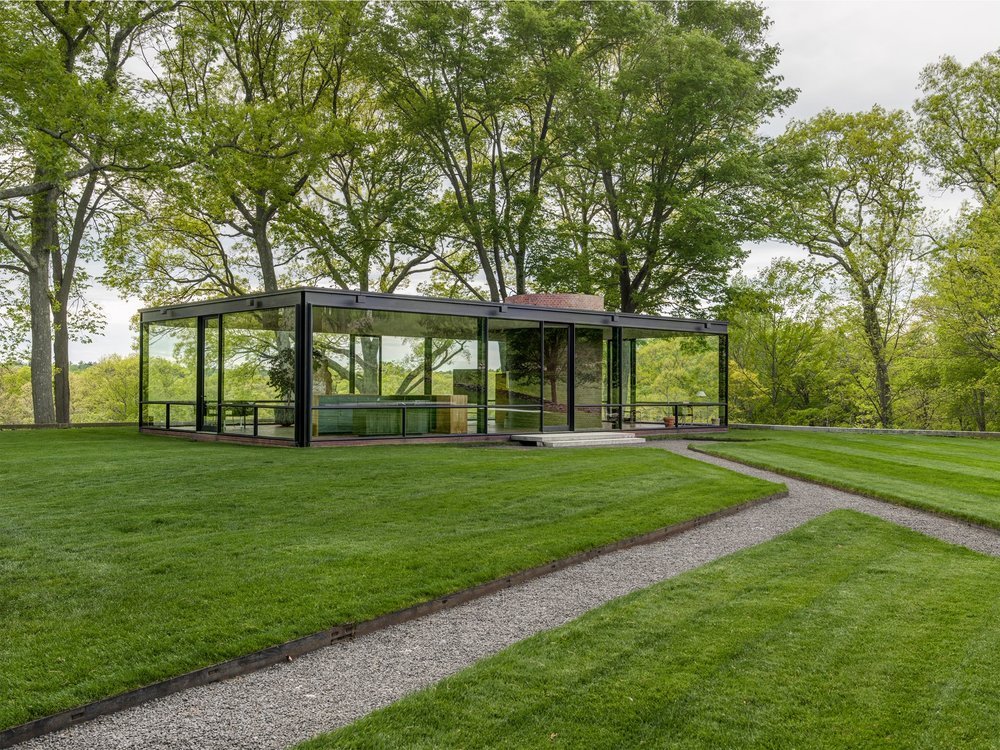
About an hour outside Manhattan, tucked behind a curtain of trees in New Canaan, Connecticut, sits one of the most influential residences of the 20th century. Philip Johnson Glass House architecture turned a simple rectangle of steel and glass into one of modernism’s defining statements — a house with no interior walls, no curtains, and almost nothing standing between its owner and the surrounding landscape.

Philip Johnson Glass House architecture

Completed in 1949 by architect Philip Johnson — winner of the first-ever Pritzker Prize — the Glass House is often mentioned in the same breath as Ludwig Mies van der Rohe’s Farnsworth House. The two buildings share a lineage: Mies first conceived of a glass house as early as 1945, and Johnson has openly credited Mies as the source of the idea after seeing early sketches of the Farnsworth House. But the two houses diverge sharply in execution — and understanding those differences is part of what makes a visit so rewarding.

This guide breaks down the building’s design in detail and lays out a complete, car-free Glass House New Canaan day trip you can do from Grand Central Terminal in a single day.

The Core Elements of Philip Johnson Glass House Architecture

Proportion and Structural Module

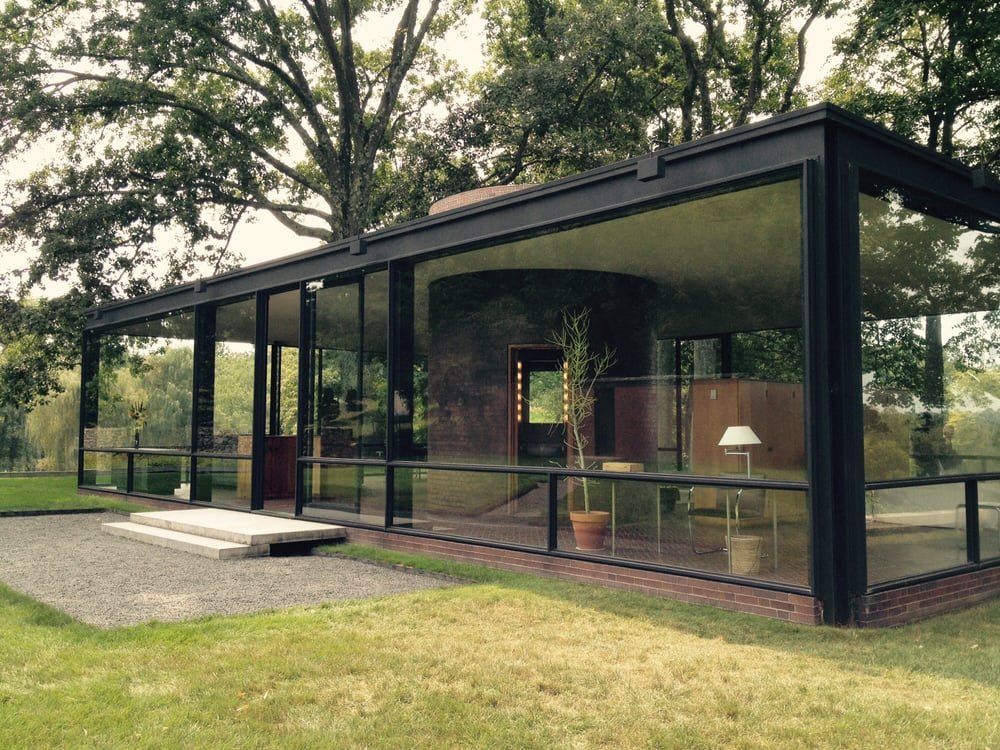
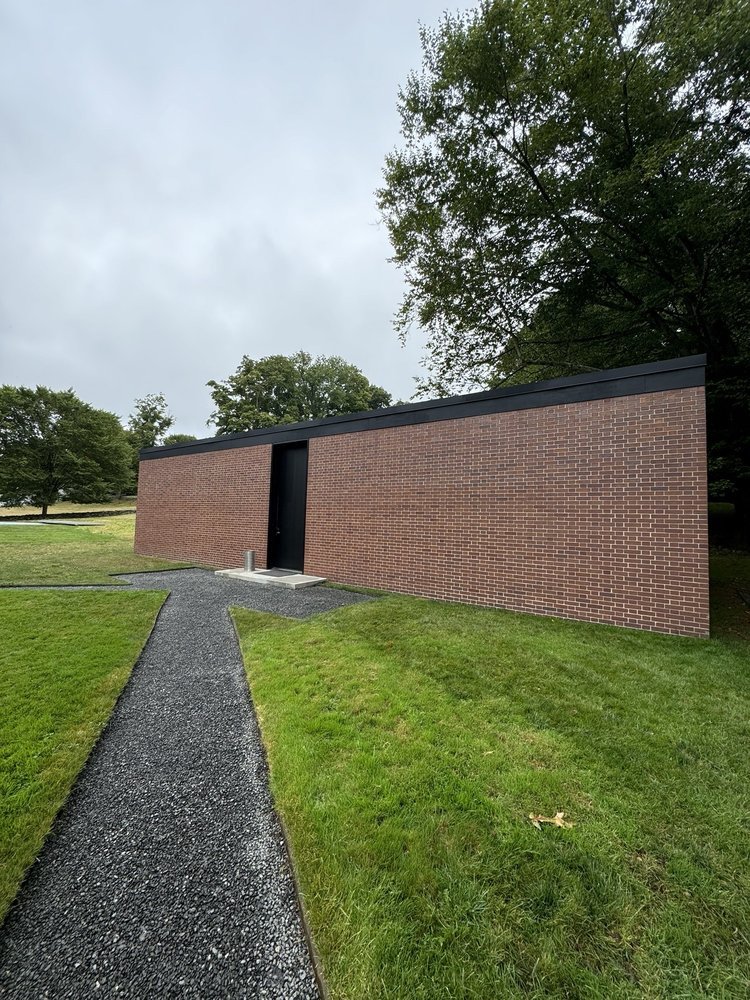
The Glass House is a single-story rectangular volume, roughly 56 feet by 32 feet — a modest footprint for a building of such outsized influence. The steel structural frame is painted matte black, a deliberate choice that lets the black lines of the columns read almost like a drawing against the greenery beyond, rather than competing with it.

A New Canaan Day Trip Guide from NYC

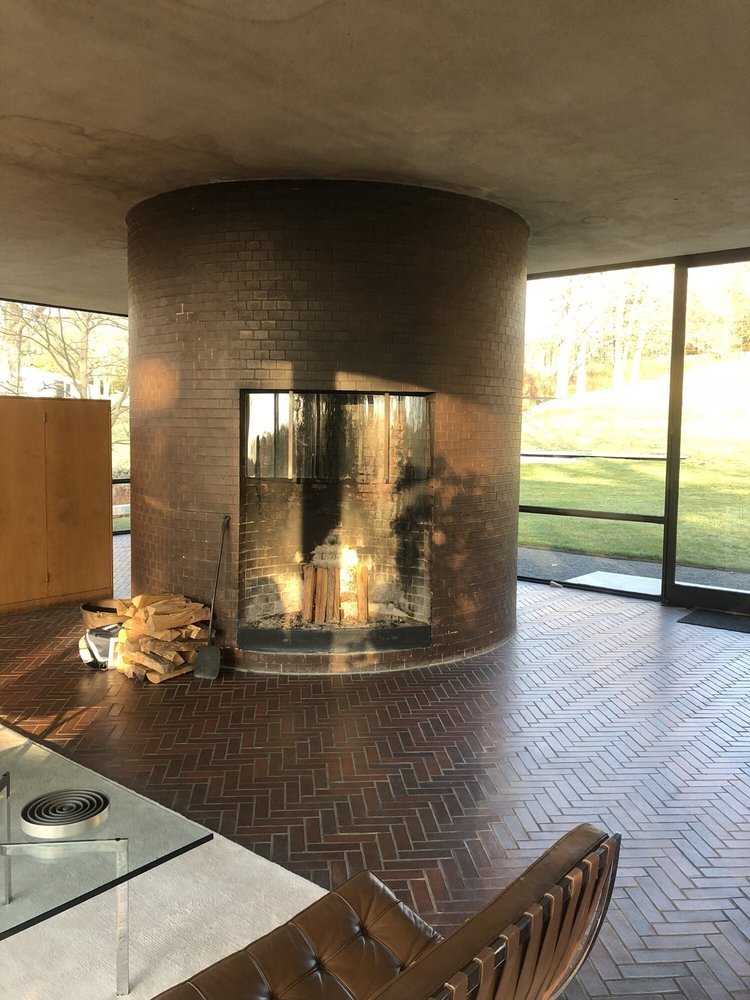
Inside, the floor is laid in a herringbone pattern of reddish brick, which does double duty: it conceals radiant floor heating and gives the otherwise cool palette of glass and steel a warm, tactile counterpoint underfoot.

A Floor Plan With No Interior Walls

This is the most radical part of the design, and it’s central to any discussion of Philip Johnson Glass House architecture. There isn’t a single fixed partition inside the house. Instead, “rooms” are defined entirely by furniture groupings and rugs:

  • A cluster of Barcelona chairs, a daybed, and a low glass table — all designed by Mies van der Rohe — mark out the living area on a rug.
  • A run of low walnut cabinetry, kept below eye level, forms the kitchen without ever blocking the 360-degree view.
  • The only object that breaks the roofline is a freestanding brick cylinder, which houses the bathroom on one side and a fireplace facing the living area on the other. It functions as the house’s single fixed anchor point in an otherwise open plan.
A New Canaan Day Trip Guide from NYC

Where Mies’s Farnsworth House consolidates its utilities into a core that never touches the exterior glass walls, Johnson was directly influenced by that decision — he was struck by how Mies had gathered the kitchen, closets, and bathrooms into one core with no part touching the outer walls. Johnson borrowed the logic but gave it his own form with the brick cylinder.

Glass House vs. Farnsworth House: Key Differences

If you’re researching Philip Johnson Glass House architecture, the comparison to Mies’s Farnsworth House (1951) in Plano, Illinois, comes up constantly, and it’s worth knowing the actual distinctions rather than treating the two as interchangeable:

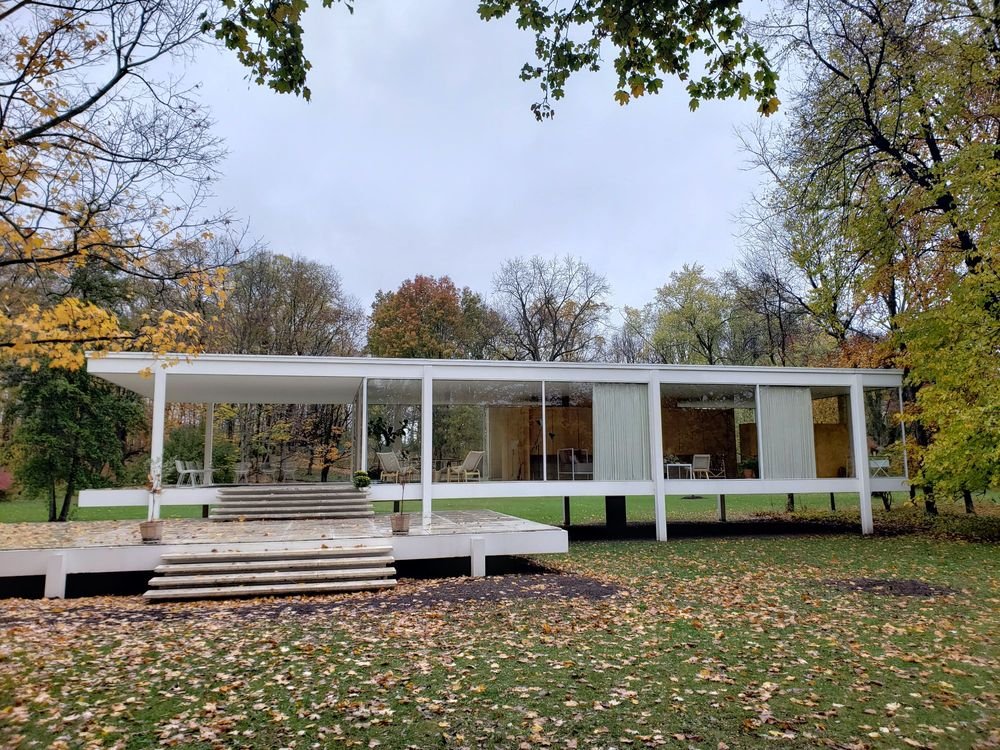
Farnsworth House (1951) in Plano, Illinois
  • Ground relationship: Johnson’s house sits directly on the land, while Mies’s Farnsworth House is raised above it on steel stilts, partly as flood protection for its riverside site.
  • Structural expression: The Glass House blurs the line between its structure and glass framing, whereas the Farnsworth House more clearly exposes and celebrates its structural frame.
  • Color: One frame is black, the other white — a small detail that changes how each building reads against its landscape.

Johnson himself was candid about the debt. Writing in 1950, he acknowledged that the idea of a glass house came from Mies, and that seeing Mies’s sketches was what pushed him to begin his own three-year design process — while noting the “obvious difference in composition and relation to the ground” between the two.

The Wider Estate: Brick House and the Other Structures

A visit built around Philip Johnson Glass House architecture should not stop at the glass box itself. The Glass House is one of fourteen structures spread across a 49-acre estate that Johnson treated as a lifelong architectural laboratory, adding buildings over nearly five decades.

Directly across the lawn from the Glass House sits its intentional opposite: the Brick House, a fully enclosed, opaque guest house. The pairing of a transparent glass pavilion with a solid, windowless brick structure was a deliberate composition — transparency versus enclosure, lightness versus mass.

A New Canaan Day Trip Guide from NYC
Brick House

Elsewhere on the property, later additions trace Johnson’s shift from modernism toward postmodern experimentation:

  • An underground Painting Gallery, built into a hillside and organized around rotating carousel-style walls.
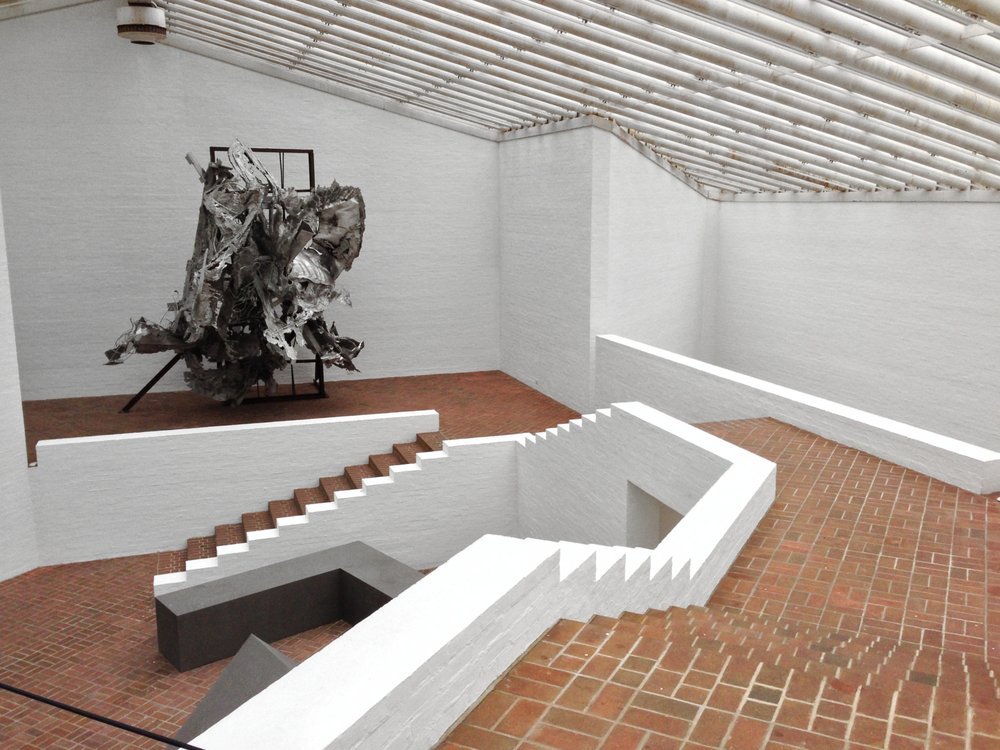
  • A Sculpture Gallery with a stepped interior and a skylit roof that floods the space with natural light.
  • Da Monsta, a curved, cartoonish structure near the entrance that shows just how far Johnson’s style traveled from the strict rectangles of 1949.
A New Canaan Day Trip Guide from NYC

Seeing these buildings together, in sequence, is really what makes the site worth the trip — it turns a single iconic house into a decades-long conversation an architect was having with himself.

Planning Your Glass House New Canaan Day Trip

Here’s what to know if you’re putting together a Glass House New Canaan day trip from New York City.

Getting There by Train

  • Take Metro-North’s New Haven Line from Grand Central Terminal toward New Canaan. Depending on the train, you may need to change at Stamford onto the New Canaan branch.
  • The ride takes roughly 70–80 minutes each way.
  • The New Canaan train station sits right across the street from the Glass House Visitor Center, so there’s no need for a taxi or rideshare on arrival.

Tickets and Tour Format

Access to the property is by guided or self-guided tour only — there is no public parking or drive-up access at the Glass House itself, and all visitors are shuttled in from the Visitor Center.

Website: https://theglasshouse.org/
Ticket: https://ci.ovationtix.com/419

  • The 2026 tour season runs from mid-April through mid-December, with tours available Sunday, Monday, Thursday, Friday, and Saturday (closed Tuesday and Wednesday). Tours run from 9:30am to 5:00pm, with the last shuttle of the day departing around 3:45pm on most days and 3:00pm on Sundays.
  • The most popular option is the roughly two-hour tour that includes five structures — the Glass House, Brick House, Painting Gallery, Sculpture Gallery, and Da Monsta — covering about three-quarters of a mile over paved, grass, and gravel paths.
  • A shorter, more accessible option covers just two structures (the Glass House and Brick House) with minimal walking.
  • On Sundays, a three-hour self-guided option lets you explore the buildings and grounds at your own pace.
  • Special golden-hour tours, timed around sunset lighting design by Richard Kelly (a frequent collaborator of both Johnson and Mies), run on select dates in spring and fall.

Advance tickets are strongly recommended, since tours regularly sell out, especially on weekends. There’s no parking at the Visitor Center itself, so if you’re not arriving by train, plan to use New Canaan’s public municipal lots.

Suggested Itinerary

  1. Depart Grand Central Terminal on the New Haven Line toward New Canaan.
  2. Arrive at New Canaan Station and check in at the Visitor Center + Design Store, 199 Elm Street, directly across from the station.
  3. Shuttle out to the estate for your guided tour of the Glass House, Brick House, and galleries.
  4. Browse the Design Store back at the Visitor Center — it stocks design-object curiosities alongside Johnson-related books and photography.
  5. Walk over to a local café in downtown New Canaan to unwind before heading back.
  6. Return to Grand Central via the same Metro-North line.

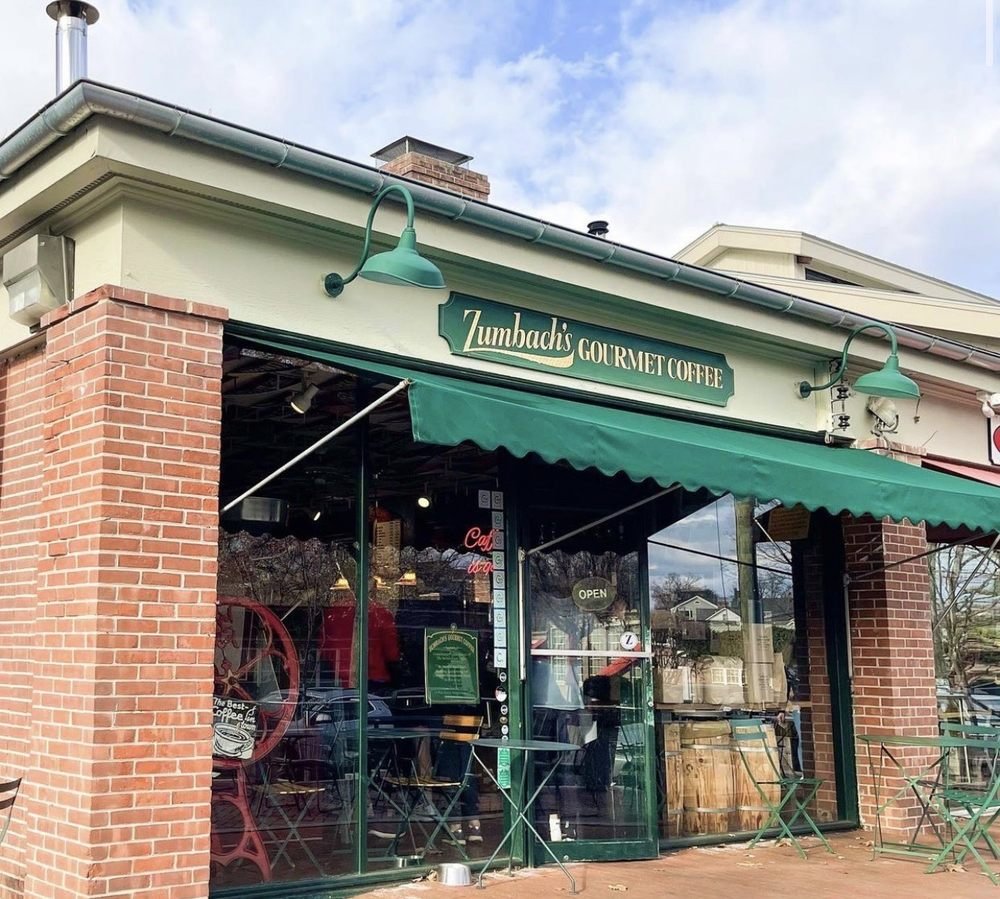
Coffee Break: Zumbach’s Gourmet Coffee

A New Canaan Day Trip Guide from NYC

A short walk from the Visitor Center (199 elm st) — about six or seven minutes, roughly 0.3 miles — brings you to Zumbach’s Gourmet Coffee at 77 Pine Street. It’s a small, classic specialty coffee shop that roasts its beans in-house daily, and it’s a comfortable spot to sit with a drip coffee or espresso and process everything you just saw.

Is the Glass House Worth the Trip?

For anyone interested in modernist design, the answer is yes — and not just for the house itself. What makes a Glass House New Canaan day trip worthwhile is seeing the full arc of Johnson’s career condensed onto one property: the disciplined, Mies-influenced rectangle of 1949 sitting a short walk from the freeform, postmodern shapes he was designing decades later. Few sites let you trace an architect’s evolving thinking so directly, structure by structure, across a single afternoon.

If you go, budget a full day — between the train ride, the tour, and time to actually sit with the building rather than rush through it, this isn’t a quick stop. But for anyone who cares about Philip Johnson Glass House architecture, it’s one of the more rewarding day trips within easy reach of New York City.

Related posts you might enjoy:

NYC 4th of July 2026: The Ultimate Guide to Macy’s Fireworks, the Times Square Ball Drop & America’s 250th Birthday Celebrations

The NYC 4th of July 2026 is shaping up to be the biggest Independence Day celebration in American history. From the first-ever summer Times Square Ball Drop to the 50th anniversary Macy’s Fireworks 2026 lighting up both the East and Hudson Rivers simultaneously, this is a once-in-250-years event you cannot miss. Here’s everything you need to know.

If there’s one place on Earth to be this summer, it’s New York City. The NYC 4th of July 2026 is not just another Independence Day — it marks the United States Semiquincentennial, the nation’s 250th birthday, and New York is throwing the biggest party in its history. Skies over Manhattan will be lit up from multiple directions, a legendary summer Ball Drop will ring in the historic midnight, and the harbor will be filled with tall ships from dozens of nations. Whether you’re already in the city or planning to travel, this is your complete guide to experiencing every unmissable moment.


NYC 4th of July 2026

Why NYC 4th of July 2026 Is Unlike Any Other

Two historic milestones collide this year:

  • America turns 250 — the Semiquincentennial (July 4, 1776 → July 4, 2026)
  • Macy’s Fireworks turns 50 — the iconic pyrotechnic tradition launched in 1976

That combination has pushed organizers to plan events at a scale that hasn’t been seen in a generation. Millions of visitors are expected to flood New York City during the week surrounding July 4th, and the city is responding with a stacked lineup of events that spans multiple days and covers land, sea, and air.


Event 1: The Historic Times Square Ball Drop — July 3, 2026

The First-Ever Summer Ball Drop for NYC 4th of July 2026

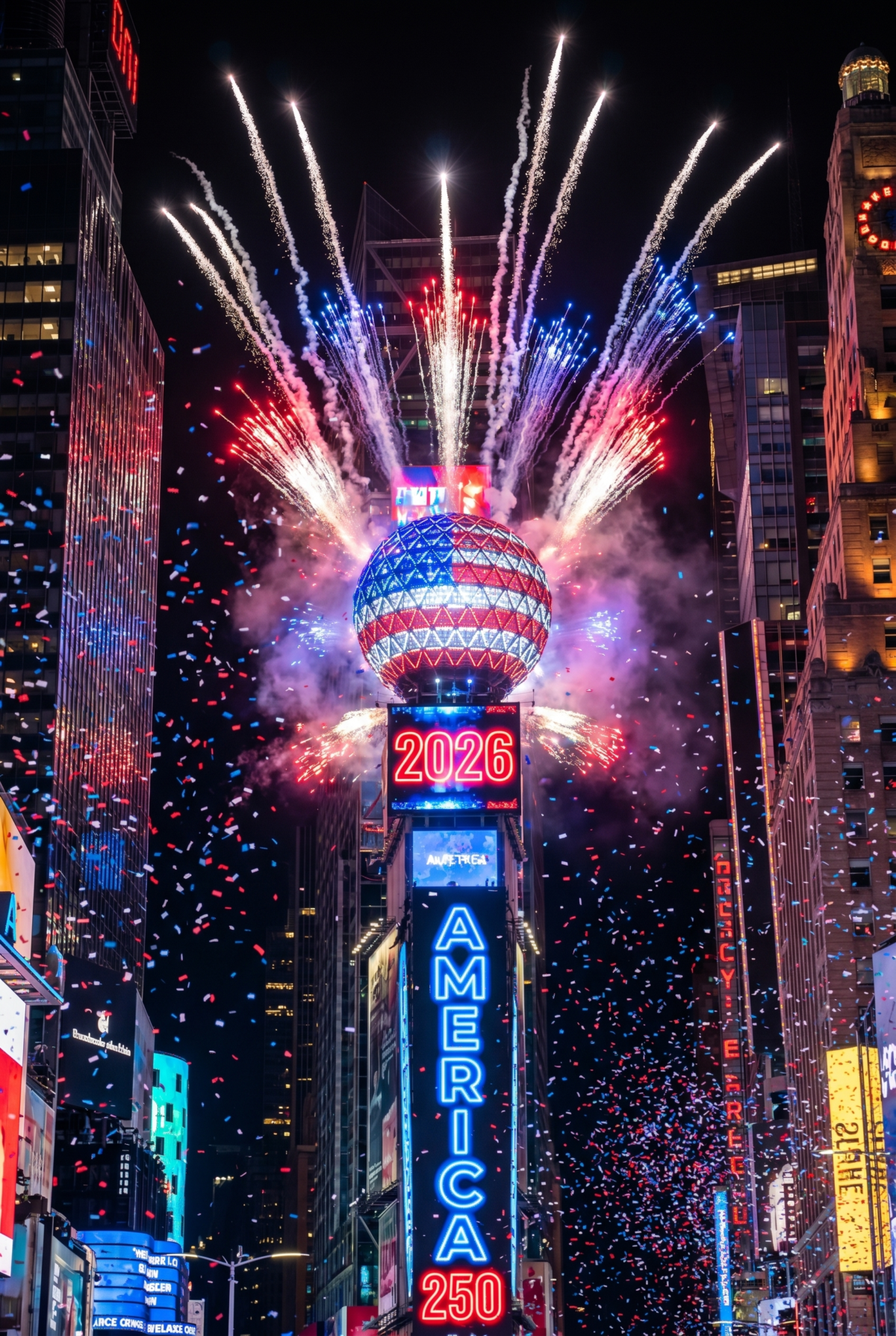
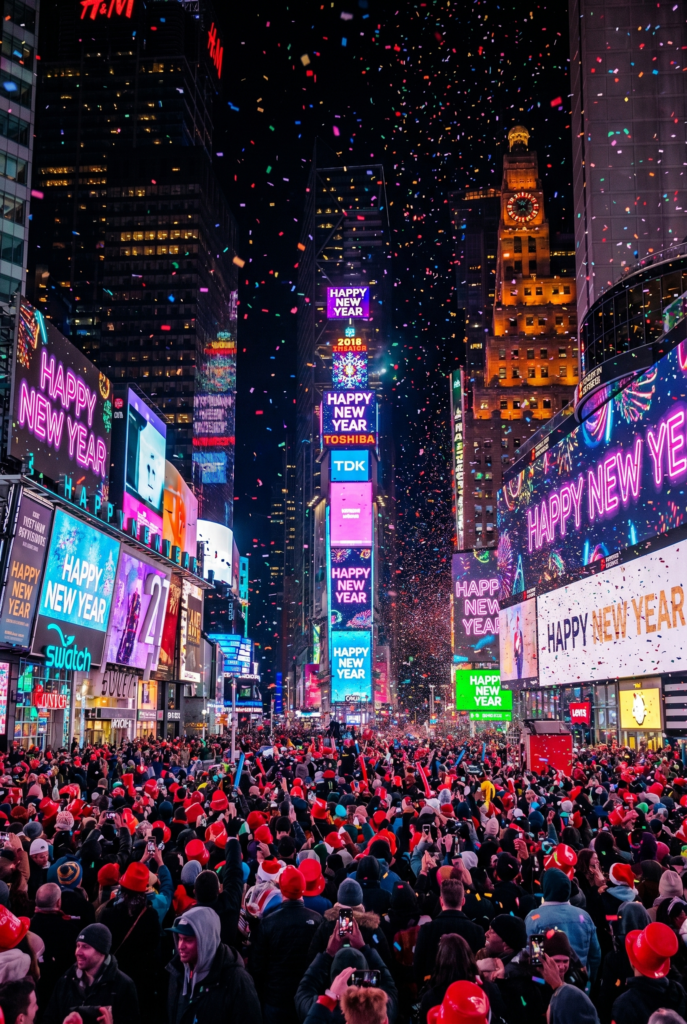
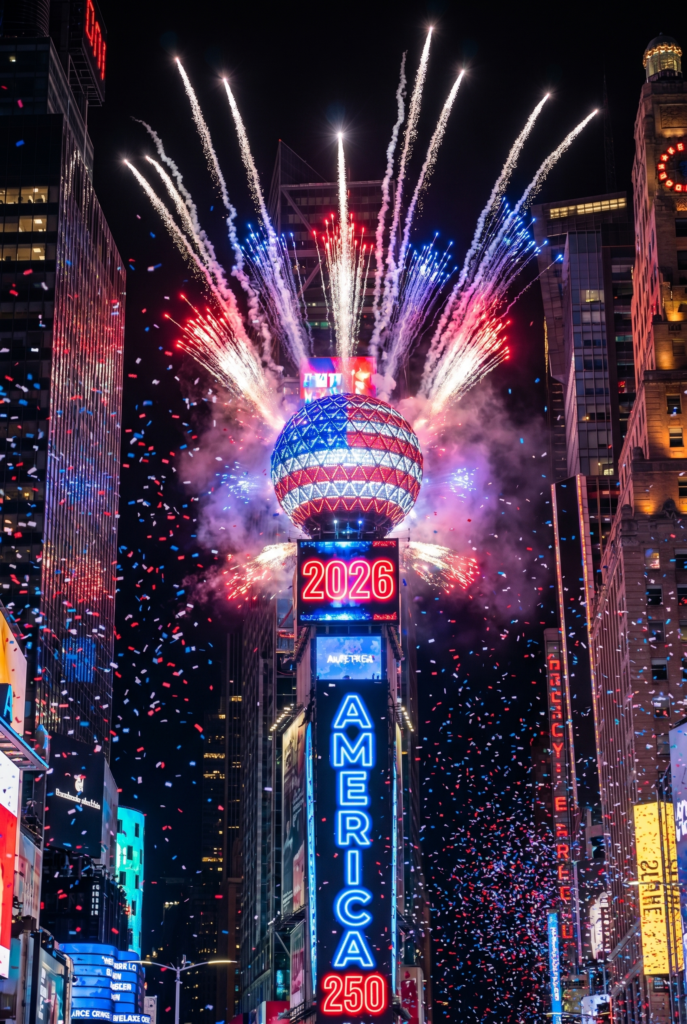
This is genuinely unprecedented. For the first time since the Times Square Ball Drop tradition began on New Year’s Eve 1907, the iconic ball atop One Times Square will descend on a night that isn’t December 31st. On the evening of Friday, July 3, 2026, the ball will drop at midnight — ringing in Independence Day and 250 years of American history in classic New York style.

The “Giving 4th” Relay: 8 Ball Drops in 24 Hours

This isn’t a one-time drop. America250 and One Times Square have announced a historic “Giving 4th” Broadcast Benefit Show that transforms the ball drop into a nationwide relay lasting nearly 24 hours — one drop for every American time zone.

Drop #New York Time (EDT)Time Zone Honored
1st Drop10:00 AMGuam & Northern Mariana Islands (Chamorro Time)
Continues throughout the dayAll continental U.S. zones
Main Drop11:59 PMEastern Time (New York Midnight)
Final DropFollowing morningAmerican Samoa

The Main Drop at 11:59 PM EDT is the centerpiece — a full production with patriotic lighting, special effects, and a confetti moment to ring in July 4th.

Watch It Live on CNN: Anderson Cooper & Andy Cohen

CNN is turning its beloved New Year’s Eve franchise into a patriotic one-off. Anderson Cooper and Andy Cohen will host Independence Eve Live with Anderson & Andy: Celebrating 250, broadcasting live from Times Square. The special airs 8 PM – 12:30 AM ET on CNN, featuring special guests described as “celebrated American icons, cultural legends, and inspiring everyday heroes.” It’s essentially the Super Bowl of patriotic broadcast television.

NYC 4th of July 2026

Best Spots to Watch the July 3 Ball Drop

  • Street-level (43rd–45th St / Broadway & 7th Ave): The Times Square Ball faces north, making the intersection of Broadway and 7th Avenue between 43rd and 45th Streets the prime ground-level viewing zone. Note that unlike New Year’s Eve, this event is primarily a TV production, so full street closures and crowd management may differ — check the Times Square Alliance website closer to the date.
  • Rooftop bars & hotel lounges: For a comfortable summer night experience, pre-book a table at rooftops like R Lounge at the Renaissance or The Knickerbocker Hotel’s rooftop — both offer direct sightlines to One Times Square. These spots fill up weeks in advance for major events.
  • Watch from home: CNN’s live stream means you can watch the full production anywhere in the world.

Event 2: Macy’s Fireworks 2026 — July 4, 2026

A Double Anniversary: 50 Years of Macy’s Fireworks 2026

Macy’s Fireworks 2026 is the crown jewel of the NYC 4th of July 2026 celebrations. This year marks the 50th anniversary of the show, which debuted during America’s Bicentennial in 1976. To honor both milestones — the nation’s 250th birthday and the show’s own half-century — Macy’s is going bigger than it ever has.

The Big Change: East River AND Hudson River

In previous years, the show has alternated between the East River and the Hudson River. For 2026, for the first time ever, fireworks will be launched from both simultaneously:

  • East River side: Barges near the Seaport District and the iconic Brooklyn Bridge, with over 60,000 pyrotechnic effects filling the sky
  • Hudson River side: Lower Hudson River in collaboration with Jersey City, visible from the west side of Manhattan and the New Jersey waterfront

This means no matter which side of Manhattan you’re on, you’ll have a show overhead.

Schedule for Macy’s Fireworks 2026

TimeWhat’s Happening
~8:00 PMPre-show music performances begin (broadcast on NBC & Peacock)
Before 9:25 PMBlue Angels aerial show over New York Harbor
~9:25 PMMacy’s Fireworks 2026 launch — approx. 25–30 minutes

The broadcast airs on NBC and Peacock from 8–10 PM ET, with a Spanish-language simulcast on Telemundo.

Best Viewing Spots for Macy’s Fireworks 2026

East River (Brooklyn Bridge / Seaport area):

  • Brooklyn Bridge Park, DUMBO (Free — Ticket Required): The most sought-after free spot. 100,000 tickets will be released on July 1st at 8:30 AM — set an alarm, they disappear within minutes.
  • Seaport District — Pier 16 & 17 (Free — Ticket Required): Front-row views directly facing the launch barges.
  • Brooklyn Heights Promenade (Free — No Ticket): The photographer’s classic for a clean Manhattan skyline shot with fireworks above.
  • Long Island City (LIC) Waterfront, Queens: A less crowded alternative with a wide-open view across the river.
  • Empire State Building (VIP Ticket): For a truly aerial perspective, the 86th or 102nd floor observation decks offer a bird’s-eye view of the entire show.

Hudson River (West Side / Jersey side):

  • Hudson River Park, Manhattan (Chelsea Piers and south): The west side waterfront offers direct views of the Hudson River launches.
  • Jersey City Waterfront (Exchange Place, Hoboken): Arguably the best Hudson River vantage point, with Manhattan’s skyline as a backdrop behind the fireworks.
  • Riverside Park: Upper West Siders will also have visibility from this park, though the primary launches are concentrated in Lower Manhattan.

Pro tip: Arrive by 3–4 PM to secure a good spot at free public viewing areas. NYPD will not allow entry with backpacks, lawn chairs, or large bags — plan accordingly.


Scrollable


Event 3: Sail4th 250 — The Largest Maritime Gathering in American History

The fireworks and the ball drop are only part of the story. The centerpiece of the entire week is Sail4th 250, running July 3–8 in the Port of New York and New Jersey. This is being called the largest peacetime maritime gathering in U.S. history.

On the morning of July 4th, 48 tall ships representing 20 foreign nations — including the Italian Navy’s Amerigo Vespucci and Cunard’s iconic Queen Mary 2 — will sail in formation under the Verrazano-Narrows Bridge, past the Statue of Liberty, and up the Hudson River. Alongside them, more than 50 U.S. and allied naval vessels will take part in only the 7th International Naval Review in American history.

Key Sail4th 250 highlights:

  • International Aerial Review: Over 100 allied and U.S. aircraft led by the U.S. Navy Blue Angels will conduct a flyover in formation above the harbor
  • Parade of Tall Ships: Ships from over 30 countries sailing past Lady Liberty in a scene straight out of the 18th century
  • Free public ship tours: July 5–8, you can board international tall ships docked across Manhattan, Brooklyn, Staten Island, and New Jersey — no passport required (though you technically step onto foreign soil)
  • July 6 — “Homecoming of Heroes” Ticker Tape Parade: A ticker tape parade down the Canyon of Heroes honoring post-9/11 combat veterans and first responders

Best spots to watch the Parade of Sail:

  • Governors Island: Exceptional harbor views as the ships pass by, with food and activities on the island
  • Riverside Park (Upper West Side): A 5-minute walk from several Midtown hotels; ships process up the Hudson River directly in front
  • Battery Park and the Staten Island Ferry: Unobstructed harbor views near the Statue of Liberty

Bonus: America’s Block Party in the Sky — July 4–5

Once the fireworks are over, the celebration continues at One Times Square’s 19th-floor Skywalk — the same building where the ball drops. On July 4th and 5th, the America’s Block Party in the Sky is a free, ticketed public event with 360-degree views of the Manhattan skyline.

On July 5th, there’s a special activity that’s especially meaningful for families: visitors can write personal messages on the confetti that will be released during the 2027 New Year’s Eve Ball Drop. Your words will literally rain down over Times Square on the night the world rings in the new year — a memory that genuinely lasts a lifetime for kids.


Full Event Calendar at a Glance

DateEventLocation
July 3Sail4th 250 begins; Times Square Ball Drop relay begins (10 AM)Times Square / Harbor
July 3, 11:59 PM⭐ Main Times Square Ball Drop (CNN live)Times Square
July 4 (Morning)Blue Angels Air Show + Parade of Tall ShipsNew York Harbor
July 4, ~9:25 PM⭐ Macy’s Fireworks 2026East & Hudson Rivers
July 4–5America’s Block Party in the SkyOne Times Square, 19th Floor
July 5–8Free public tours of tall shipsManhattan, Brooklyn, NJ
July 6“Homecoming of Heroes” Ticker Tape ParadeCanyon of Heroes, Manhattan

Insider Tips for NYC 4th of July 2026

1. Book accommodations now. New York City is expecting millions of visitors for a 6-day window around July 4th — hotels in Midtown and Lower Manhattan are filling fast. Midtown East hotels (near Times Square) and waterfront properties in Brooklyn and Jersey City are especially in demand.

2. Get fireworks tickets the moment they drop. Brooklyn Bridge Park’s 100,000 free tickets release on July 1st at 8:30 AM. Have the ticketing page open and ready.

3. Consider a dinner cruise. If you want to avoid the crowds entirely and see both the tall ships and the fireworks from the water, harbor dinner cruises for July 4th offer unbeatable sightlines — but they book out months in advance.

4. Dress smart. It’s a New York summer — expect temperatures potentially in the mid-to-upper 90s°F. Sunscreen, water, and light breathable clothing are essential for a day outdoors on the waterfront.

5. Plan your transit. Subway lines near the waterfront will be extremely congested after the fireworks. Build extra time into your exit plan, or consider walking along the waterfront before hailing a ride.

6. Watch the broadcast. If the crowds feel overwhelming, NBC and CNN offer world-class coverage of every major event. You can watch Macy’s Fireworks 2026 on NBC/Peacock and the Ball Drop on CNN from anywhere.


Final Thoughts

The NYC 4th of July 2026 is a once-in-a-generation event. The convergence of America’s 250th birthday, the 50th anniversary of Macy’s Fireworks 2026, and the largest maritime gathering in peacetime history makes this a week unlike anything most living Americans have ever witnessed. Whether you’re lining the waterfront for the tall ships, counting down from Times Square, or watching the dual-river fireworks display light up the Manhattan skyline — this is history, and New York City is exactly where you want to be.

Start planning now. This one won’t come around again for another 250 years.


Related posts you might enjoy:

Inside NYC’s Favorite Korean Grocery Store: The Ultimate H-Mart NYC Survival Guide & Must-Buy K-Food Items

H-Mart NYC isn’t just a grocery store — it’s a cultural phenomenon. Whether you’re a New York local, a long-term resident, or a slow traveler exploring the city like an insider, this guide covers everything you need to know: the best K-food must-buy items, money-saving shopping tips, and what to eat at the legendary food court.

If you’ve spent any time in New York and stumbled into the buzzing aisles of H-Mart NYC on West 32nd Street in Koreatown, you already know: this place is something else entirely. It’s part grocery store, part cultural time capsule, part TikTok rabbit hole made real. And if you haven’t been yet — consider this your official invitation.

H-Mart NYC

New York is notoriously expensive. A sit-down dinner in Midtown can set you back $40 before a single drink. But inside H-Mart NYC, you can fill a basket with restaurant-quality ingredients, ready-to-eat banchan (Korean side dishes), and enough K-food must-buy items to last a week — all without breaking the bank. That’s not a travel hack. That’s just how New Yorkers who know, actually live.

This guide is for the slow traveler, the curious foodie, the budget-conscious transplant, and anyone who wants to shop and eat the way locals actually do.


What Is H-Mart — And Why Does All of NYC Seem Obsessed With It?

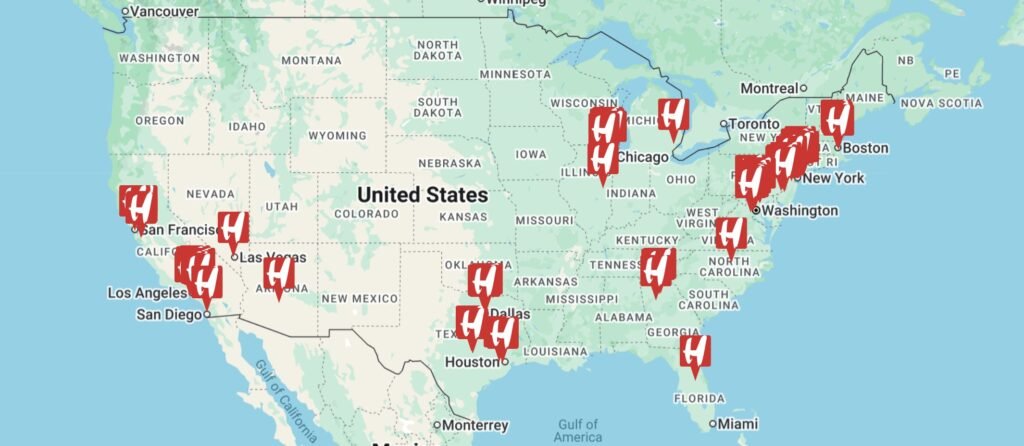
H-Mart is the largest U.S.-based grocery chain specializing in Asian products, and it traces its roots all the way back to 1982 — when founder Il Yeon Kwon, a South Korean immigrant, opened a small corner grocery store in Woodside, Queens. That humble beginning has since grown into a nationwide institution. As of 2025, there are more than 97 H-Mart stores across the United States.

H-Mart NYC

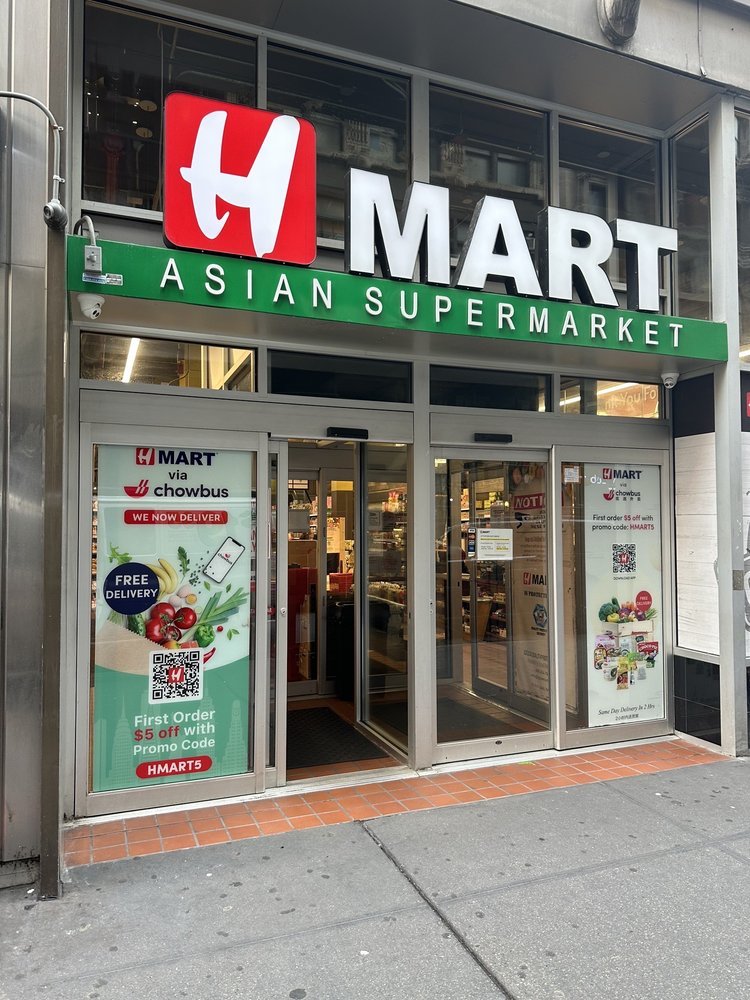
But numbers don’t capture what H-Mart feels like, especially in New York. The flagship Manhattan location at 38 W 32nd St (the heart of Koreatown) has become ground zero for the city’s growing Korean food obsession. Reviewers consistently call it a “super H-Mart” with a huge selection of Asian products — from fresh produce and seafood to frozen goods, candies, snacks, and a prepared foods area with sushi, dumplings, rice bowls, fried chicken, and seaweed salad.

And then there’s the second location at 210 Amsterdam Avenue on the Upper West Side, which opened to an already-buzzing crowd in May 2024, greeting shoppers with ingredients for staple Korean dishes like japchae and beef bulgogi, as well as pre-made classics like kimchi, kimbap, and tteokbokki.

H-Mart is no longer a niche ethnic grocery. It’s a legitimate New York institution.


H-Mart NYC and the Rise of K-Food Culture

To understand why H-Mart NYC is packed every single day, you need to understand the bigger cultural wave it’s riding.

A 2024 report from the Korea Agro-Fisheries & Food Trade Corporation noted a 30% increase in Korean restaurant openings in New York City since 2020. Delivery platforms like DoorDash reported a 25% spike in Korean food orders during lunch hours compared to two years prior. Korean cuisine is no longer a trend — it’s woven into the fabric of how New Yorkers eat.

H-Mart NYC

And H-Mart sits right at the center of this shift. Fueled by K-pop, K-drama, and a generation of food creators on TikTok, Korean ingredients and snacks have crossed over from niche to mainstream. South Korea’s food exports hit a record $13.6 billion in 2025, and many of those products — Bibigo dumplings, Buldak ramen, gochujang — are now stocked at H-Mart locations across NYC.

The store doesn’t just sell food. It sells a way of eating.


H-Mart NYC K-Food Must-Buy Items: Your Complete Shopping List

Whether it’s your first visit or your fiftieth, here are the K-food must-buy items that New York insiders — and now the entire internet — swear by.

🍱 1. Frozen Kimbap (The One That Started a Nationwide Craze)

If you’ve been on TikTok in the last two years, you’ve seen it. The frozen kimbap moment began when South Korean food startup Allgot Co. placed frozen kimbap on Trader Joe’s shelves, and it sold out within weeks — a Korean-American food creator’s TikTok review of the product garnered over 11 million views, causing a nationwide shortage.

The spillover effect? Massive traffic to H-Mart. Marketing experts noted it was “great news for a more authentic Korean experience through a Korean grocer like H-Mart to really benefit off of something that Trader Joe’s did for them.”

H-Mart NYC carries multiple varieties — spicy squid, vegetable, fried tofu and burdock, and kimchi tuna mayo. Just snip a corner, microwave for 2–3 minutes, and you have a meal for under $5. It’s the ultimate NYC grab-and-go lunch.

Pro Tip: Stock up when you see them. Flavors rotate and popular varieties sell out fast, especially on weekends.


🥟 2. Bibigo Mandu (Dumplings) and Ready Rice (Hatban)

Bibigo is the K-food brand that’s gone truly global — CJ CheilJedang’s Bibigo brand is now available in over 30 countries, and Harvard Business School added a CJ CheilJedang case study to its curriculum in 2024, examining how Bibigo built global distribution from a Korean base.

At H-Mart NYC, you’ll find the full Bibigo lineup: pork and vegetable mandu, kimchi mandu, beef bulgogi dumplings, and more. Pan-fry them in 10 minutes and you have a dinner that rivals anything in a sit-down restaurant — for a fraction of the price.

Pair with Hatban (햇반), Korea’s iconic microwavable cooked rice. 90 seconds in the microwave, and you have perfectly cooked white, brown, or multi-grain rice. NYC apartments with tiny kitchens were practically made for this product.


🍜 3. Instant Ramen (Far Beyond Shin Ramyun)

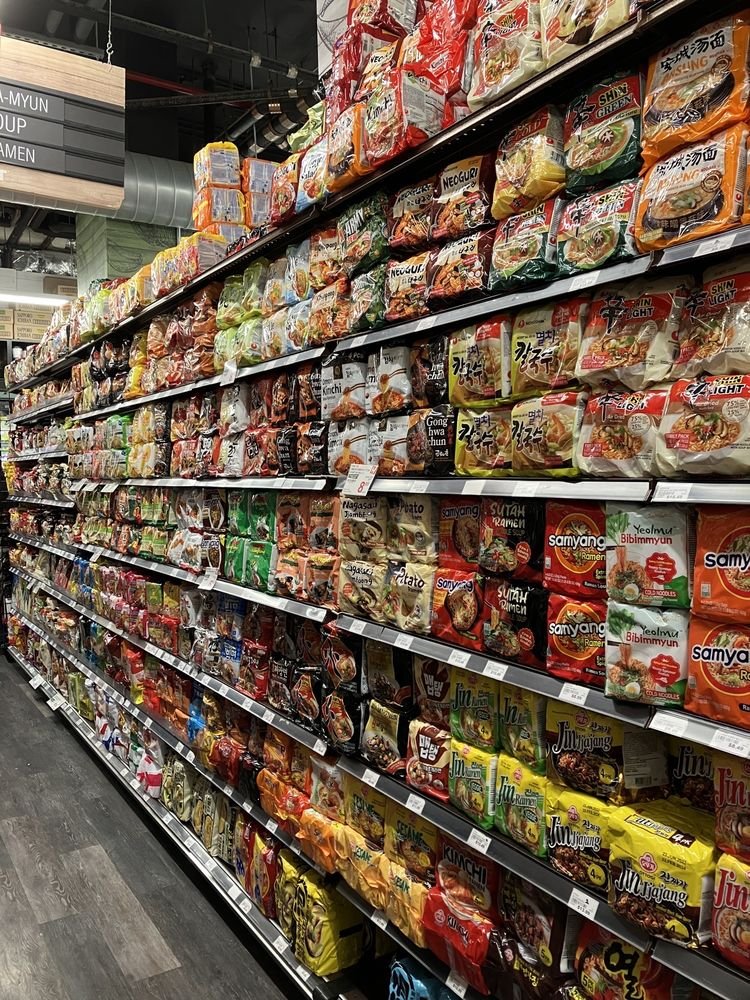
H-Mart is the perfect one-stop shop to grab instant ramen — everything from the spicy Korean brands with carbonara and kimchi flavors to the classic Japanese brands like Nissin and Maruchan, alongside extra ingredients to level up your bowl.

The classics are Shin Ramyun (신라면) and Buldak (불닭볶음면), but don’t sleep on the newer flavors: Carbo Buldak, Rose Tteokbokki Ramen, and Jjamppong (seafood spicy noodles). Budget-friendly, deeply satisfying, and endlessly customizable.


🧂 4. Banchan Corner (The Small-Kitchen Lifesaver)

This is the section that makes H-Mart truly special for NYC residents.

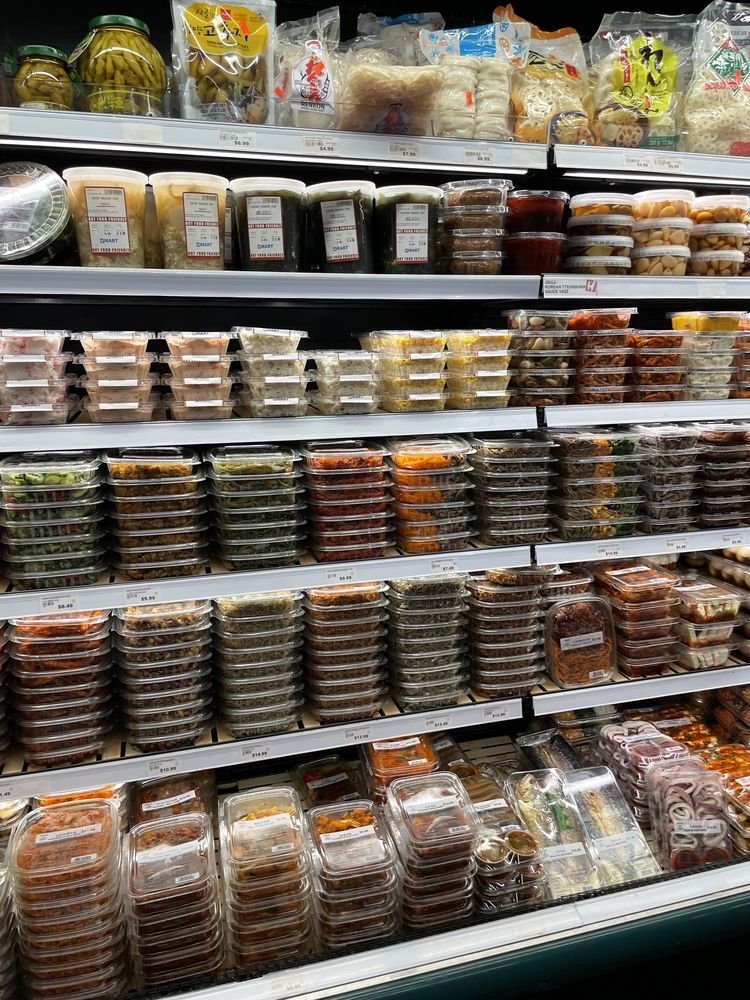
The banchan (반찬) counter stocks ready-to-eat Korean side dishes: kimchi, spinach namul, japchae, fish cake (eomuk), kongjorim (braised black beans), and marinated meats like bulgogi and jeyuk (spicy pork). For anyone living in a Manhattan studio with a two-burner stove, this is a revelation.

Scoop a few containers, grab your Hatban, and you have a proper Korean meal — assembled in minutes. It’s exactly the kind of slow, intentional eating that makes living in a fast city feel manageable.


🍟 5. K-Snacks: The Items People Buy by the Case

Walk the snack aisle at H-Mart NYC and you’ll understand immediately why locals come back weekly.

The K-food must-buy items in this category include:

  • Turtle Chips (꼬북칩) — a layered, crunchy corn snack in flavors like sweet corn, butter, and honey butter. These disappear fast.
  • Milkis — Korea’s beloved milk-and-soda carbonated drink, often described as a creamy, sweet alternative to soda. Non-Koreans discover it and never go back.
  • Pepero — chocolate-dipped biscuit sticks, perfect as a travel gift or desk snack.
  • Calbee Shrimp Chips — H-Mart is filled to the brim with Asian snacks, and shrimp chips are a standout: light, airy, and delivering a satisfying crunch.
  • **Korean Seaweed Snack Packs (김) ** — roasted, lightly salted, and dangerously addictive. These are the ones New Yorkers buy by the multi-pack.

Insider Move: The snack section near the register often has discounted multipacks. Stock up for your pantry or grab a few as souvenirs — they’re far better than anything from an airport gift shop.


🫙 6. Pantry Essentials: The Korean Kitchen Foundation

If you plan to cook even a few Korean recipes during your time in NYC, these are the H-Mart NYC pantry staples worth picking up:

  • Roasted sesame oil — a finishing oil with a deep, nutty flavor, essential for stir-fries, noodle bowls, and marinades.
  • Gochugaru — the iconic Korean red chili powder, the backbone of kimchi, stews, and marinades.
  • Gochujang — a fermented red chili paste with a deep, complex heat. One tub lasts months.
  • Doenjang — Korean fermented soybean paste. Think of it as a more robust, umami-forward miso.
  • Soy sauce (Jin Ganjang) — the aged, Korean-style soy sauce is noticeably different from standard soy sauce. Once you try it, you’ll buy it every time.

How to Save Money Shopping at H-Mart NYC: Insider Tips

New York is an expensive city, but H-Mart is one of the few places where shopping smart genuinely pays off. Here’s how to maximize every visit.

✅ Check the Weekly Sale Flyer Before You Go

H-Mart runs rotating weekly specials — often deeply discounted on proteins, produce, and snack multipacks. Check hmart.com or follow @hmartnyc on Instagram before heading out. The savings on items like marinated short ribs (galbi) or whole fish can be significant.

✅ Visit on Weekday Mornings

This is the single best tip for H-Mart NYC shoppers. Weekend afternoons are crowded, and the ready-to-eat (grab-and-go) banchan and prepared foods section gets picked over quickly. Weekday mornings — especially Tuesday through Thursday — offer the freshest selection, shorter lines, and a more relaxed experience.

✅ Don’t Overlook the Produce Section

H-Mart has some of the best produce for a grocery chain in the United States, sourcing from the country of origin while maintaining high quality control and a quick turnover rate. The produce section is also a haven for items harder to find in standard American grocery stores — jackfruit, bok choy, shiso leaf, persimmons.

Asian greens, fresh tofu, and daikon radish are almost always cheaper here than at Whole Foods or comparable NYC grocers.

✅ Sign Up for H-Mart Rewards

The rewards program may not be flashy, but it accumulates discounts over time — especially if you’re a regular shopper. It’s worth the two-minute signup at the register.


The H-Mart NYC Food Hall: Eat Before (or After) You Shop

The H-Mart NYC Koreatown location isn’t just a grocery store — it’s a full experience, especially once you head upstairs.

The Ktown H-Mart now features a 2nd floor food court that includes a Bibimbap bar where you can customize your own rice bowls with proteins like bulgogi, spicy pork, teriyaki chicken, or grilled salmon, along with a variety of toppings and sauces. Bowls start around $10.99 — a genuinely fair price for a filling, customizable meal in Manhattan.

Beyond the bibimbap bar, the food court offers:

  • Tteokbokki — spicy rice cakes, served for around $5. They have a kick.
  • Soups and stews — including doenjang jjigae and kimchi jjigae.
  • Korean fried chicken — crispy, saucy, and deeply satisfying.
  • A sushi station — freshly rolled, reasonably priced for a quick lunch.

And don’t miss the bakery section, where you’ll find Korean-style breads: soft milk bread (soboro), red bean buns (danpatppang), and cream-filled pastries from brands like Paris Baguette or Tous Les Jours. Grab one with a coffee after your shop, find a seat upstairs, and let yourself settle into one of those rare unhurried moments that New York occasionally allows.


H-Mart NYC: A Cultural Phenomenon, Not Just a Store

It’s worth pausing to acknowledge what H-Mart actually represents in the context of New York City.

For many Asian Americans, H-Mart has stood not only as a gold standard for Asian supermarkets but as a cultural hub for finding food, ingredients, and cookware that connect people with their heritage. It’s the place where first-generation families shop for the ingredients they grew up with, where second-generation kids bring their non-Korean friends for the first time, and where curious New Yorkers discover that Korean food is far more than just Korean BBQ.

The frozen kimbap craze, the Bibigo takeover of mainstream supermarkets, the line of non-Korean New Yorkers debating which ramen brand is superior in the instant noodle aisle — this is what quiet globalization looks like: Korean food showing up in freezer aisles, lunchboxes, and weeknight meal plans, becoming normal grocery-store food for a much wider public.

H-Mart NYC is where that shift is most visible, most alive, and most delicious.


NYC Souvenir Idea: Best Korean Snacks to Bring Home

Heading back after a trip to New York? Skip the I ♥ NY magnets. Here are the K-food must-buy items that make genuinely great gifts: Snack Why It Travels Well Turtle Chips (꼬북칩) Sealed bag, unique flavor, universally loved Pepero Box Classic gift in Korea, surprisingly unfamiliar abroad Seaweed Snack Multi-Pack Lightweight, healthy, highly giftable Milkis (canned) Novelty drink that’s easy to pack Gochujang Tube Airline-safe if under 100ml, genuinely useful in any kitchen Buldak Ramen (set) The international “dare” snack that everyone wants to try


H-Mart NYC: Key Information

Detail Info Koreatown Location 38 W 32nd St, New York, NY 10001 Koreatown Hours Mon–Sun: 8:00 AM – 11:00 PM Upper West Side Location 210 Amsterdam Ave (between 69th & 70th St) Nearest Subway (K-Town) 2-min walk from 34th St – Herald Sq Station Online/Delivery hmartdelivery.com Weekly Sales hmart.com


Final Thoughts: Shopping Like a New Yorker

The beauty of H-Mart NYC — and the reason it fits so perfectly into the slow travel philosophy — is that it asks you to slow down. To read the labels. To ask the person next to you what they do with that cut of meat. To try the sample at the banchan counter and decide you need three containers instead of one.

New York moves fast. But a weekday morning at H-Mart, with a red bean bun in hand and a basket full of K-food must-buy items, is one of the more quietly pleasurable ways to feel like you actually live here.


📍 Find your nearest H-Mart NYC location: hmart.com/store-location
🛒 Check this week’s H-Mart sales and specials: hmart.com/weekly-sale


Related posts you might enjoy:

Mother’s Day NYC: The Best Family-Friendly Museums and Rooftop Parks in 2026

May in New York City is pure magic — and Mother’s Day (May 10, 2026) is the perfect excuse to explore the city’s finest museums and outdoor spaces with the whole family. Here’s your complete guide to the best family-friendly museums and rooftop parks in NYC this spring.

May is one of New York City’s most luminous months — the trees are in full bloom, the days stretch longer, and the city hums with a particular kind of energy that only comes with spring. And right in the heart of it all: Mother’s Day, falling on Sunday, May 10, 2026. Whether you’re a local family looking for something new or visiting the city for the occasion, NYC offers an extraordinary mix of culture, outdoor beauty, and shared moments to make the day truly special.

This guide covers the best Mother’s Day NYC family activities — from world-class museum programs designed with kids in mind to open-air rooftop parks where the whole family can breathe, laugh, and take in some of the most iconic views on the planet. Bookmark it, share it, and start planning now — the best spots fill up fast.


🏛️ Family-Friendly Museums in NYC for Mother’s Day

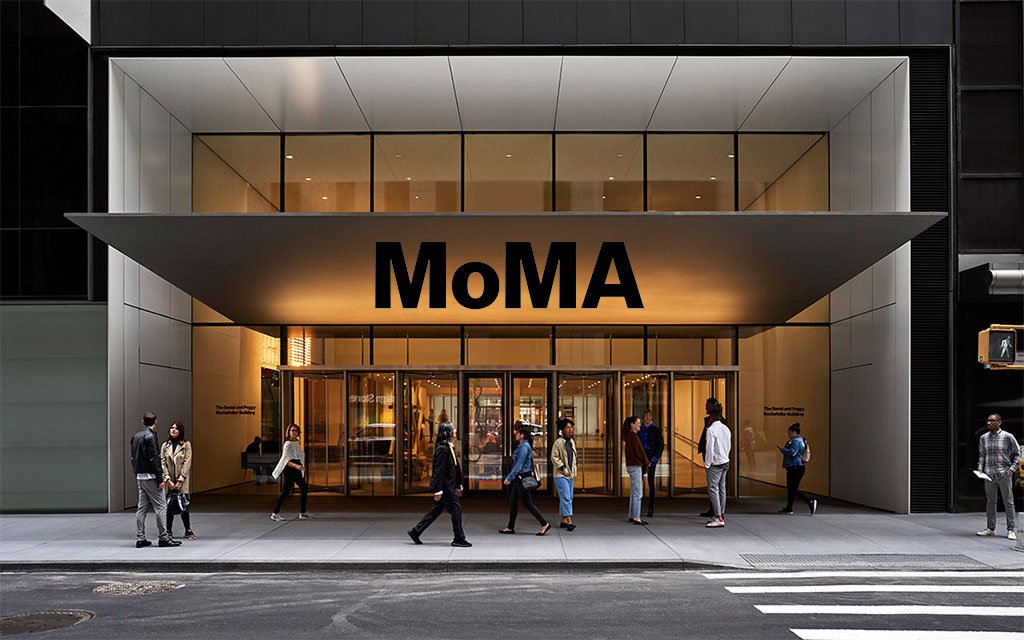
1. MoMA (Museum of Modern Art) — Where Art Meets Curiosity for All Ages

Mother's Day NYC

When it comes to family-friendly museums in NYC, MoMA consistently leads the pack. The museum’s Heyman Family Programs are specifically designed so that children can engage with modern and contemporary art in ways that feel intuitive, playful, and genuinely exciting — not intimidating.

Kids 16 and under enjoy free admission year-round, and on select dates the museum hosts Family Gallery Talks, hands-on activity guides, and in-person creative workshops that walk young visitors through the galleries with purpose. During peak spring weekends, keep an eye on MoMA’s calendar for educator-led gallery tours and drop-in creative labs — both perennial favorites with NYC families.
Best For: Families with kids aged 5 and up who love making things and exploring ideas visually.

Pro Tip: After your gallery time, head down to the Abby Aldrich Rockefeller Sculpture Garden on the ground floor. It’s one of the great secret exhales in Manhattan — open sky, modernist sculptures, and room for kids to wander freely while parents decompress. It’s also one of the best photo spots in Midtown. The garden is included with museum admission.

📍 11 W 53rd St, Midtown Manhattan | moma.org/visit/families


Recommended item you might want:


2. AMNH & The Gilder Center — A Day of Discovery on the Upper West Side

Mother's Day NYC

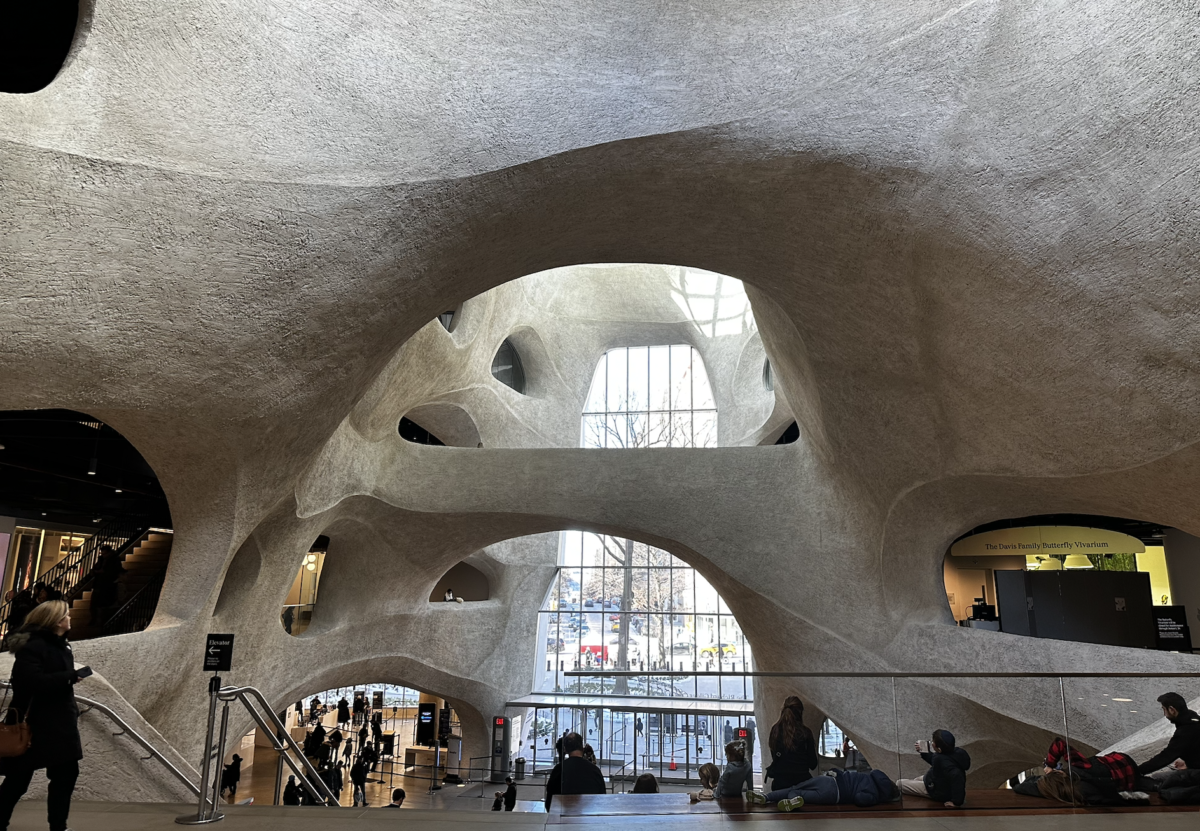
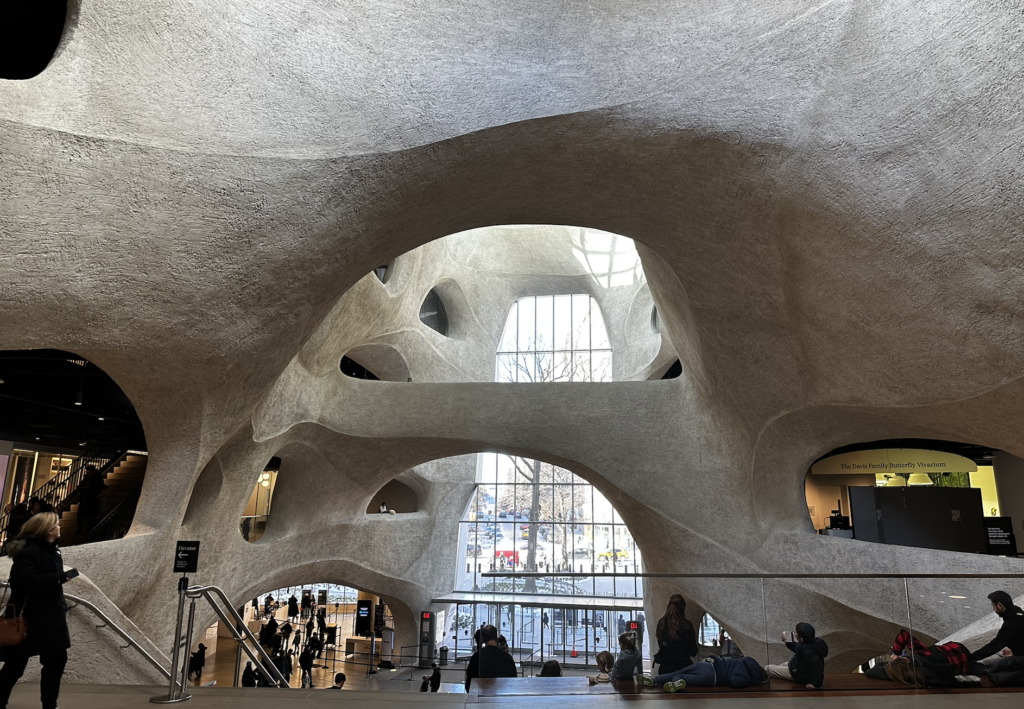
For science-loving families, the American Museum of Natural History offers an almost overwhelming richness — and since the opening of the Richard Gilder Center for Science, Education, and Innovation, it has become one of the most exciting destinations for kids in the entire country.

The Gilder Center is a stunning 230,000-square-foot expansion designed by Studio Gang, with a five-story atrium inspired by canyons of the American Southwest. It adds more than 30 new connections to the museum’s existing buildings, and houses some of the most hands-on, family-forward experiences in New York.

Here’s what to prioritize with kids:

Mother's Day NYC
butterfly vivarium

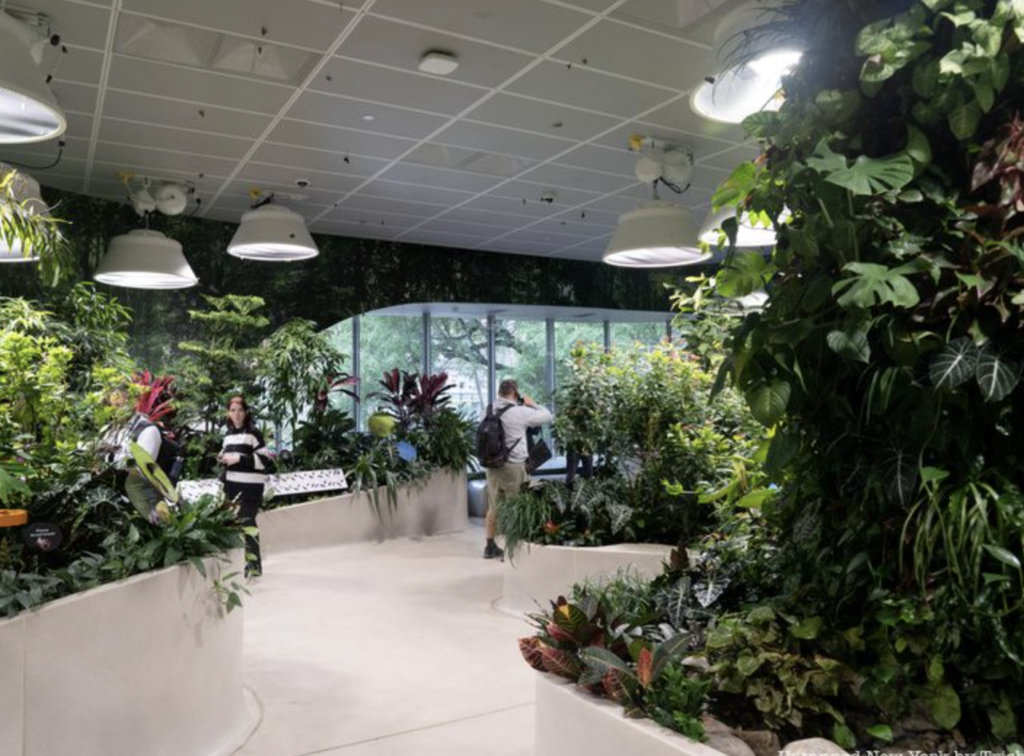
Davis Family Butterfly Vivarium — A 2,500-square-foot tropical micro-climate on the second floor where up to 1,000 free-flying butterflies from 80 different species flutter freely among lush vegetation. There’s a pupae incubator where you can watch chrysalises split and adult butterflies emerge in real time. Kids can use magnifying glasses at the feeding dishes for a close-up view. It’s warm (about 80°F), humid, and genuinely magical — especially in May. Note: an additional timed ticket is required beyond general admission, and spots sell out, so book in advance.

Susan and Peter J. Solomon Family Insectarium — On the ground floor, this 5,000-square-foot space brings visitors face-to-face with 18 live insect species, including leafcutter ants carrying leaves across a skybridge. Insectarium access is included with general museum admission.

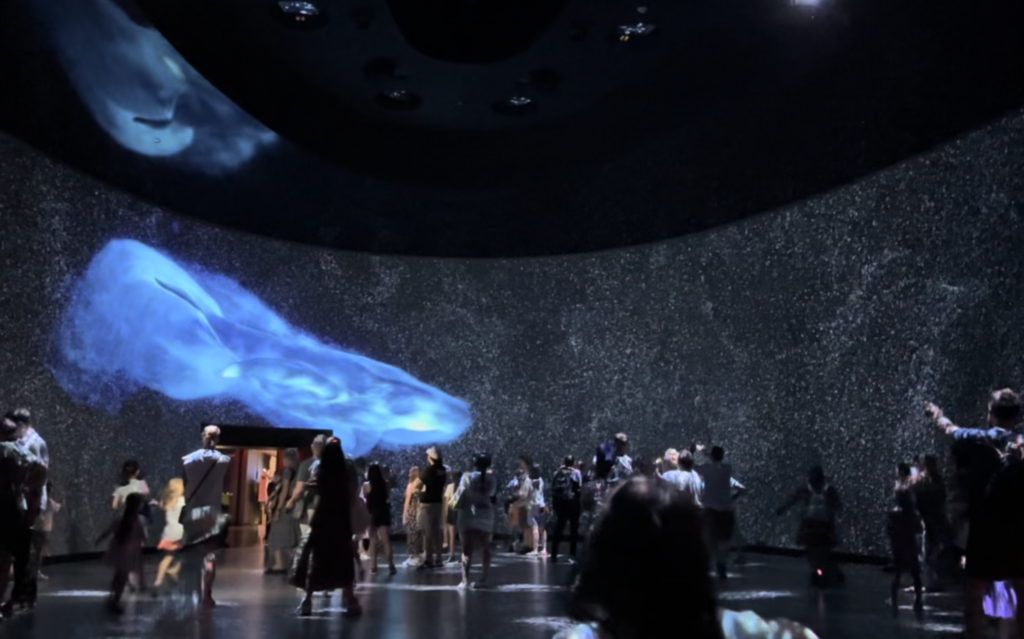
Invisible Worlds

Invisible Worlds Immersive Experience — A 12-minute, 360-degree immersive journey through the connections that link all life on Earth, from rainforest canopies to the human brain. A timed ticket is required in addition to general admission.

Best For: Families with curious kids of all ages — toddlers through teens will find something riveting here.

Pro Tip: NY, NJ, and CT residents can purchase general admission on a pay-what-you-wish basis, though ticketed exhibitions (Butterfly Vivarium, Invisible Worlds) still require purchased timed tickets. Book everything online well ahead of Mother’s Day weekend.

📍 Central Park West at 79th St, Upper West Side | amnh.org


🌿 Family-Friendly Rooftop Parks in NYC for Mother’s Day

New York’s rooftops aren’t just for cocktails and skyline selfies. The city has invested meaningfully in open, public green spaces with panoramic views — and in spring, they are some of the finest places to simply be. Here are the top picks for families.


3. Pier 57 Sky Park — NYC’s Largest Rooftop Park

This is the crown jewel of Mother’s Day NYC family activities that most tourists haven’t discovered yet. Opened in spring 2022, the Pier 57 Sky Park spans nearly two acres of rooftop parkland above the historic Chelsea waterfront — making it the largest public rooftop park in New York City.


Recommended item you might need for a picnic:

  • ATTRACTIVE DESIGN – Our sophisticated and attractive outdoor blanket is tartan & creative stripe design is fashion forwa…
  • WATERPROOF & DURABLE – This picnic blanket is constructed with a waterproof PEVA backing in order to keep out moisture, …
  • USE IT ANYWHERE – Simply fold up this picnic mat and use its handy strap to conveniently carry it over your shoulder and…

Designed by landscape firm !melk, the park offers sweeping panoramic views of the Hudson River, Lower Manhattan, the New Jersey waterfront, and a perfect vantage point over Little Island, the neighboring floating park designed by Heatherwick Studio (whose unusual tulip-stem architecture is best appreciated from above). Open grass lawns give kids room to run freely, while bleacher seating makes it easy for the whole family to settle in for a picnic or a front-row Hudson sunset.

The park is completely free and open to the public daily from 6 AM to 1 AM.

Downstairs, Market 57 — curated by the James Beard Foundation — solves the family lunch problem elegantly: 15+ independent vendors covering everything from dim sum (Nom Wah) to Vietnamese, Thai, Japanese, and more. There’s also a unique Oda sound installation in the indoor “Living Room” that streams live audio from a Costa Rican rainforest, including a dawn chorus from the Macaw Sanctuary. It’s a small sensory surprise that kids absolutely love.

Best For: All ages; especially great for families with toddlers and young children who need open space to run.

Pro Tip: Arrive around 5:30–6 PM for the golden hour light on the Hudson. The sunset views from the rooftop are genuinely spectacular and completely free — one of the most romantic and relaxed ways to end Mother’s Day.

📍 25 11th Ave (at W 15th St), Chelsea | pier57nyc.com/rooftop


4. Javits Center Rooftop Orchard & Farm — Urban Agriculture Meets Family Wonder

One of Manhattan’s most unexpected and underrated outdoor spaces sits on top of the Jacob K. Javits Convention Center on the Far West Side. The Javits Center’s rooftop farm and orchard is a genuine working green space — part pollinator habitat, part urban garden — covering more than 6.75 acres atop the convention center.


Recommended item you might want:

  • AMERICAS #1 DIGITAL FRAME: Join 4 million connected Americans through moments that matter. Featured by Rolling Stone, Op…
  • EFFORTLESS SETUP WITHIN SECONDS: Download the Nixplay app, plug in your frame, and follow simple on-screen steps—no tech…
  • A GIFT STRAIGHT FROM THE HEART: Preload photos, videos, and a personalized message using your phone before gifting. The …

In May, the apple and pear trees are often in bloom, creating a fragrant, almost countryside atmosphere that feels nothing short of surreal with the Hudson River and Manhattan skyline as your backdrop. The rooftop is part of a broader sustainability initiative that has turned the building into a model for urban ecological design, home to beehives, native plantings, and migratory bird habitats.

Best For: Families interested in nature, sustainability, and a conversation-starter about urban ecology and food systems.

Pro Tip: Rooftop access at Javits is primarily available through special events and tours — check their schedule in advance for any spring programs. Even a guided look at the farm is a memorable and educational experience for kids curious about where food comes from and how cities can support wildlife.

📍 429 11th Ave, Hell’s Kitchen | javitscenter.com


⚠️ A Note on The Met’s Cantor Roof Garden

Many guides still recommend The Met’s Iris and B. Gerald Cantor Roof Garden for spring in NYC — and historically, it has been one of the city’s great seasonal highlights. However, the roof garden closed in October 2025 and will remain closed until approximately 2030 as part of the $500 million Oscar L. Tang and H.M. Agnes Hsu-Tang Wing expansion. The annual Roof Garden Commission series has also paused during construction.

The good news: the Tang Wing, designed by Mexican architect Frida Escobedo, will expand the rooftop space from 7,500 to 10,000 square feet with new terraces overlooking Central Park. When it reopens, it will be extraordinary. For now, The Met’s interior galleries — including the new “Raphael: Sublime Poetry” exhibition (on view through June 28, 2026) — remain very much open and worth a visit on Mother’s Day weekend.

📍 1000 Fifth Ave, Upper East Side | metmuseum.org


💡 Planning Tips for Mother’s Day Weekend in NYC

Book Early. The Butterfly Vivarium at AMNH requires a timed ticket in addition to general admission, and slots on the May 10 weekend will sell out. MoMA’s workshops can also reach capacity. Reserve online at least 2–3 weeks ahead.

Start with Museums, End Outdoors. A morning at MoMA or AMNH, followed by an afternoon at Pier 57’s Sky Park, makes for a beautifully paced day. You get the cultural richness in the cooler morning hours, and the outdoor magic in the warm afternoon light.

Consider a Museum Membership. If you’re a frequent NYC family, an AMNH membership makes the Butterfly Vivarium free and removes the pay-what-you-wish limitation. MoMA family memberships include free admission for the whole family year-round.

Pack for the Rooftops. Bring sunscreen, a light layer for early evenings, and a blanket if you plan to picnic at Pier 57. May weather in NYC is gorgeous but can shift — layers are your friend.


What’s Your Favorite NYC Family Spot?

Whether you’re a lifelong New Yorker or planning your first Mother’s Day trip to the city, we’d love to know — what’s your go-to NYC destination for a family day out? Drop it in the comments below. And if this guide helped you plan something special, share it with another family who deserves a beautiful May Sunday.

Happy Mother’s Day. 🌸


Last updated: April 2026. Always verify current hours, ticket availability, and programming directly with each venue before your visit.

Related post you might enjoy:

NYCxDESIGN 2026: The Ultimate Insider’s Guide to New York Design Week

NYCxDESIGN 2026 turns New York City into a living gallery from May 14–20. Here’s a working designer’s fully verified playbook — covering every major confirmed event, the best neighborhoods to explore, and the practical tips to make the most of New York Design Week 2026.

NYCxDESIGN 2026

Every May, New York City quietly transforms. Studios unlock their doors. Showrooms reshape themselves into something closer to gallery space. And one of the world’s most complex, chaotic, and beautiful cities starts telling a different kind of story — one written entirely in design.

NYCxDESIGN 2026, New York City’s official design week, returns for its 14th edition from May 14–20, 2026, under the theme “Design Connects Us.” More than 163,000 designers, cultural leaders, and global creatives are expected across all five boroughs — with roughly a third traveling into the city specifically for the festival. Over 250 hosted events span the full week, from major trade fairs and public installations to intimate studio tours, keynote talks, and late-night showroom crawls.

If you work in interiors, architecture, or product design — or simply have a deep appreciation for the built world — New York Design Week 2026 is not optional. This guide covers every major confirmed event, with dates, locations, and the designer-level context to help you make the most of each one.


What Is NYCxDESIGN? Understanding New York Design Week 2026

NYCxDESIGN began as a city-led initiative in 2012 and has since grown into an independent nonprofit anchoring New York’s creative identity on the global stage — alongside Milan Design Week and London Design Festival as one of the world’s most significant annual design events.

Crucially, NYCxDESIGN is not a single-venue fair. It is a citywide platform of independently hosted events across studios, showrooms, retail spaces, museums, schools, and public spaces throughout all five boroughs. The 2026 festival features two major trade and consumer design fairs — ICFF and the Afternoon Light Design Fair — alongside a day-long AI Summit, the SHINE lighting exhibition, the Design Pavilion by Lexus in Times Square, Oui Design! celebrating French-American creative exchange, guided city tours, open studios, keynote talks, product launches, and evening receptions.

The disciplines represented span architecture, landscape and urban design, interior design, product and industrial design, graphic design, lighting, sound, technology, art, and entertainment.

NYCxDESIGN 2026 at a Glance

  • 📅 Official Festival Dates: May 14–20, 2026 (some events begin May 11)
  • 📍 Location: All five boroughs, New York City
  • 🎟️ Entry: Mix of free, RSVP, and ticketed events
  • 📱 App: NYCxDESIGN app + Bloomberg Connects app (iOS & Android)
  • 🌐 Full calendar: nycxdesign.org

1. ICFF + WANTED at the Javits Center: The Anchor Event of NYCxDESIGN 2026

NYCxDESIGN 2026

Dates: May 17–19, 2026 | Location: Jacob K. Javits Convention Center

The International Contemporary Furniture Fair (ICFF) is North America’s leading platform for contemporary furnishing design and the single biggest anchor event of New York Design Week 2026. Running May 17–19 at the Javits Center, it brings together over 400 established and emerging design brands from more than 35 countries — covering furniture, lighting, seating, outdoor pieces, kitchen and bath, wall coverings, textiles, carpet and flooring, materials, and accessories.

The 2026 edition is guided by the theme “Common Ground: A Global Dialogue on Design and Shared Values” — positioning design as a connective force across cultures, disciplines, and communities.

What’s New at ICFF 2026

  • Bauhaus Archive × Tecta Exhibition (presented by Rarify): ICFF’s first collaboration uniting Berlin’s official Bauhaus archive with German manufacturer Tecta — collapsing the distance between museum and trade fair, history and active production.
  • Healthy Materials Lab Exhibit, led by Jonsara Ruth (Design Director, Parsons School of Design): A focused look at non-toxic, human-centered material choices in the built environment.
  • Habitat for Humanity Partnership: In a first for ICFF, a portion of registration proceeds supports affordable housing initiatives across New York City and Westchester County.
  • Mayfair Design District Collaboration: A new partnership bringing a London curatorial perspective through the fair’s Bespoke programming track.
  • ICFF Talks Program: A full lineup of panel sessions, keynote presentations, and intimate conversations examining everything from healthy building materials to design’s role in housing equity.

WANTED: The Emerging Talent Floor

Running alongside ICFF and occupying approximately 20,000 sq. ft. of the show floor, WANTED is where you discover tomorrow’s names today:

  • Look Book (with Dezeen) — 70+ high-end North American design studios
  • Launch Pad (with Dwell Magazine) — International emerging designers presenting new concepts and prototypes
  • Schools Showcase (with Design Milk) — Work from 20+ global design schools
  • Design Schools Workshop: “The Unseen Narratives” — A partnership with Centro (Mexico), exploring how sound, data, rhythm, and emotion can transform perception of daily life

Designer’s Tip: May 17–18 are trade-professional days; May 19 is open to the public and fills quickly. Register in advance for complimentary trade access at icff.com. Head to the Hospitality and Contract sections first — that’s where the most commercially relevant shifts in modular furniture, sustainable finishes, and flexible spatial systems tend to surface.


2. The Design Pavilion by Lexus in Times Square: Urban Design as Public Experience

NYCxDESIGN 2026

Dates: May 14–19, 2026 | Location: Times Square, Midtown Manhattan | Free & open to all ages

Returning to Times Square for 2026, the Design Pavilion by Lexus is an immersive installation blending design, craft, art, technology, and innovation. Through daily programming open to visitors of all ages, the experience invites engagement with leading artists and industrial designers across the week.

What makes this installation worth studying — beyond the obvious photogenic context of LED towers and kinetic signage — is the design challenge embedded in its brief: how do you create a moment of human scale and intentional rest inside one of the most overstimulating public environments on earth? The structures selected for this site function as what designers call urban furniture — not just sculpture, but infrastructure for pause and pedestrian experience.

Note: The Lexus Design Pavilion has been a recurring NYCxDESIGN anchor since 2019. The 2026 edition is confirmed; specific installation details will be announced closer to the opening.

Photo Tip: Arrive before 8 AM for the best light. The LED boards are at full intensity, the crowds haven’t arrived, and the architectural geometry of the structure reads most clearly from the north end of the Broadway pedestrian plaza between 45th and 47th Streets.


3. SHINE at The Seaport: A Lighting Exhibition Worth Making Time For

Dates: May 14–20, 2026 | Location: The Seaport, Lower Manhattan | Free

SHINE is one of NYCxDESIGN’s own flagship exhibitions — and in 2026 it returns for its third consecutive year, building on the success of the 2024 and 2025 editions.

Curated by award-winning industrial designer Harry Allen in collaboration with COOL HUNTING and sponsored by Kikkerland Design, SHINE brings together 70 designers presenting original light objects at The Seaport’s waterfront setting. Each piece explores the intersection of craft, technology, personal expression, and function — treating the light object not as an accessory but as a primary design discipline.

For designers and decorators, this is one of the most directly applicable exhibitions of the week: the scale is residential, the ideas are current, and the waterfront context gives you a completely different read on how artificial light behaves in relation to open sky and water. It’s also free and open all week — no registration required.


4. Afternoon Light Design Fair at WSA: The Curator’s Alternative to ICFF

Dates: May 16–19, 2026 | Location: WSA, Downtown Manhattan | Trade + Public

New to the NYCxDESIGN 2026 lineup as a confirmed anchor fair, the Afternoon Light Design Fair brings together 80+ carefully selected exhibitors — a more intimate, editorially driven counterpart to the scale of ICFF.

Confirmed participating brands and studios include Anglepoise, Carl Hansen & Søn, Ford Bostwick, Gantri × Rarify, Humanscale Living, Matter Made, Matthew McCormick, Palet, Parma Tile, Phase Design, Resource Furniture, Symbol Audio, USM, and Willett, among many others.

The curatorial direction here reflects a broader industry shift: away from spectacle, toward thoughtful material choices, enduring craftsmanship, and the intersection of craft and everyday function. If ICFF is the full market survey, Afternoon Light is the edit.


5. Friday Night on the Town: The Showroom Crawl You Don’t Want to Miss

Date: May 15, 2026 | Time: 4:00–10:00 PM | Locations: TriBeCa, Meatpacking, Flatiron, SoHo, NoMad

On the evening of May 15, New York’s design districts come alive simultaneously. Showrooms across TriBeCa, Meatpacking District, Flatiron, SoHo, and NoMad extend their hours until 10 PM for Friday Night on the Town — the festival’s most social evening.

Key programming within the crawl includes:

  • AN After Dark: NYC Design Districts Showroom Crawl — A structured tour through the most active showroom zones
  • SoHo Design Night — Independent events and activations across SoHo’s concentrated design corridor
  • NoMad Design District events
  • Interni’s Big Italy — A major Italian design event co-organized with the Italian Trade Agency, NYCxDESIGN, and ICFF, stretching from NoMad and Madison Avenue to SoHo

Designer’s Tip: This is the best single evening for experiencing the breadth of Manhattan’s high-end residential and hospitality design market in one go. The lighting showrooms along West Broadway and Greene Street are particularly strong — touch the fixtures and observe how light behaves in a real room rather than on a spec sheet.


6. NYCxDESIGN Keynote Program: Two Talks Worth Scheduling Around

Santiago Calatrava at the Saint Nicholas Shrine

Date: May 16, 2026 | Time: 5:00–7:30 PM | Location: Financial District

A featured public talk by international architect and structural engineer Santiago Calatrava at the Saint Nicholas Greek Orthodox Church and National Shrine at the World Trade Center — the church he designed, completed in 2022, replacing the parish house destroyed on September 11. The talk is followed by a personal tour of the Oculus, led by his son Gabriel Calatrava.

This is architecture experienced inside the building its architect created, at a site of profound public significance. Very few design-week events offer this kind of layered context.

New York in Light: A Night Boat Tour

Date: May 17, 2026 | Location: Departure from waterfront

Renowned lighting designer Hervé Descottes guides a boat tour of New York’s skyline through the lens of light, form, and architectural landmark. Made possible by Signify Color Kinetics. Part of the NYCxDESIGN Keynote Program — check nycxdesign.org for ticketing.


7. Future Now AI Summit at Cornell Tech: Design’s Most Urgent Conversation

Date: May 19, 2026 | Location: Cornell Tech, Roosevelt Island | Ticketed

Expanded from a keynote slot into a full-day summit in response to demand, the Future Now AI Summit is NYCxDESIGN’s dedicated program on artificial intelligence in design practice.

Confirmed speakers include:

  • Keynote: Phil Gilbert, former Head of Design, IBM
  • Panelists from: Adobe, Google DeepMind, IBM, Mastercard, MIT Media Lab, School of Visual Arts, SHoP Architects
  • Host: Will Hall, CTO of PreSeason

The central questions — how are generative tools reshaping authorship? what happens to design practice when AI accelerates ideation? — are ones every working designer needs to be engaging with now, not in five years. Book early; this sold out as a keynote slot and is expected to fill quickly as a full-day event.


8. NYCxDESIGN Tours: The City as the Exhibition

Dates: May 15–19, 2026 | Various locations

NYCxDESIGN 2026 features a confirmed guided tours program that turns the city’s own fabric into the exhibition:

  • Defensible Dwelling and Placemaking in Brownsville: Live on Livonia — Presented by the NYC Department of Transportation, exploring community-led affordable housing and cultural reinvestment in Brownsville, Brooklyn
  • Harlem Sculpture Gardens Tour — Large-scale sculpture and design works across parks, plazas, and public spaces in West Harlem, led by Executive Director and Chief Curator Savona Bailey-McClain (West Harlem Art Fund)
  • Wagner Park Tour — Presented by the American Society of Landscape Architects, focusing on the park’s rebuilt flood-resilient landscape and climate-adaptive design
  • NYCxDESIGN High School Student Tours — Visiting end-of-year exhibitions at Cornell Tech and other participating institutions

These tours are underused by visiting professionals and overused by people who’ve figured out that the official programming is where the real depth lives. Sign up early through nycxdesign.org.


9. DUMBO x Design Day + Festival Closing Party

Date: May 20, 2026 | Time: 12:00–9:00 PM | Location: DUMBO, Brooklyn

The festival closes in Brooklyn’s most design-dense neighborhood, with a day of open studios and activations followed by the official closing party.

Confirmed participants in the DUMBO program include BIG (Bjarke Ingels Group), Snøhetta, Fishs Eddy, Henrybuilt, Hudson Wilder, and Reform, among many others.

Two standout moments:

  • BIG hosts a panel moderated by Lora Appleton (The Female Design Council), featuring female leaders at the firm and spotlighting their new publication BIG Atlas
  • Snøhetta marks the opening of its new 25,000 sq. ft. New York headquarters and unveils a new identity and logo it has designed for the DUMBO neighborhood itself

10. Oui Design! — French Design in New York

Dates: May 14–20, 2026 | Various locations across NYC

Now in its fourth edition, Oui Design! is presented by Villa Albertine as an NYCxDESIGN International Spotlight. The program encompasses exhibitions, open studios, talks, and special events celebrating the dialogue between French and American creative communities.

The centerpiece is a major week-long exhibition at Villa Albertine’s Payne Whitney Mansion, showcasing Craft & Design residency laureates — many of whom are presenting in the United States for the first time.


Practical Guide: Navigating NYCxDESIGN 2026 Like a Pro

Before You Arrive

  1. Register early. ICFF trade days, the AI Summit, the Opening Night Party at Halo Twenty Eight (May 14), and the Santiago Calatrava keynote all require advance booking. The festival calendar is live at nycxdesign.org and on the NYCxDESIGN app (iOS and Android) and Bloomberg Connects app.
  2. Download the app. Filter events by neighborhood, discipline, and date. Build your itinerary before you land — popular events fill up.
  3. Trade professionals: Register at icff.com for complimentary ICFF trade access (May 17–18).

On the Ground

  1. Plan by neighborhood, not by category. Crossing the city multiple times a day will drain you fast. A suggested framework:
DayAreaKey Events
May 14CitywideOpening Night Party (Halo Twenty Eight), SHINE opens, Design Pavilion opens, Oui Design! opens
May 15SoHo / TriBeCa / NoMadFriday Night on the Town (4–10 PM showroom crawl), Parsons student showcase
May 16Afternoon Light Fair (WSA) + Financial DistrictAfternoon Light opens, Santiago Calatrava talk + Oculus tour
May 17–18Javits CenterICFF + WANTED (trade days), NYCxDESIGN Awards (May 18), Night Boat Tour (May 17)
May 19Javits Center + Cornell TechICFF public day, Future Now AI Summit
May 20DUMBO, BrooklynDUMBO x Design Day, BIG panel, Snøhetta HQ opening, Festival Closing Party
  1. Wear comfortable shoes. This is a walking festival spread across a city. Prioritize footwear.
  2. Attend at least one guided tour. The NYCxDESIGN tour program offers access to perspectives and places you won’t find on any showroom floor.

Getting Around

  • Javits Center: The M34 SBS bus runs directly from the east side. The ferry from Pier 79 can be faster than taxis during morning rush.
  • DUMBO: F or A train to York St, or the East River Ferry from Pier 11 in the Financial District. The Brooklyn Bridge walk is worth it if weather cooperates.
  • Cornell Tech (Roosevelt Island): The Roosevelt Island Tram from 59th St & 2nd Ave is the most memorable way to arrive, and takes about 3 minutes.

The Big Picture: What NYCxDESIGN 2026 Is Really About

The 2026 theme — Design Connects Us — might read as a brand line, but the programming backs it up with specificity. ICFF partners with Habitat for Humanity. The AI Summit asks hard questions about authorship and creative labor. Calatrava speaks inside the building he designed at Ground Zero. The closing party happens in a neighborhood whose new identity was itself designed by one of the studios celebrating that night.

That’s not decoration. That’s design being used as a tool for civic meaning, economic equity, and cultural memory — all in the same week, in the same city.

Full festival calendar: nycxdesign.org ICFF registration: icff.com NYCxDESIGN app: Available on the App Store and Google Play


    Related posts you might enjoy:

    New York’s 10 Legendary Jazz Clubs: Where Time Stands Still on Stage

    Step into New York’s legendary jazz clubs where history breathes every night. From Village Vanguard’s 90-year legacy to Blue Note’s world-class performances, discover the iconic venues where jazz legends were born and continue to thrive in Greenwich Village, Midtown, and beyond.

    New York’s jazz clubs are more than just venues—they’re living history. The basement where Miles Davis caught his breath, the stage where John Coltrane poured his soul into every note, the piano where Bill Evans held the night captive—these moments have layered upon each other to create today’s New York jazz scene. Let’s follow the trail of legends past and present, exploring the venues where history still breathes every night.

    1. Village Vanguard: The Sacred Ground of Jazz Since 1935

    Greenwich Village | Operating since 1935

    Miles Davis, John Coltrane, Bill Evans, Sonny Rollins, Thelonious Monk, Wynton Marsalis, Brad Mehldau, and Joe Lovano have all graced this underground stage. Opening in 1935, this uniquely shaped basement space stands as New York’s longest continuously operating jazz club.

    The live albums recorded here have become textbooks of jazz history. Starting with Sonny Rollins’ 1957 recording, over 100 albums have been born within these walls. Village Vanguard functions less as a performance venue and more as a recording studio where tonight’s performance becomes tomorrow’s standard.

    Though intimate with only 130 seats, the distinctive triangular architecture creates perfect acoustics. The red velvet curtains, low ceilings, and close proximity to the stage offer an intimacy unmatched anywhere else. Every Monday night since 1966, the Vanguard Jazz Orchestra has maintained its residency.

    Address: 178 Seventh Avenue South, New York, NY 10014
    Website: villagevanguard.com

    2. Blue Note: The Living Mainstream of Modern Jazz

    Greenwich Village | Where legends and rising stars share the stage

    Herbie Hancock, Chick Corea, Wayne Shorter, Wynton Marsalis, Dizzy Gillespie, Sarah Vaughan, Oscar Peterson, Keith Jarrett, and James Carter have all performed on this stage. Ray Charles even held week-long residencies here annually.

    Since opening in 1981, Blue Note has demonstrated that jazz is a living, evolving art form by featuring both legendary masters and contemporary virtuosos on the same stage. Founded by Danny Bensusan, it quickly became New York’s premier jazz club and soon earned its place among the world’s most prestigious jazz venues. Today, Blue Note has locations worldwide including Tokyo, Milan, Rio, and Beijing.

    In 2001, the club established its own label, Half Note Records, to release live albums directly. Since 2011, it has hosted the annual Blue Note Jazz Festival. Performances run nightly at 8 PM and 10:30 PM, with jazz brunch on Sundays. As a full-service restaurant, you can enjoy dinner while immersed in world-class jazz.

    Address: 131 West 3rd Street, New York, NY 10012
    Website: bluenotejazz.com

    3. Smalls Jazz Club: Where Jazz Is Reborn

    Greenwich Village | The crucible of 1990s jazz renaissance

    Brad Mehldau, Joshua Redman, Kurt Rosenwinkel, Peter Bernstein, Mark Turner, and Jason Lindner all developed their careers in this basement. Founded in 1994 by Mitch Borden, Smalls became the epicenter of the 1990s New York jazz renaissance.

    Initially operating with a $10 cover charge and BYOB policy, it functioned as a playground for young musicians. Famous for late-night jam sessions, rising stars honed their craft here. After briefly closing following 9/11, it reopened in 2006 with improved sound systems and a full bar.

    Since 2013, Smalls has pioneered live-streaming and archiving every performance online. Subscribers can revisit past shows, with revenue shared among artists. Though only accommodating about 60 people, this intimacy defines its character. Open Tuesday through Thursday from 7:30 PM, and Friday through Sunday from 2 PM. Sister club Mezzrow is located nearby.

    Address: 183 West 10th Street, New York, NY 10014
    Website: smallslive.com

    4. Birdland: The Jazz Corner of the World

    Midtown | Symbol of jazz’s golden age

    Charlie Parker, Dizzy Gillespie, Count Basie, John Coltrane, Miles Davis, Art Blakey, and Thelonious Monk all performed on this stage. Opening on December 15, 1949, and named after Charlie “Bird” Parker, Birdland symbolizes New York jazz’s golden era.

    Though the original Broadway location closed in 1965 due to rising rent, the club was revived on the Upper West Side in 1986 and now resides in the Midtown theater district. True to its nickname “The Jazz Corner of the World,” the weight of big band and vocal jazz remains alive here.

    The Count Basie Orchestra made this their home base, and George Shearing’s classic “Lullaby of Birdland” (1952) was composed to honor this very club. During the 1950s, Hollywood stars like Frank Sinatra, Marilyn Monroe, and Marlon Brando were regulars.

    Today’s Birdland operates two spaces: the main performance hall and the underground Birdland Theater. Serving Cajun-style American cuisine, it’s open daily from 5 PM to midnight (1 AM on weekends). Monday nights feature Jim Caruso’s Cast Party, showcasing Broadway stars.

    Address: 315 West 44th Street, New York, NY 10036
    Website: birdlandjazz.com

    5. Smoke Jazz & Supper Club: Refined Jazz Nights

    Upper West Side | Where mature jazz resides

    Ron Carter, McCoy Tyner, Kenny Barron, Harold Mabern, George Coleman, Wynton Marsalis, Brad Mehldau, and Chris Potter have all performed here. Opening on April 9, 1999, founders Paul Stache and Frank Christopher created a space that demonstrates what sophisticated jazz truly means.

    Inheriting over 30 years of jazz tradition from the former Augie’s Jazz Bar location, Smoke was named Best New Jazz Club by New York Magazine in 2000. Located on Duke Ellington Boulevard (106th Street) near Harlem in the Upper West Side.

    Candlelit tables, velvet sofas, antique chandeliers, and a full bar combine to create an authentic jazz atmosphere. Though intimate with about 50 seats, the acoustics are exceptional. Pianist David Hazeltine noted it’s rare to find a club where the piano sounds this clear, while Harold Mabern called it the best jazz club in the world.

    Chef Patricia Williams developed soulful American cuisine that perfectly balances dinner and music. In 2014, Smoke established its own label, Smoke Sessions Records, producing Grammy-nominated releases. Open Wednesday through Sunday, with performances running until midnight on Fridays and Saturdays.

    Address: 2751 Broadway, New York, NY 10025
    Website: smokejazz.com

    6. The Iridium: Where Guitar Legends Made History

    Midtown West | Les Paul’s home stage

    Les Paul, Jeff Beck, Steve Miller, Buddy Guy, Joe Walsh, and Joe Satriani have all performed here. Opening in January 1994, The Iridium is inseparable from guitar legend Les Paul, who performed here every Monday night from 1995 until his death in 2009 at age 94—nearly 15 years of weekly performances.

    This venue birthed new traditions where the boundaries between jazz and rock blurred. Initially starting in the Empire Hotel basement across from Lincoln Center, it relocated to its current Times Square location in 2001.

    With 180 seats, The Iridium showcases diverse genres including jazz, blues, rock, folk, and cabaret. Its label IridiumLive has released Albert Lee’s ‘Live At The Iridium’ and Jeff Beck’s Grammy-nominated ‘Rock ‘N’ Roll Party Honoring Les Paul.’

    As a full-service restaurant featuring upscale American cuisine and a 450-square-meter wine cellar, performances begin nightly at 7 PM, with dinner service starting at 6:30 PM. Located at Broadway and 51st Street for excellent accessibility.

    Address: 1650 Broadway, New York, NY 10019
    Website: theiridium.com

    7. Arthur’s Tavern: West Village’s Timeless Night

    Greenwich Village | Home of the Bird

    Charlie Parker and Roy Hargrove have graced this small bar’s stage. Opening in 1937, Arthur’s Tavern boasts 88 years of history and is known as the last existing club where Charlie Parker regularly performed, earning it the nickname “Home of the Bird.”

    Pianist and singer Al Bundy performed here for 22 years, with a plaque honoring him hanging on the door. This venue blending traditional jazz, blues, swing, and funk remembers when jazz was part of everyday life.

    Though maintaining a humble, friendly neighborhood bar atmosphere, live music fills the space every night. The Grove Street Stompers have performed every Sunday since 1986, with various bands playing Monday through Saturday.

    No cover charge—just order at least one drink per person. Cash only, no credit cards accepted. The small space creates intimate proximity to the stage. Open Monday-Thursday and Sunday from 5 PM to 2 AM, Friday-Saturday from 5 PM to 4 AM.

    Address: 57 Grove Street, New York, NY 10014
    Website: arthurstavern.nyc

    8. Dizzy’s Club: Where Jazz Meets Institution

    Jazz at Lincoln Center | Purpose-built for jazz

    Named after Dizzy Gillespie, this club regularly features Wynton Marsalis, Wycliffe Gordon, and members of the Jazz at Lincoln Center Orchestra. Opening in fall 2004 on the 5th floor of Frederick P. Rose Hall, Jazz at Lincoln Center’s new headquarters, Dizzy’s Club is part of the world’s first performance, education, and broadcast facility built specifically for jazz.

    Designed by Rafael Viñoly as a $131 million facility, the space was specially created for jazz music’s warmth and clarity. Though intimate with 140 seats, experiencing jazz while overlooking Central Park and the Manhattan skyline is truly transcendent. Tony Bennett praised it as New York’s finest jazz room.

    Unlike most historic jazz clubs located in basements, Dizzy’s Club occupies an elevated position with stunning Central Park views. It also serves an educational role in preserving jazz history for future generations. Wynton Marsalis has served as artistic director since 1987, leading the Jazz at Lincoln Center Orchestra.

    Serving New Orleans-style soul food, performances run Monday-Saturday at 7 PM and 9 PM, and Sundays at 5 PM and 7:30 PM.

    Address: 10 Columbus Circle, 5th fl., New York, NY 10019
    Website: jazz.org

    9. Café Carlyle: Where Jazz Meets Cabaret

    The Carlyle Hotel | The last bastion of New York’s golden age cabaret

    Bobby Short, Woody Allen, Eartha Kitt, and Barbara Carroll held regular residencies here. Recently, artists like Judy Collins, Sutton Foster, and St. Vincent have performed extended runs.

    Opening in 1955 within The Carlyle Hotel, Café Carlyle represents the intersection of New York high culture, jazz, and cabaret. Decorated with murals by Marcel Vertès, this space is called the last bastion of New York’s golden age cabaret.

    Bobby Short performed here regularly for nearly 40 years from 1968 until just before his death in 2005, while Woody Allen played clarinet every Monday. Though accommodating only about 60 people, the narrative depth is profound.

    Formal attire is recommended in this elegant atmosphere where you can enjoy cabaret and jazz alongside French cuisine. Broadway stars, jazz artists, and Grammy winners regularly hold residencies. The 2024-2025 season featured a special series commemorating Bobby Short’s 100th birthday.

    Cover charges start at $80 depending on the artist, with separate food and beverage orders required. Valet parking is available at the hotel’s 76th Street entrance. Open Monday-Saturday from 6:30 PM, with performances typically starting at 8:45 PM.

    Address: 35 East 76th Street, New York, NY 10021
    Website: rosewoodhotels.com/cafe-carlyle

    10. Zinc Bar: Where Jazz Boundaries Expanded

    Greenwich Village | Underground stage of evolution

    Zinc Bar demonstrates how New York jazz has evolved with the times. Since the 1970s, this Soho and Village area venue has functioned as a stage where jazz, Latin jazz, world music, and Afro-Cuban jazz intersect.

    Joe Henderson, McCoy Tyner, Gonzalo Rubalcaba, Miguel Zenón, and David Sánchez—performers who led jazz’s expansion after hard bop—have all graced this stage. Rather than specific albums or singular moments, Zinc Bar’s legend lies in showing the flow of jazz evolution.

    It stands as one of the venues most consistently demonstrating how post-bebop jazz created new languages through Latin rhythms and world music influences. The music performed here has proven that jazz is no longer a single style but an open structure.

    Located at the bottom of a descending staircase, the space is dark and dense. The proximity between stage and audience is close, with flexible seating arrangements creating different atmospheres for each performance.

    Address: 82 West 3rd Street, New York, NY 10012
    Website: zincbar.com


    Planning Your Jazz Journey in New York

    These ten legendary venues represent different facets of New York’s jazz heritage. From Village Vanguard’s unchanged 1935 aesthetic to Dizzy’s Club’s modern institution, each space tells its own story while contributing to the living history of jazz.

    Tips for visiting:

    • Reserve in advance, especially for popular venues like Blue Note and Village Vanguard
    • Expect minimum drink requirements at most clubs
    • Dress codes vary from casual to formal depending on the venue
    • Many clubs offer multiple sets per night—check schedules online
    • Consider multi-club nights in Greenwich Village where several venues are within walking distance

    Whether you’re a devoted jazz aficionado or a curious first-timer, these venues offer more than just music—they offer a chance to step into history, to sit where legends once sat, and to experience the art form that defines New York’s cultural soul.

    The stages may be empty during the day, but at night, they still pulse with the same energy that moved Miles, Coltrane, and countless others. This is where time stands still, and jazz lives forever.​​​​​​​​​​​​​​​​

    Dia:Beacon: A Pilgrimage to Minimalist Art in New York’s Hudson Valley

    Reading the City: Where to Read Alone in NYC

    Quiet Corners, Hidden Benches, and Sanctuaries for the Solitary Reader

    There’s a particular kind of silence that only happens when you’re reading in public—surrounded by people but deeply elsewhere. In a city like New York, where noise is the native language, finding a place to sit down with a book and truly disappear is a subtle act of rebellion.

    This post is for the readers who carry novels in their bags, for those who sit with poetry in coffee-stained corners, for anyone who craves quiet among chaos. Here are five places in NYC where reading alone doesn’t feel lonely—it feels intentional.

    📍 1. Jefferson Market Garden – West Village

    Tucked behind the Gothic spire of the Jefferson Market Library is a garden that feels like a secret. Jefferson Market Garden is only open seasonally, but when it is, its benches are shaded, its flowers are fragrant, and its silence is golden.

    Bring a slim paperback. Mornings between 10 AM and noon are best, when the neighborhood is calm and the sunlight softens the pages. This is a garden for slow chapters and slow breathing.

    📍 2. Albertine Books – Upper East Side

    Inside the ornate walls of the French Embassy on Fifth Avenue lies Albertine, a bookstore where French and English literature sit side by side. Climb to the second floor, where celestial murals cover the ceiling, and find a chair near the window.

    The room is hushed like a chapel. No laptops. No espresso machines. Just pages and thoughts. If you like your solitude to come with a side of Parisian elegance, this is your place.

    📍 3. Riverside Park @ 91st Street Garden – Upper West Side

    Sometimes, reading outside isn’t about escape—it’s about connection. The 91st Street Garden, made famous by You’ve Got Mail, is a small, well-kept oasis overlooking the Hudson. The benches face the water and the breeze is generous.

    Early evenings are perfect. The sky fades behind the trees, and your book becomes backlit by the river. It’s the kind of space where fiction feels more honest than real life.

    📍 4. McNally Jackson Bookstore – Seaport

    Not all bookstores welcome lingering. McNally Jackson invites it. The Seaport location is quieter than its Soho cousin, with wide aisles and scattered chairs that encourage you to sit and stay.

    The natural light and waterfront calm make it ideal for a solo Sunday visit. Buy a book, or don’t. No one will ask. Just pick a corner and read like the city isn’t spinning so fast around you.

    📍 5. Rose Main Reading Room – NY Public Library, Midtown

    This is where reading becomes sacred. The Rose Main Reading Room at the New York Public Library is less a room and more a cathedral for thought. Vast ceilings. Long oak tables. The silence is almost physical.

    It’s not a casual space—you’ll want to bring a hardcover and your best pen—but it rewards stillness like nowhere else. You’ll feel small here, but not insignificant. Just part of something grander: the long story of readers in New York.

    Tips for Reading Alone in NYC

    • Go early: Weekday mornings are quieter everywhere
    • Bring: A light book and water
    • Leave your phone off: Let the city blur behind the words

    Closing

    Reading alone in New York isn’t antisocial—it’s deeply social, just with a different rhythm. It’s you, the words, and the city breathing in the background. So find a spot. Open a book. Let the city wait for you for once.

    Slow Travel NYC