
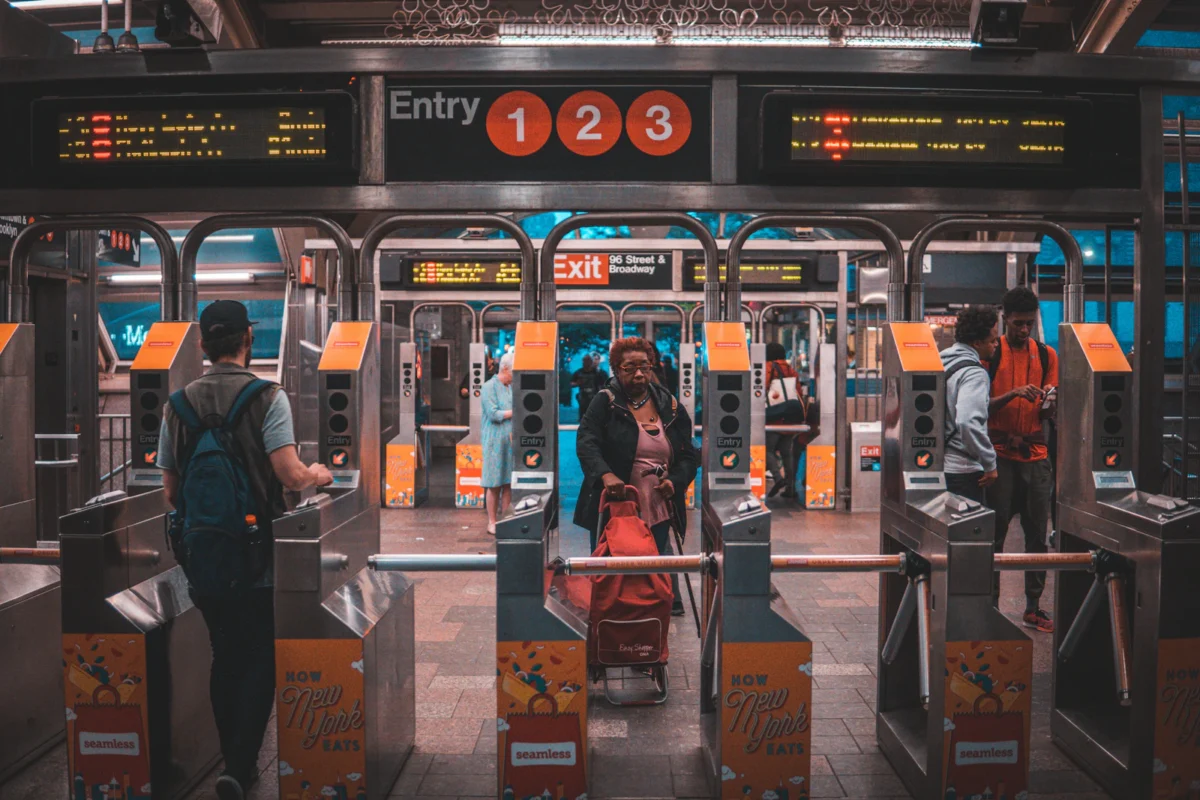
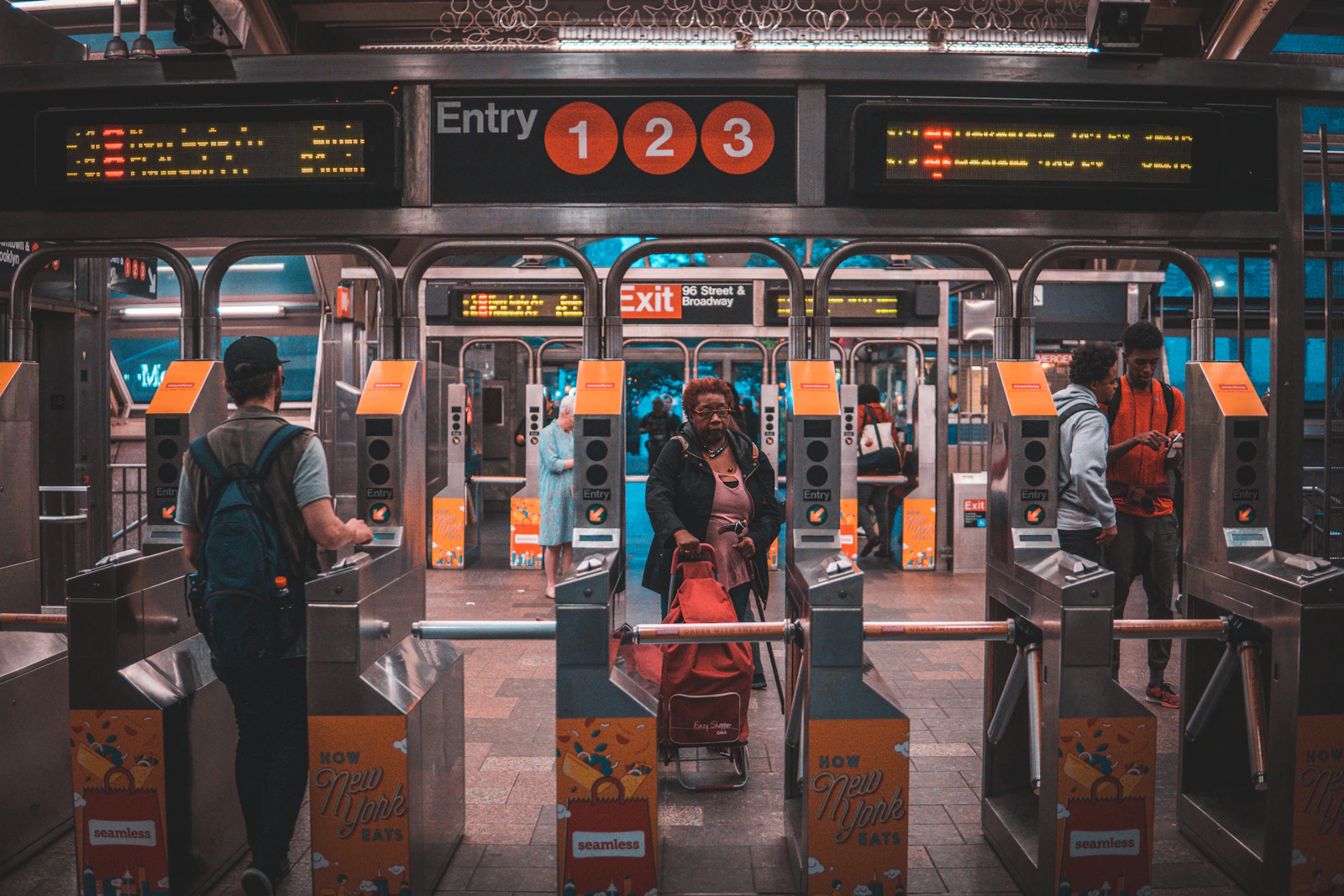
Twelve rides. That is the number to remember on the New York subway in 2026. Tap the same card or phone twelve times within seven days and the OMNY fare cap kicks in: every ride after that, on the subway or a local bus, costs nothing until the week resets. At the current $3 base fare, nobody paying full fare spends more than $35 a week.
If you are working out how to pay for the subway in NYC for the first time, or you are a New Yorker still holding a MetroCard with a few dollars on it, the rules are simpler than they look but stricter than they seem. Below is what changed in January 2026, how the cap actually counts, where people lose money without noticing, and what to do with an old MetroCard.
Fares and rules in this guide are as of October 2026, based on MTA and OMNY pages. The MTA can change them, so check the linked official pages before you rely on a number. This is not financial advice; see our disclosure.
Key Takeaways
- Base fare: $3 for the subway and local bus since January 4, 2026 (reduced fare $1.50).
- OMNY fare cap: pay for 12 rides in a 7-day window and the rest are free. Maximum $35 a week, or $17.50 for reduced fare.
- One card, one cap: a physical credit card, the same card in Apple Pay or Google Wallet, and a smartwatch each count as separate payment methods with separate caps.
- Paying for friends: you can tap for up to three others, but only your first tap counts toward your cap.
- MetroCard: no longer sold or refilled since January 1, 2026. It is still accepted for now, but the MTA has not announced the final date.
- Not covered by the cap: AirTrain JFK, LIRR, Metro-North, PATH and express buses (express buses have their own $67 cap).
What Changed in 2026: The Short Version
On January 4, 2026, the MTA’s approved fare changes took effect. The base fare rose ten cents to $3, the seven-day fare cap became permanent at $35, and the 7-Day and 30-Day Unlimited MetroCards were retired. There is no monthly unlimited pass anymore. The weekly cap is the only form of unlimited riding left on the subway and local bus.
A few days earlier, MetroCard sales ended. Since January 1, 2026, you cannot buy or refill a MetroCard anywhere, and the vending machines that sold them have been removed. In practice, tap-and-ride is now how nearly everyone pays.
The change I notice most is quieter than the price. Nobody stands at a machine anymore deciding whether to buy a weekly pass on day one. You just tap, and the system decides at the end of the week whether you would have been better off with unlimited.
How the OMNY Fare Cap Works
The official OMNY page describes the cap in one line, but four details decide whether you actually reach it.
The seven-day window starts with your first tap
Your first tap on a given card or device starts a new seven-day period. Pay for 12 rides within that period and any further subway or local bus rides are free until it ends. Then the next tap starts a fresh window.
The window is tied to your first tap, not to Monday. If you land on a Thursday evening and tap into the subway, your week runs to the following Thursday.
Twelve rides, but the twelfth is cheaper
Twelve rides at $3 would be $36, yet the cap is $35. So the twelfth ride costs $2, and everything after it costs $0. A small detail, but it explains why your statement may show an odd charge on the day you hit the cap.
Free transfers don’t count as rides
A transfer between subway and bus, or bus to bus, within two hours is free as long as you use the same card or device for both legs. Because it is free, it does not count as one of your 12 paid rides. According to the OMNY fare cap FAQ, each paid trip counts once toward the cap.
Same card, same device, every time
This is the rule that catches people. Each payment method builds its own cap. A Visa card tapped directly, the same Visa inside your phone’s wallet, and the same Visa on your watch are three different payment methods to OMNY. PIX11 reported that mixing them splits your rides across separate caps and can cost you free transfers too.
Pick one way to tap on the day you arrive and stick to it. If you use a phone, set that card as the default in your wallet so the phone doesn’t switch cards on its own.
How to Pay for the Subway in NYC: Your Options Compared

When people ask how to pay for the subway in NYC now, the honest answer is: with whatever contactless card or phone you already carry. The table below compares the options as of October 2026.
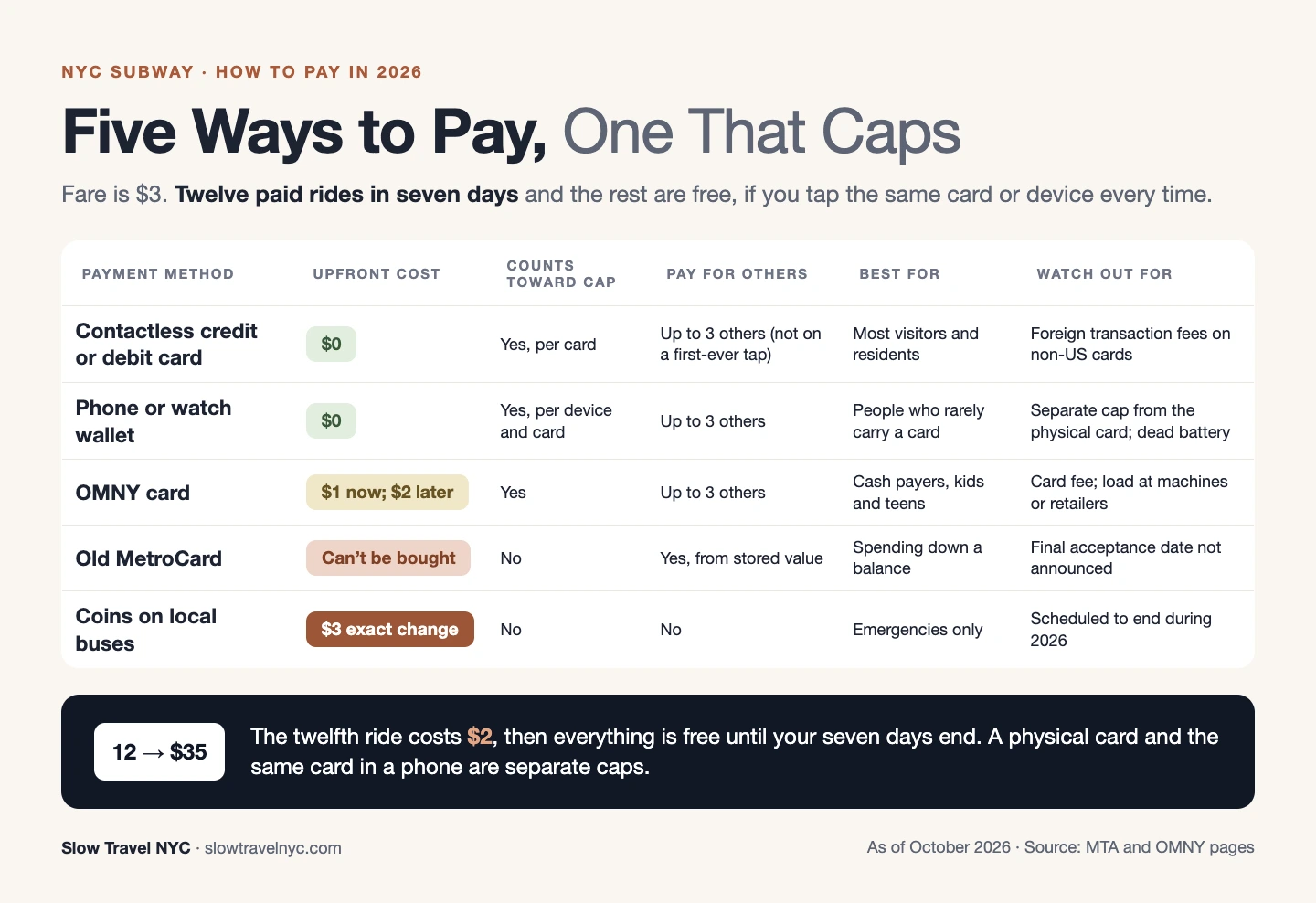
Contactless bank cards and phones
If your card has the contactless symbol, it works at every subway turnstile and on every local bus. There is no account to set up. One limit worth knowing: the first time a card or device is ever tapped on an OMNY reader, it can’t be used to pay for other riders on that same trip. Tap once for yourself, then it can cover your group next time.
For visitors from abroad, the fare is in dollars, so your bank may add a foreign transaction fee of 1% to 3% on every $3 tap. That adds up over a week. A card without that fee is the simplest fix; we compared options in our no foreign transaction fee card guide.
The OMNY card
The OMNY card is a reloadable plastic card sold at OMNY vending machines in subway stations and at about 2,700 retail stores. You can load it with cash, which matters if you don’t want to tap a bank card or if you are buying for a teenager. The MTA says the card lasts up to five years.
The card fee is currently a $1 promotional fee. Under the 2026 fare changes, it rises to $2 once MetroCard is no longer accepted. You can also preload $35 onto an OMNY card to cover a full capped week; unused value rolls over rather than expiring.
Reduced Fare, Express Buses and Kids
| Fare type (as of October 2026) | Per ride | Weekly cap | Notes |
|---|---|---|---|
| Subway and local bus | $3.00 | $35 | 12 paid rides in 7 days |
| Reduced fare (seniors 65+, people with disabilities, Medicare recipients) | $1.50 | $17.50 | Requires a personalized Reduced-Fare OMNY card |
| Express bus | $7.25 | $67 | Cap covers express bus, local bus and subway |
| Reduced-fare express bus | $3.60 | Confirm on MTA | Reduced-Fare OMNY card required |
| AirTrain JFK, LIRR, Metro-North, PATH | Separate fares | Not included | Paid on top of subway fares |
Express buses are the coach buses that run from the outer boroughs into Manhattan. Their rides don’t count toward the regular $35 cap, but they have a separate $67 weekly cap that also covers your subway and local bus rides in that period.
Children under 44 inches tall ride free on the subway and local bus when traveling with a fare-paying adult. Taller children pay full fare, and an OMNY card loaded with cash is the easiest way to give them their own cap.
What a Week Actually Costs: Four Scenarios
Numbers make the cap clearer than rules do. These examples assume full fare and one person per card unless noted.
| Trip | Rides | What you pay | Why |
|---|---|---|---|
| Long weekend, 3 days, mostly walking | 7 | $21 | Under the cap; 7 × $3 |
| 5 days, 3 rides a day | 15 | $35 | Capped on ride 12; rides 13–15 free |
| 10 days, about 2 rides a day | 20 | $35 + $18 = $53 | First 7-day window capped (14 rides); days 8–10 start a new window (6 rides) |
| Couple, 5 days, one card for both | 15 each | $35 + $45 = $80 | Partner’s taps never count toward a cap; two cards would cost $70 |
The last row is the most common way to overpay. If two people share one phone for every tap, only the first tap each time counts toward the cap. The second person pays full fare all week. Give each traveler their own card or phone.
To see how transit fits into the rest of your spending, plug these numbers into our NYC Trip Budget Calculator.
Is a Capped Week Worth Chasing?
For a slow traveler, the cap changes how a week feels more than how much it costs. Once you hit twelve rides, the bus becomes free to hop on for three stops when your feet are tired, or to ride the length of an avenue just to watch the neighborhoods change through the window. The calculation stops sitting in the back of your mind.
But don’t take extra rides just to reach the cap. A three-day visit spent walking from the West Village to SoHo and back will often come in well under $35, and that is the better trip. The cap protects heavy riders; it doesn’t reward anyone for riding more.
Reality Check: Where the Fare Cap Falls Short
- Mixed taps split your progress. Card one day, phone the next, and you can end up with two half-built caps and no free rides.
- Group taps don’t count. Paying for friends works, but their rides never move your cap.
- The window doesn’t follow your calendar. It starts with your first tap, so a 10-day trip spans two windows and can cost up to $70 even if you ride every day.
- The airport isn’t included. AirTrain JFK, commuter rail and PATH are separate systems and charge separately. Reports in 2026 list the AirTrain JFK fare at $8.75; confirm on the Port Authority site before you go.
- Disputes take effort. OMNY records every tap, but if a charge looks wrong you need to check it yourself. Registering your card for a free account at OMNY.info lets you see each trip and the progress toward your cap.
- Bank fees still apply. A non-US card with a foreign transaction fee pays that fee on every tap until the cap, and transfers don’t erase it.
- Coins are on their way out. The MTA said coins would stop being accepted on buses during 2026. Don’t plan around them.
What to Do With an Old MetroCard
If you have a MetroCard in a drawer, it may still be worth something. As of mid-2026, amNY reported that the MTA was still accepting MetroCards on subways and buses, with no final date set. The MTA’s MetroCard page says the end date will be announced later in 2026.
Your options:
- Spend it down. Use it until the balance runs out. MetroCard rides don’t count toward the OMNY cap, so on a heavy week this can cost slightly more than tapping.
- Move the balance to an OMNY card. Customer Service Centers can transfer remaining value to an OMNY card.
- Claim it later. According to the MTA, remaining balances can be transferred or reimbursed for two years after the expiration date printed on the back of the card.
Unlimited MetroCards had to be first used by March 31, 2026 to get their full term, so an unused weekly or monthly pass is now mainly a matter for a refund claim.
If you are planning a first visit, we keep these changes updated in our first-time NYC travel checklist.
FAQ
How does the OMNY fare cap work?
Tap the same contactless card, phone or OMNY card for every ride. After 12 paid subway or local bus rides within seven days of your first tap, further rides in that window are free. The maximum is $35 a week at full fare, as of October 2026.
Can two people use the same card and both get the fare cap?
No. You can pay for up to three other riders with one card, but only your own first tap counts toward the cap. Everyone who wants to be capped needs their own card or device.
Does Apple Pay count toward the same cap as my physical card?
No. A physical card and the same card in a phone or watch wallet are treated as different payment methods. Each builds its own cap, so use one method all week.
When does the MetroCard stop working?
The MTA has not announced a final acceptance date as of October 2026. Sales and refills ended on December 31, 2025. Leftover balances can be moved to an OMNY card or reimbursed for up to two years after the card’s printed expiration date.
Does the OMNY fare cap include AirTrain JFK or the LIRR?
No. AirTrain JFK, LIRR, Metro-North and PATH are paid separately and don’t count toward the subway and bus cap. Only the express bus network has its own $67 weekly cap that bundles subway and local bus rides.
The Slower Way to Ride
The fare cap is a small piece of policy that quietly removes a decision from your day. Choose one card, tap it every time, and let the week sort itself out. Then spend the attention you saved on the city itself: a bench in a quiet corner of Midtown, a bus ride along Fifth Avenue at dusk, a walk you might have skipped if you were still counting swipes.