The Noguchi Museum exhibition Noguchi’s New York is not a typical retrospective. Noguchi Museum is one of the best Museums in New York. When you walk into the galleries in Long Island City, Queens, you are not greeted by a triumphant chronology of an artist’s greatest hits. You are met, instead, by the sketches, blueprints, rejection letters, and unrealized visions of a man who spent sixty years trying — and often failing — to give a city a better version of itself.
Isamu Noguchi first arrived in New York in 1922, at seventeen years old. He would leave and return, leave and return, for the rest of his life. He died here in 1988. As he once put it: “I’m really a New Yorker. Not Japanese, not a citizen of the world, just a New Yorker who goes wandering around like many New Yorkers.” This exhibition, now on view through September 13, 2026, takes that self-definition seriously — and asks what it actually cost him.
What Is the Noguchi Museum Exhibition Noguchi’s New York?
Organized to mark the 40th anniversary of The Isamu Noguchi Foundation and Garden Museum, Noguchi’s New York brings together more than 50 works — sculptures, models, stage sets, archival photographs, and administrative documents — to examine one of the most complex artist-city relationships in 20th-century American art.
The exhibition examines Noguchi’s deep and dynamic relationship with New York City, exploring how its material, cultural, social, and political landscape indelibly transformed his artwork and thinking, and how he in turn transformed the city.
What makes this Noguchi Museum exhibition distinctive is precisely what it doesn’t leave out. Rather than presenting only completed masterworks, curators have foregrounded the projects that never happened: playground proposals that city officials dismissed without a second glance, public sculptures killed in committee, civic spaces imagined and buried in bureaucratic files. These failures, the show argues, are just as revealing as the successes.
Isamu Noguchi New York: A 60-Year Relationship Defined by Collision
An Artist Born on the Border
To understand Noguchi’s relationship with New York, you have to understand who he was before he got here. Born in Los Angeles in 1904 to Japanese poet Yone Noguchi and American writer Leonie Gilmore, Noguchi grew up between cultures — raised partly in Japan, educated in Indiana, and trained in New York. He was, from the beginning, a man without a fixed category.
In the 1920s, he traveled to Paris and worked as an assistant to Constantin Brâncuși, absorbing the fundamentals of modern sculpture. But he quickly broke from the model of the studio sculptor making objects for pedestals. For Noguchi, sculpture was inseparable from the body that moved through it, the ground it sat on, the light that fell across it. Furniture, gardens, stage sets, playgrounds, plazas — all of it was sculpture, if you understood sculpture broadly enough.
New York as Laboratory and Obstacle
Noguchi first arrived in New York in 1922 at just seventeen. Though his career unfolded across Paris, Tokyo, and Mexico City, the city remained his constant point of return. Noguchi’s New York examines this enduring relationship, revealing how New York’s political tensions, architectural density, and civic ambitions shaped his artistic vision.
In the 1920s and ’30s, the city was the ideal laboratory. Industrial materials — aluminum, steel, plate glass — were available on a scale impossible elsewhere. The avant-garde moved fast. He collaborated with Martha Graham, whose radical approach to dance gave Noguchi some of his most generative commissions; his stage sets for her productions remain landmarks of 20th-century design. He designed furniture for Herman Miller. He built a reputation as someone who refused to stay in one lane.
But New York also showed him its hardest face. As a mixed-race immigrant artist during the years of the Great Depression, World War II, and the Cold War, Noguchi was never simply an artist in New York — he was always also something else, someone who had to prove his right to belong.
Robert Moses and the Politics of Public Space
No figure haunts this exhibition more persistently than Robert Moses, the parks commissioner and master builder whose iron grip on New York’s public spaces extended from the 1930s through the 1960s. Moses shaped the physical city more than any elected official of the era — and he was the single greatest obstacle to Noguchi’s public ambitions.
In 1934, Noguchi submitted a proposal for Play Mountain — a pyramid-shaped earthwork designed for children to climb without equipment, a pure sculptural landscape for play. Moses rejected it. In subsequent years, Noguchi proposed playgrounds for Riverside Park and other public sites. Moses rejected those too. The exhibition highlights Noguchi’s unflagging attempts to give back by sculpting communal spaces for exploration and play — efforts often thwarted, most notably by the influential NYC Parks Commissioner Robert Moses.
The rejections were not simply aesthetic disagreements. They reflected a deeper incompatibility between Noguchi’s vision of art as participatory civic space and Moses’s preference for efficient, standardized, manageable infrastructure. Noguchi believed that the city’s children deserved something beautiful and strange to climb. Moses wanted swing sets and slides.
Key Works in the Isamu Noguchi New York Exhibition
Play Mountain (1933) and the Unrealized Playground Proposals
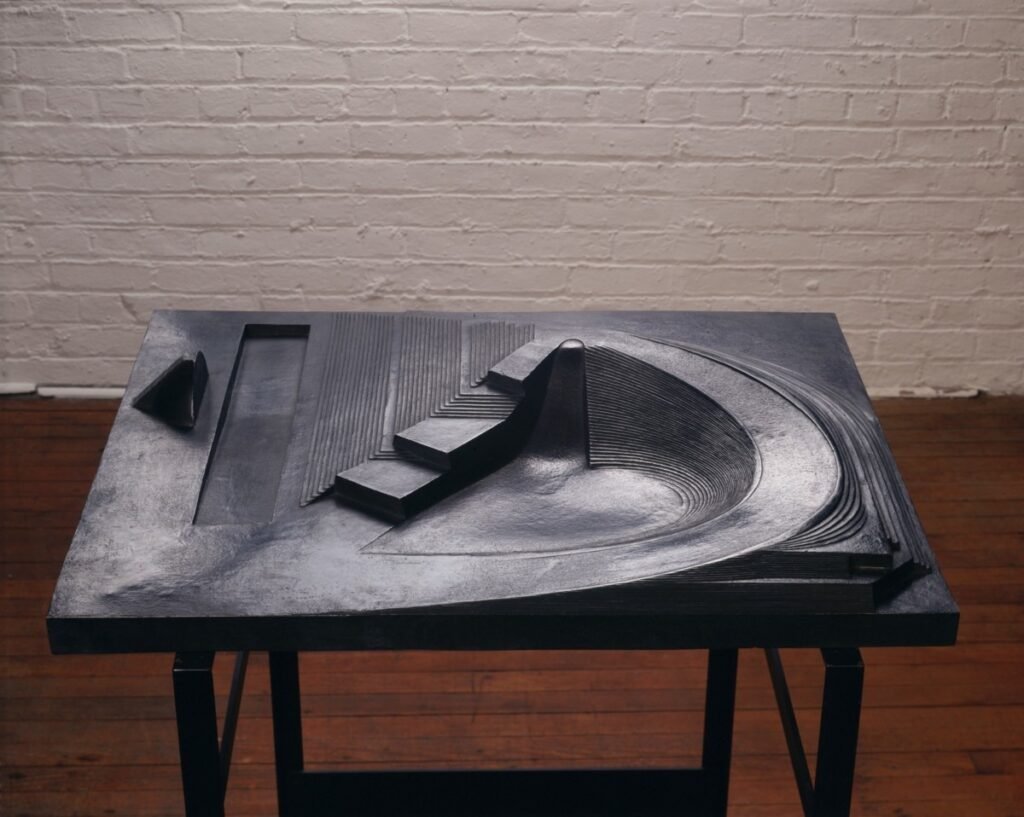
Central to the exhibition is Noguchi’s radical rethinking of public sculpture. A key section brings to life his unrealized playground and plaza proposals — projects that imagined art as a catalyst for communal play rather than passive monumentality. Models and blueprints for works such as Play Mountain (1933) and Contoured Playground (1941) are animated through newly commissioned short films, translating speculative designs into vivid, moving form.
These films are worth the visit alone. Seeing children move through the spaces that never existed is both a pleasure and a quiet indictment.
News (Associated Press Building Plaque, 1938–40)
One realized commission on view at the exhibition may be familiar to New Yorkers: News (Associated Press Building Plaque) (1938–40), Noguchi’s first public work in the United States — a large-scale stainless steel relief installed at Rockefeller Center. Archival photographs and drawings trace the making of this piece, which renders a group of newspaper men as a celebration of the city’s heroic working class. It is one of the few places in the exhibition where the city and the artist arrived at something together.
Red Cube (1968) and Sunken Garden (1961–64)
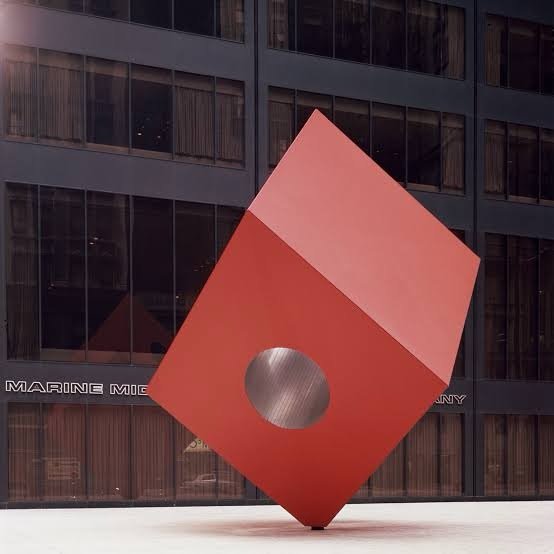
Two public art displays are just a block away from each other in Lower Manhattan — both the work of Noguchi. They are the Red Cube at 140 Broadway and the Sunken Garden at Chase Manhattan Bank Plaza. Both are on view as part of the exhibition context, and both remain among the most quietly radical pieces of public sculpture in the city.
Unidentified Object (1979)
Perhaps no work better captures Noguchi’s position in New York than Unidentified Object, the 11-foot basalt sculpture that stood at Doris C. Freedman Plaza in Central Park — his first public sculpture on city land, unveiled when he was 74 years old. The photograph of Noguchi at its debut, standing in front of the Plaza Hotel in a rumpled suit, is one of the most moving images in the show. It took him most of a lifetime to get a piece of stone into Central Park.
The Noguchi Museum Itself as Exhibition: A 40th Anniversary Reflection
One of the most original arguments this Noguchi Museum exhibition makes is about the museum itself. After decades of watching his public proposals rejected, Noguchi built his own public space. In 1985, he opened The Isamu Noguchi Foundation and Garden Museum in a converted 1920s factory in Long Island City — at the time, the first museum in the United States established by a living artist.
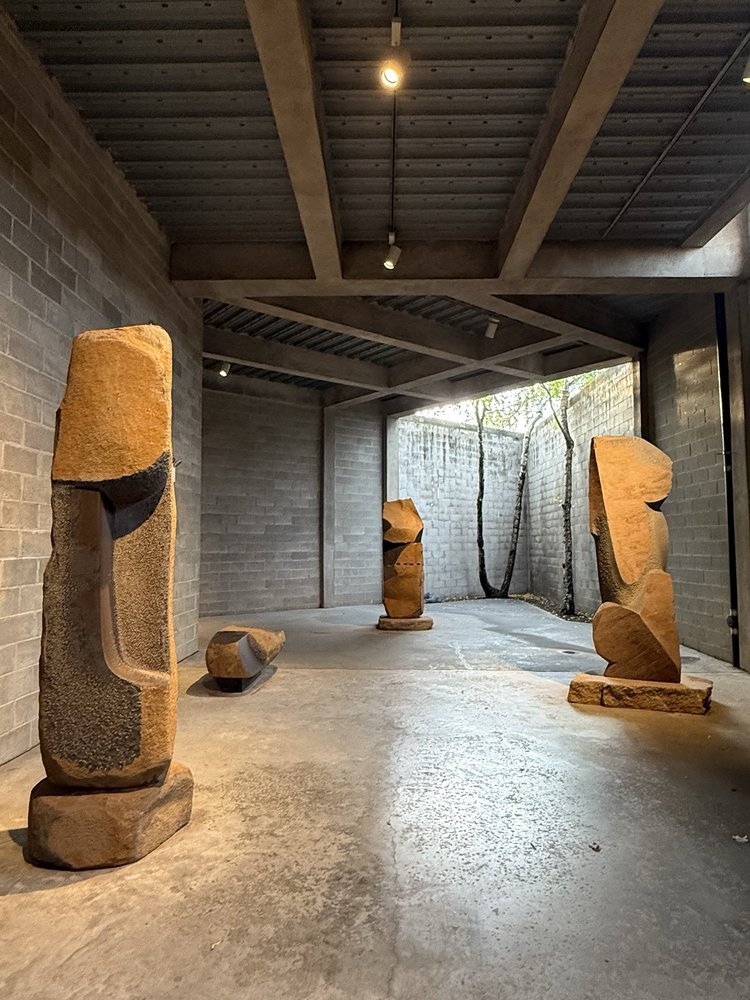
The space is extraordinary. Two gallery floors and an outdoor sculpture garden, where granite, basalt, and marble works sit under open sky and change with the light and the seasons. It is everything his rejected playgrounds were supposed to be: a place where people walk among art, sit with it, think inside it.
Noguchi called it a gift to the city. As Amy Hau, director of the Noguchi Museum, noted: “We are just so proud here in Queens that he not only established the beginnings of a very wonderful collection, but giving it to the city in this way as a museum for all of us to enjoy.”
The 40th anniversary framing makes this point without sentimentality: the museum is not a consolation prize. It is the most complete realization of everything Noguchi believed about art and public life.
Visitor Guide: Everything You Need to Know Before You Go
Exhibition Details
| Detail | Info |
|---|---|
| Exhibition | Noguchi’s New York |
| Dates | February 4 – September 13, 2026 |
| Hours | Wednesday–Sunday, 11am–6pm (closed Mon & Tue) |
| Address | 9-01 33rd Rd at Vernon Blvd, Long Island City, Queens, NY |
| Admission | Adults $20 / Students & Seniors $15 |
| Reservations | Advance booking recommended via the museum website |
Getting There
Take the 7 train from Midtown Manhattan to the Vernon Blvd–Jackson Ave stop in Queens. The museum is about a 10-minute walk from the station through the industrial waterfront neighborhood of Long Island City — an area worth exploring before or after your visit for its concentration of galleries and waterfront parks.
What to Expect Inside
The museum occupies a converted factory building. The ground floor galleries hold the historical arc of the exhibition — early portrait busts, archival documents, the rejected playground proposals, and models for unrealized public works. The upper floor carries his applied works: stage designs, Akari light sculptures (his iconic paper lanterns), furniture.
The outdoor sculpture garden is the emotional heart of the space. Large stone works in granite, basalt, and marble are arranged across a gravel courtyard, shifting with the light. Visitors can sit on benches, listen, and look — the garden does a remarkable job of muting the surrounding city noise. Come on a clear day if you can.
Tips for Getting the Most Out of the Noguchi Museum Exhibition
Read the rejection letters. The administrative documents — particularly Moses’s terse dismissals of Noguchi’s playground proposals — are among the most affecting objects in the show. They make the sculptures feel urgent in a way that art history rarely does.
Watch the animated films. The newly commissioned short films showing how children might have moved through Play Mountain and Contoured Playground are a genuine innovation in exhibition design. Give them time.
Stay in the garden. Most visitors spend 20 minutes in the outdoor space when they should spend an hour. Sit down. Let the stone and the light do their work.
Connect the indoor and outdoor. The exhibition makes most sense if you carry what you’ve seen in the galleries into the garden. The garden is the argument. It’s what Noguchi built when the city said no.
Why This Exhibition Matters Right Now
The questions Noguchi asked about New York — about who public space is for, who gets to shape it, what art can do in a city — have not been answered. The exhibition positions Noguchi not only as a sculptor of objects, but as a visionary thinker who treated New York itself as a material — shaping, challenging, and reimagining the city through art.
That vision runs directly into questions cities are still failing to answer: How do public spaces get designed, and for whom? Who decides what belongs in the park? What does it cost an artist — particularly an immigrant artist navigating race, nationality, and institutional gatekeeping — to imagine a better city?
Noguchi spent sixty years asking those questions in New York. This exhibition asks them again.
Plan Your Visit
Noguchi’s New York is on view through September 13, 2026, at The Noguchi Museum, 9-01 33rd Rd at Vernon Blvd, Long Island City, Queens. Admission is $20 for adults, $15 for students and seniors. Advance reservations are recommended and can be made at noguchi.org.
The museum is open Wednesday through Sunday, 11am to 6pm.
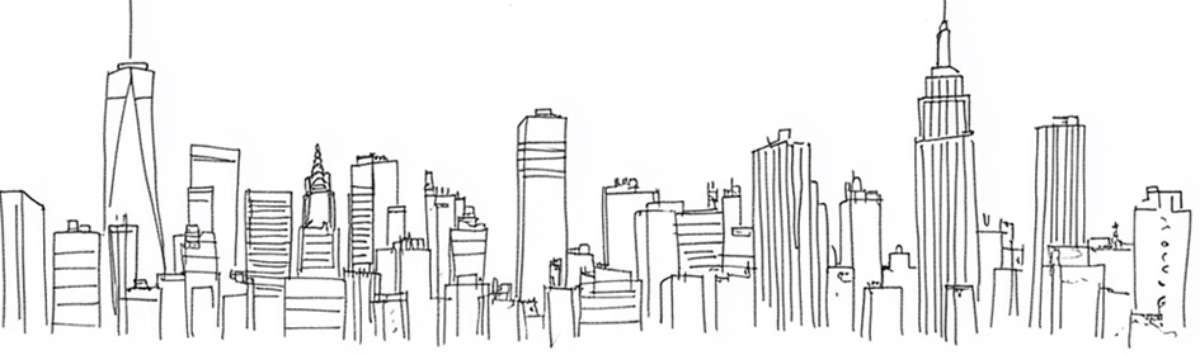
While in the neighborhood, consider pairing your visit with the nearby MoMA PS1 (a 10-minute walk) or a stop along the Long Island City waterfront for views of the Manhattan skyline — views Noguchi himself would have known from his studio.
Last updated: February 2026
NYC’s Best Street Food: Hidden Gems and Award-Winning Carts Locals Actually Eat At