It’s 2:40 on a Tuesday afternoon, it has started to drizzle, and every café on the block has a laptop at every seat and a sign that says “45-minute limit.” This is when quiet hotel lobbies in Manhattan earn their keep. A good one gives you a deep chair, soft light and a room that was designed for lingering, for the price of a coffee or a single drink.
I’ve come to think of a handful of these lobbies as the city’s best-kept living rooms. Not all of them are calm all day, and none of them owe you a seat. This guide covers six that work for a slow hour, what each one actually asks of you, and when to go so you’re not sitting in the middle of a happy hour or an Instagram queue.
Quick Answer: The Calmest Lobbies, at a Glance
- For a grand, unhurried hour: Waldorf Astoria’s Peacock Alley (Midtown East) — the whole lobby functions as bar seating, so order something.
- For the most dramatic room: The Beekman’s Bar Room under its nine-story atrium (Financial District) — calmest before the after-work crowd.
- For a literary afternoon: The Algonquin (Theater District) — a compact lobby lounge with the Blue Bar folded into it.
- For a fireplace and a book: Kimpton Hotel Eventi (Chelsea/NoMad edge) or Romer Hell’s Kitchen’s Study corner.
- For a garden in winter light: The Ludlow’s Lobby Lounge & Garden (Lower East Side).
- Rule of thumb: go between roughly 10 a.m. and 3 p.m. on a weekday, order at least one thing, and keep calls outside.
What Makes a Hotel Lobby “Quiet” (and Open to You)
Most hotel lobbies open to the public in NYC fall into one of three types. Some are pure pass-throughs — a front desk, two chairs and a lot of luggage. Others are bars wearing a lobby’s clothes, where every seat is technically restaurant seating. The rare third kind is a true living room: soft seating set apart from the elevator traffic, where a guest and a neighbor can share a sofa without either feeling out of place.
For this list I looked for four things: seating that isn’t on the path to the elevators, low or no music during the day, a reasonable way to buy a coffee or a drink, and a room that doesn’t fill up with photographers. Rooms that are beautiful but built for passing through didn’t make it, however photogenic they are.
6 Quiet Hotel Lobbies in Manhattan
1. Waldorf Astoria — Peacock Alley (Midtown East)
The Waldorf reopened in 2025 after an eight-year, roughly $2 billion restoration, and Kinfolk notes that its Art Deco public rooms remain open to everyone, not just guests. Peacock Alley has been returned to its 1931 design, with Cole Porter’s grand piano and the restored Waldorf clock at its center.
The detail that matters for sitting: according to VinePair’s look at the new bar, the public part of Peacock Alley now covers not just the bar stools but the entire lobby. In practice that means the lobby seats are bar seats, and ordering is the expected price of the chair. Go mid-morning or early afternoon, when the room is closest to the hushed hall it was built to be.
2. The Beekman — The Bar Room under the Atrium (Financial District)
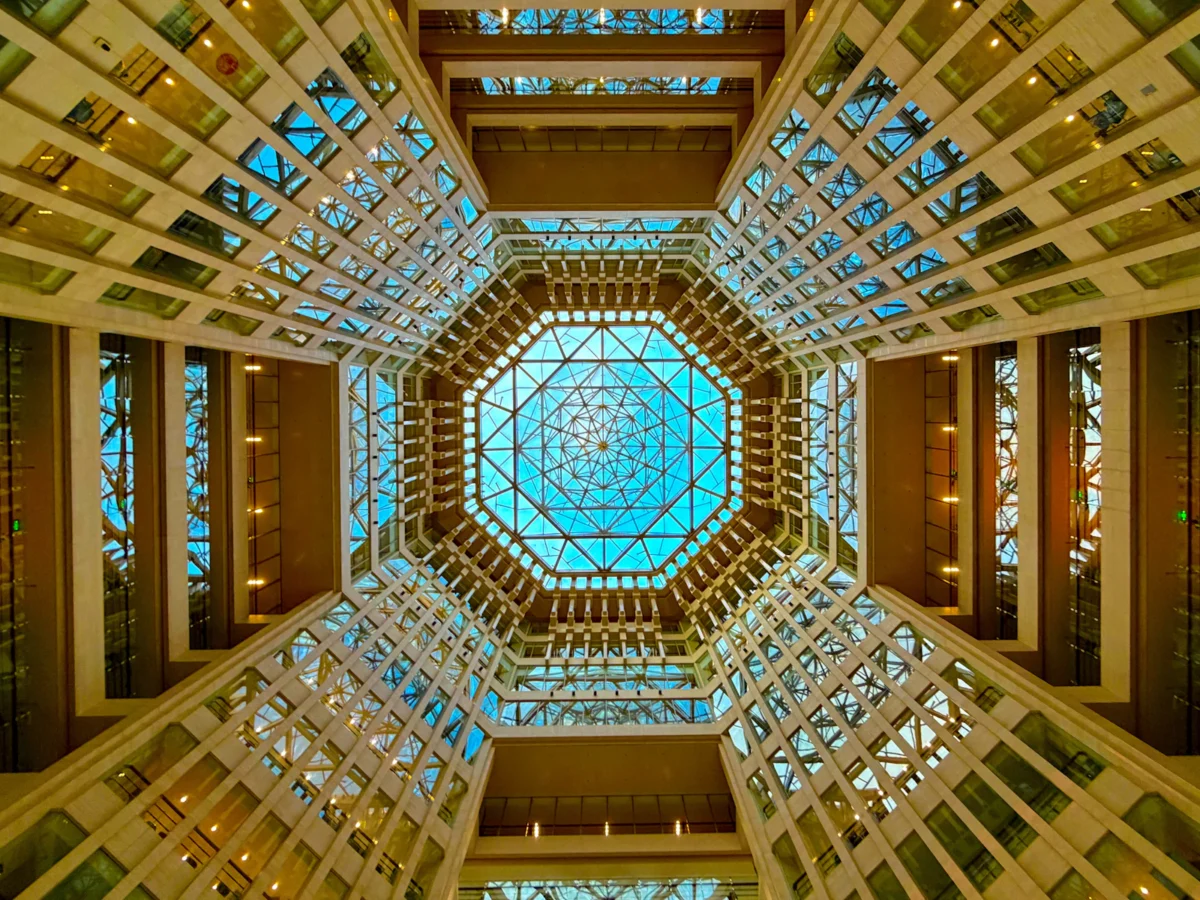
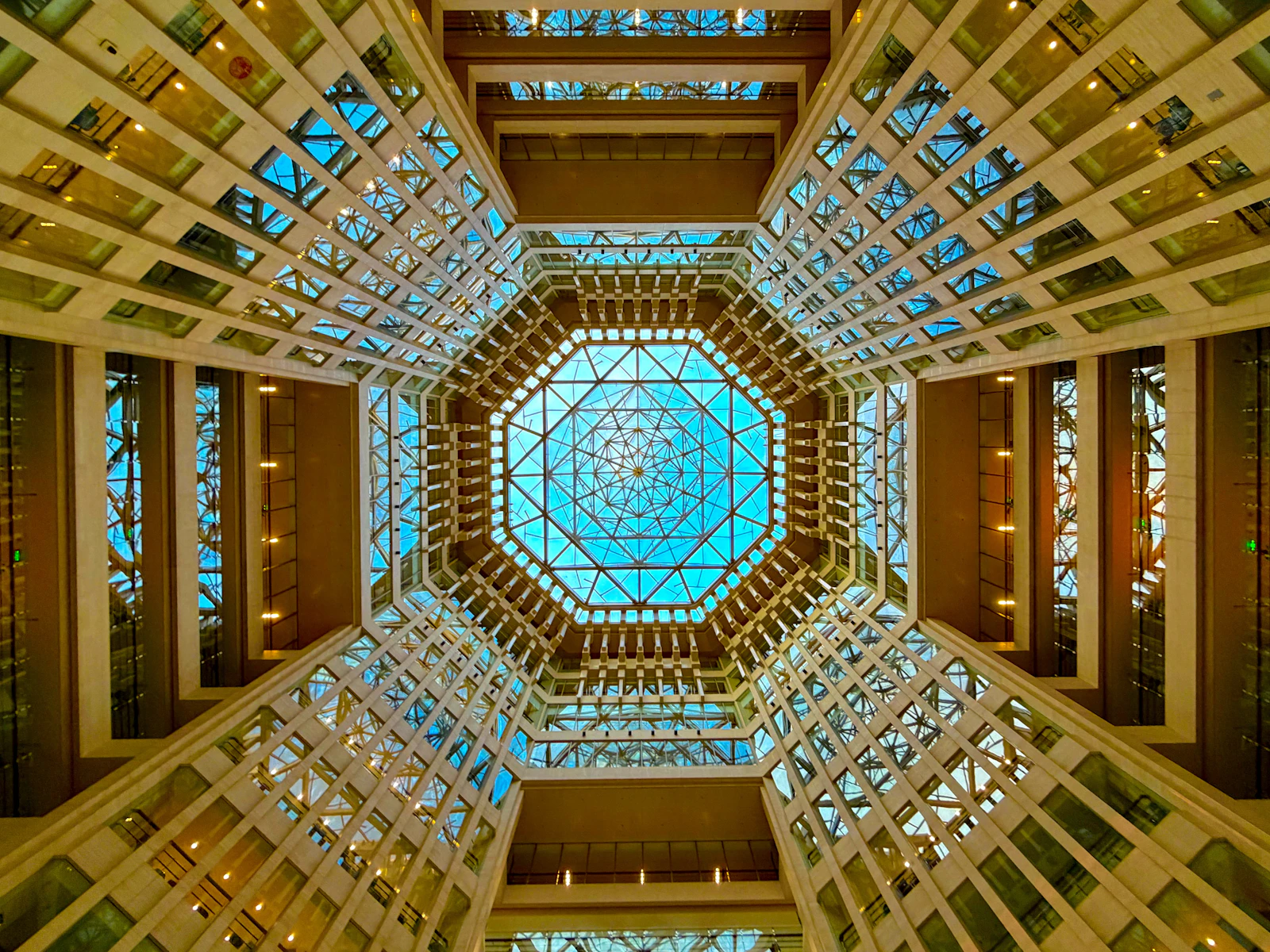
The Beekman’s nine-story Victorian atrium, topped with a pyramidal skylight, is one of the most photographed interiors downtown. The Bar Room beneath it is dressed like a 19th-century parlor — leather and velvet sofas, bookcases, and portraits of Edgar Allan Poe, who once worked in the building, as Oyster’s review describes. The hotel lists an all-day menu for the space.
The honest caveat is timing. After-work hours are busy: one reviewer who booked the Bar Room for 6 p.m. on a Monday found it packed, and the room is a magnet for people who pop in to photograph the atrium. Late morning is the window I’d aim for. Pick a sofa toward the edges rather than dead center under the skylight, where sound collects.
3. The Algonquin (Theater District)
The Algonquin has been operating since 1902, and its lobby is where the Round Table — Dorothy Parker and company — gathered for lunch in the 1920s. A pandemic-era redesign by Stonehill Taylor moved the Blue Bar into the lobby itself, as Hospitality Design reported, with curved velvet seating and drapes that divide the room into smaller pockets.
It’s a compact room, not a cavernous one, so it suits a solo reader better than a group. Afternoons before the pre-theater rush are the calm window. The hotel’s resident cat — currently Hamlet VIII, per the hotel’s own description — is a quiet bonus, not a promise; he keeps his own schedule.
4. Kimpton Hotel Eventi — The Living Room (Chelsea / NoMad edge)
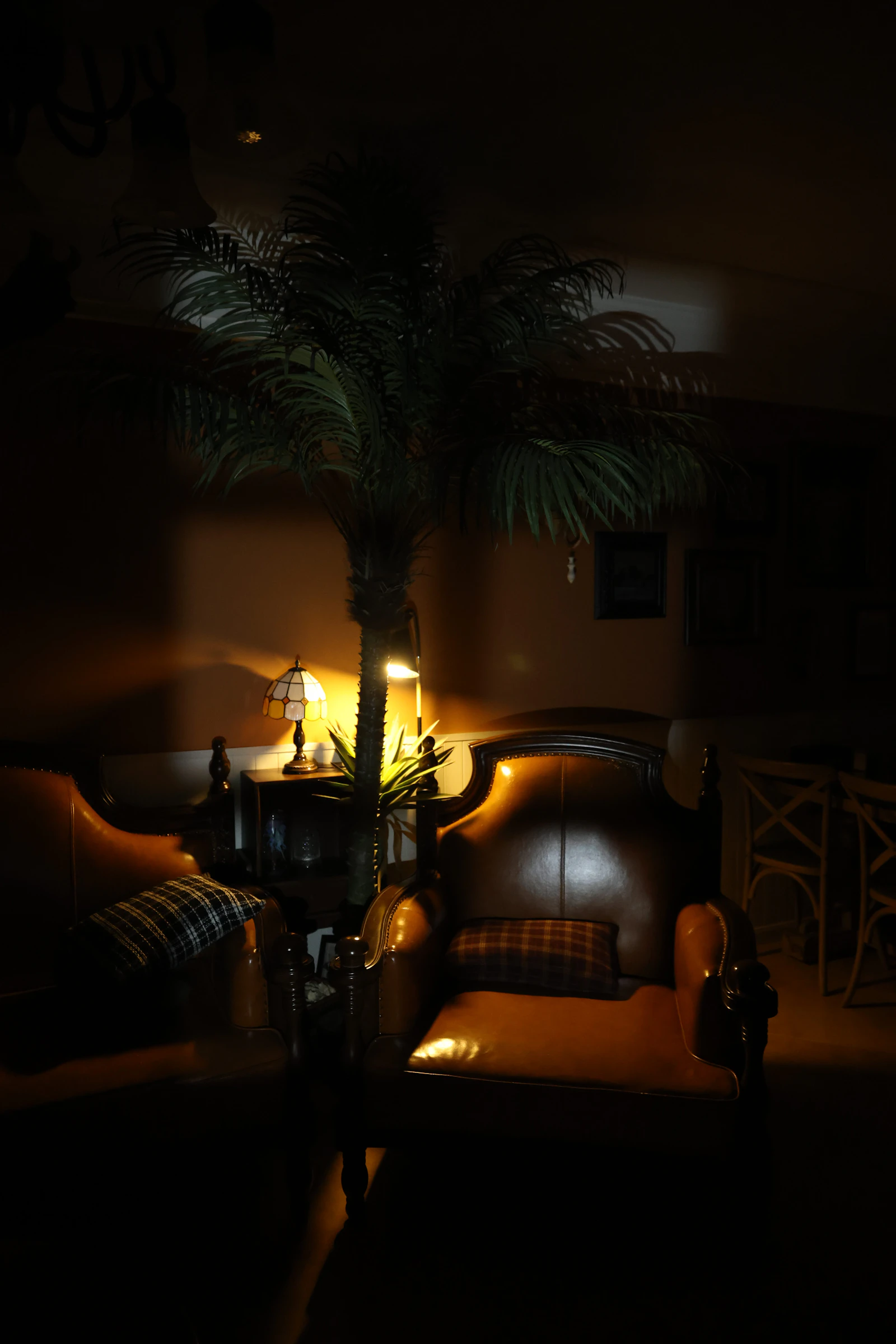
Eventi’s lobby was redesigned around Kimpton’s “living room” concept, with tufted leather sofas, slipper chairs and a fireplace. A 2015 refresh also used blackened steel and textured glass screens to separate the lobby seating from the adjoining lounge, per Hospitality Design — which is exactly what keeps noise from the bar from washing over the sofas.
Kimpton properties have historically offered guests morning coffee and an evening wine hour in the lobby, but treat that as a guest perk and confirm at the desk before counting on it. For non-guests, buying something at the street-level café or the bar is the courteous move. This is a good pick if you’re near Penn Station or the Flower District and want twenty quiet minutes before a train.
5. Romer Hell’s Kitchen — The Study (Midtown West)
Romer leans into the neighborhood-living-room idea, with a lobby café, a “Corner Store” in place of a gift shop, and So & So’s piano bar for evenings. The part slow travelers want is the Study, a fireplace corner that reviewers describe as surprisingly quiet for reading or work.
The trade-off is that this is a social hotel at night, so keep it to the daytime. In the morning and early afternoon, before the piano bar takes over the building’s energy, it feels much more like a library than a hotel.
6. The Ludlow — Lobby Lounge & Garden (Lower East Side)
The Ludlow’s lobby lounge is open daily and serves light fare, and it opens onto a garden — rare in a neighborhood where most “outdoor seating” is a sidewalk. Lobby coffee and newspapers are listed among the hotel’s common-area amenities, though whether non-guests can help themselves is a question for the staff, not an assumption.
This is the most neighborhood-scaled room on the list: low lamps, deep chairs, and a crowd that tends to be locals rather than tour groups. On a bright fall or winter afternoon, the garden light is the reason to come.
Comparison: Which Quiet Lobby Fits Your Afternoon
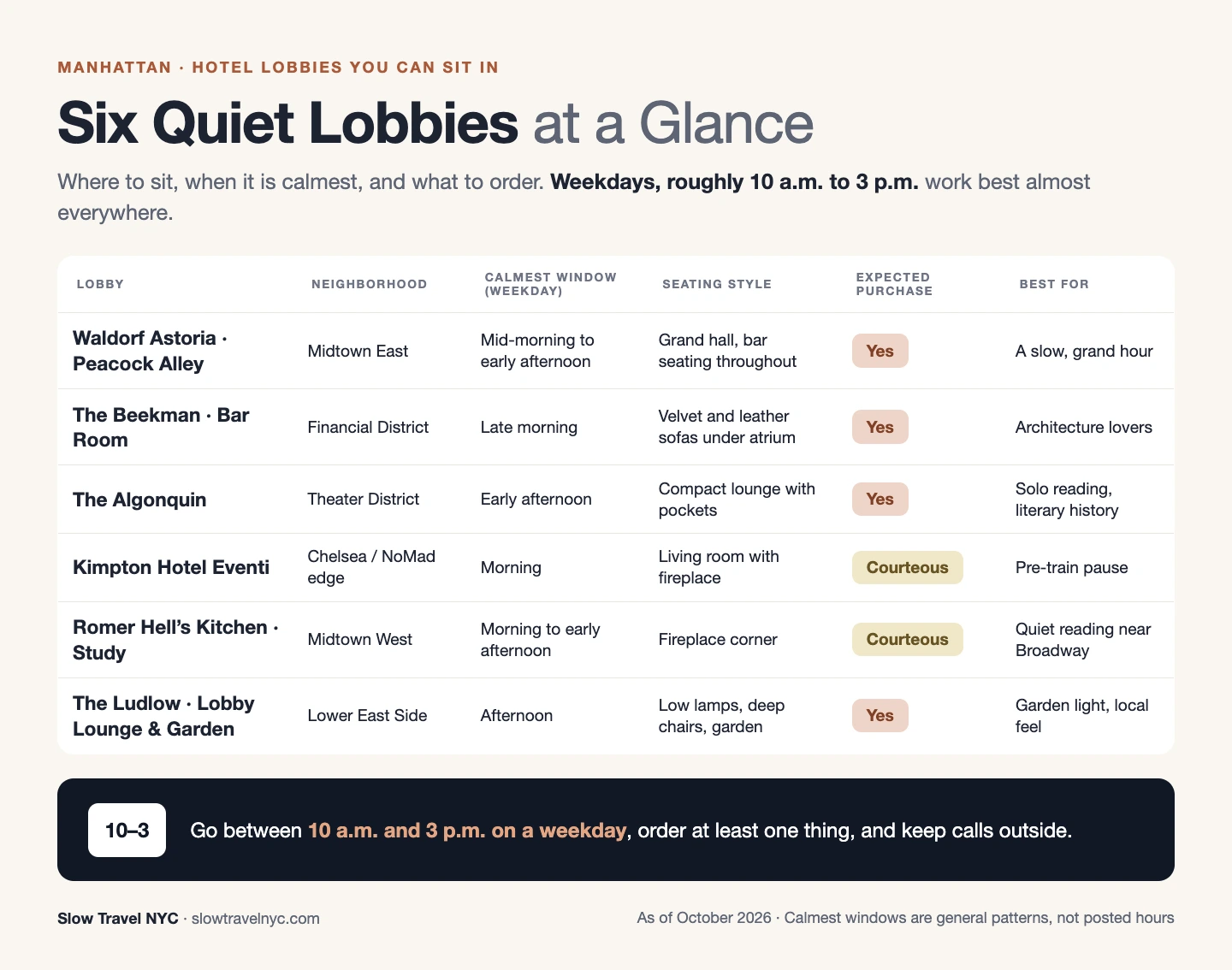
Calmest windows are general patterns, not posted hours. As of October 2026, check each hotel’s current hours before you go.
Reality Check: The Unwritten Rules (and the Real Costs)
A lobby is private property, and “open to the public” means welcome, not entitled. Here’s what nobody posts on the door:
- You’re buying the chair, not the coffee. At most of these rooms, a drink is the polite cost of an hour. I haven’t confirmed current menu prices for each hotel, so budget generously and check menus on arrival. If you’re working out what to leave on a lounge tab, the NYC Tip & Tax Calculator does the math.
- Seating can be reclaimed. Bars that double as lobbies often hold tables for guests or reservations once the evening starts. If staff ask you to move, that’s the arrangement.
- Laptops and calls change the room. A quiet lobby stays quiet because people treat it like a library. Long video calls are the fastest way to lose that welcome — step outside for them.
- Wi-Fi isn’t guaranteed. Some hotels offer lobby Wi-Fi to everyone, some only to guests or loyalty members. Plan as if you’re offline.
- Busy beats beautiful. The most famous rooms fill up fast after 5 p.m. and on weekends. A less dramatic lobby on a Tuesday will often feel more luxurious than a spectacular one on a Saturday.
- Things close. The Graduate on Roosevelt Island, long a favorite calm lobby, appeared to close abruptly in November 2025. Confirm before you make the trip.
Lobbies That Look Calm but Aren’t
The Ace Hotel New York on West 29th Street is still one of the city’s best-known lobby hangouts, with Stumptown next door and long communal tables. It’s also dark, social and often loud, with backless stools and a lobby that shifts to a bar scene at night — great for energy, not for stillness. Hotel bars in general are a different experience; if that’s what you’re after, my guide to glamorous hotel bars in Manhattan covers the evening side of this city.
If a lobby is full, don’t fight for a seat. Some of the calmest places in Midtown aren’t hotels at all — I’ve gathered them in the quietest places to sit in Midtown.
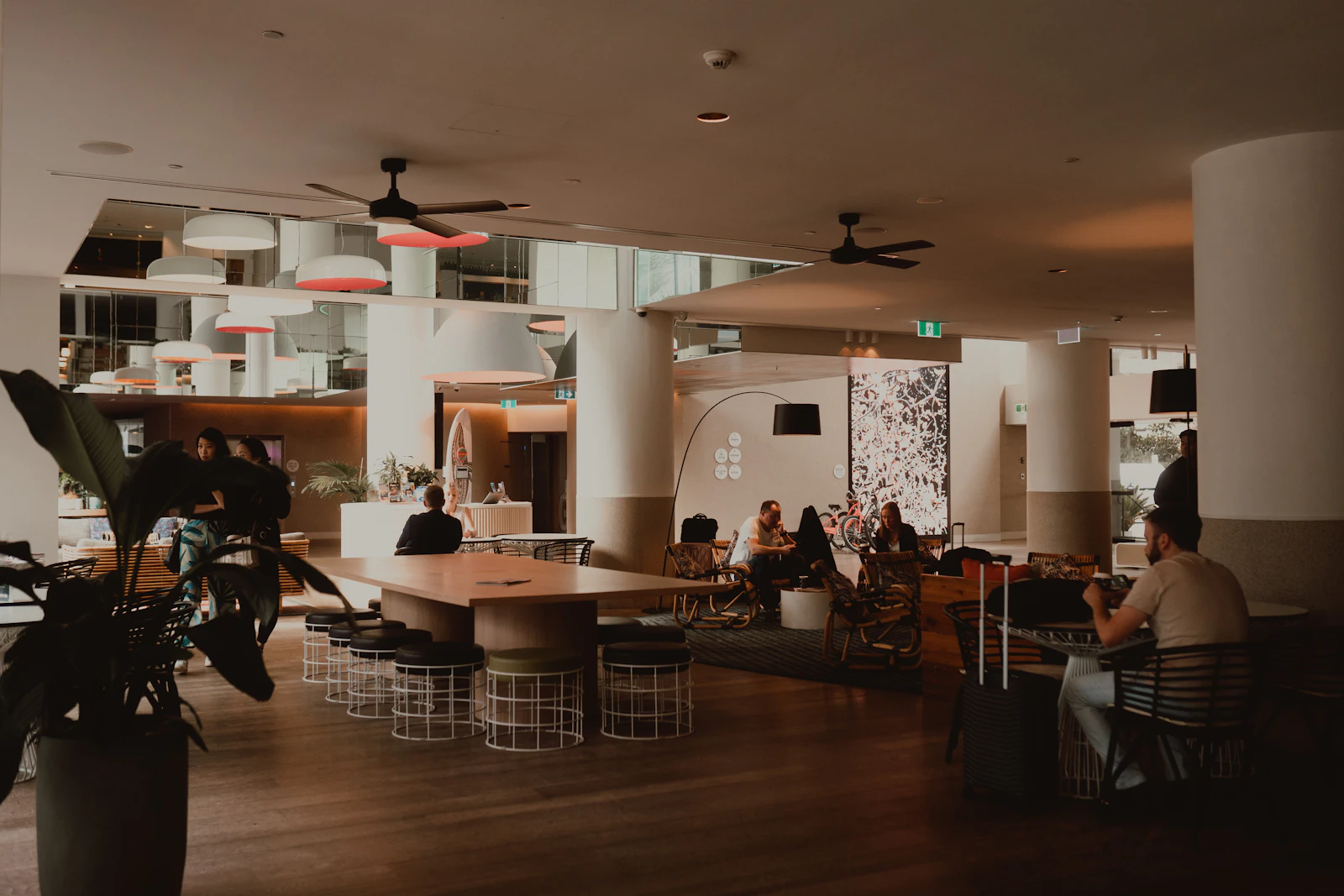
How to Spend a Slow Hour in a Hotel Lobby
My own rule is simple: one book, one drink, phone face down. The point of a hotel lobby open to the public in NYC isn’t to work for free — it’s to borrow a room that was built with more care than most of the city’s indoor spaces, and to give it back a little calmer than you found it.
A few habits that help:
- Arrive with a purpose that fits the room. Reading, writing a postcard, or waiting for dinner reservations all suit a lobby. Spreading out three devices doesn’t.
- Order early. Ordering in the first five minutes signals that you’re a customer, not a squatter, and staff tend to leave you be.
- Sit on the edges. Corners and side alcoves are quieter than the center of any atrium.
- Pair it with a walk. The Beekman sits close to the Brooklyn Bridge walkway; the Algonquin is a short walk from Bryant Park. A lobby makes a good bookend to a slow walk.
If you’re building a whole afternoon around reading, where to read alone in NYC has more ideas, and an afternoon tea in Manhattan is the more formal cousin of a lobby hour.
FAQ
Can you sit in a hotel lobby in NYC if you’re not a guest?
Usually, yes, but it’s at the hotel’s discretion. Most quiet hotel lobbies in Manhattan expect non-guests to buy something at the lobby bar or café, and staff can ask you to leave or move, especially during busy evening hours.
Which hotel lobbies are open to the public in NYC without a reservation?
Waldorf Astoria’s Peacock Alley, The Beekman’s Bar Room, The Algonquin’s lobby lounge, Kimpton Hotel Eventi, Romer Hell’s Kitchen and The Ludlow all welcome walk-ins to their lobby bars or lounges, though The Beekman can fill up and may prioritize reservations and guests in the evening.
What’s the best time to visit a quiet hotel lobby in Manhattan?
Weekdays between roughly 10 a.m. and 3 p.m. After 5 p.m., most lobby bars fill with the after-work crowd, and weekends bring more visitors and photographers.
Is it OK to work on a laptop in a hotel lobby?
Quiet laptop work is generally tolerated, but hotels aren’t coworking spaces. Buy something, avoid video calls, don’t hold a large table for hours, and assume Wi-Fi may be limited to guests.
Do I have to tip in a hotel lobby bar?
If you order from a server or bartender, tip as you would at any NYC bar — commonly 18–20% at table service or $1–2 per drink at the bar. The NYC Tip & Tax Calculator can help.
The Quietest Room Is the One You Don’t Rush
A Manhattan hotel lobby can be the most generous room in a crowded city, if you treat it like a living room rather than a free office. Choose one, go early on a weekday, order something you’ll enjoy slowly, and let an hour pass the way it’s supposed to. The city will still be there when you step back out.