Quiet Hotel Lobbies in Manhattan Where You Can Actually Sit (2026)

A slow traveler’s guide to quiet hotel lobbies in Manhattan: six rooms where a coffee buys you an unhurried hour, when to go, and the house rules nobody posts.

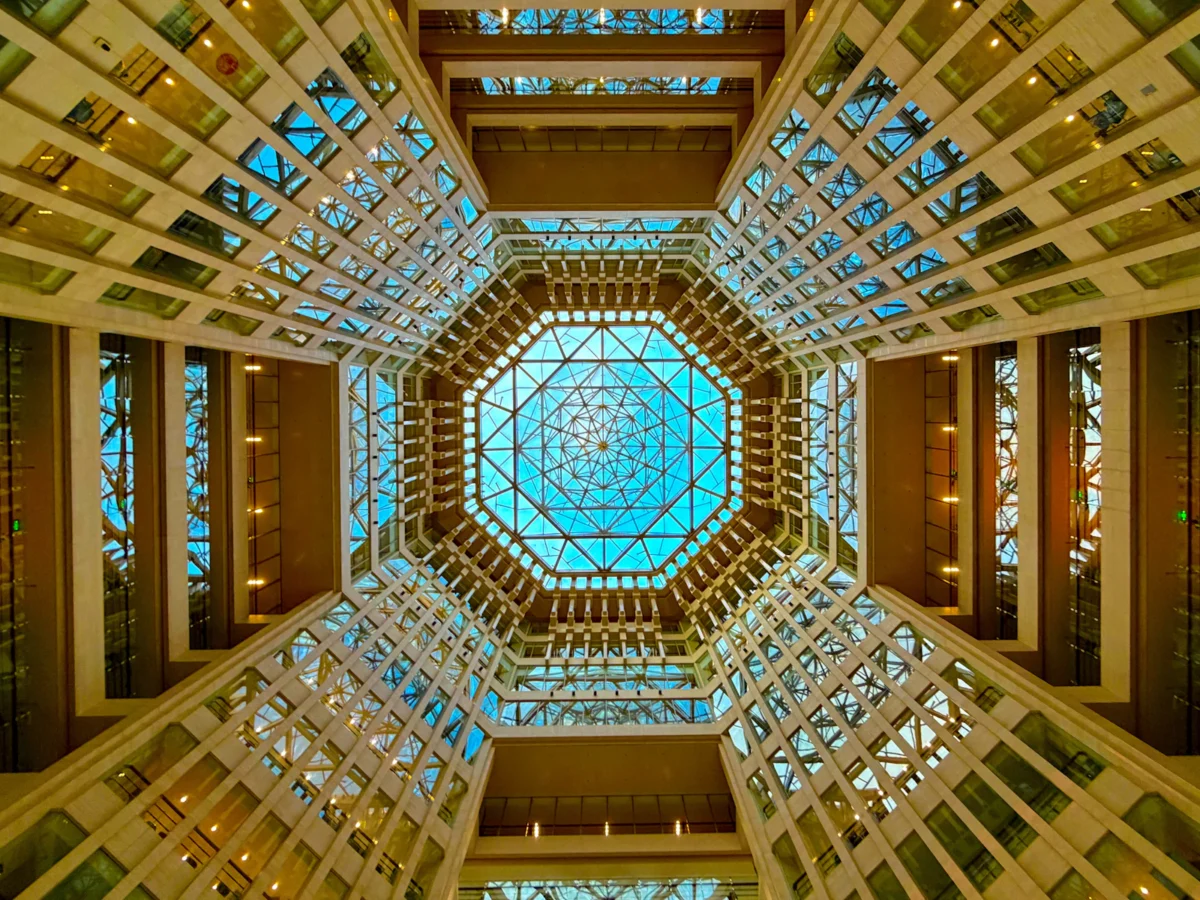
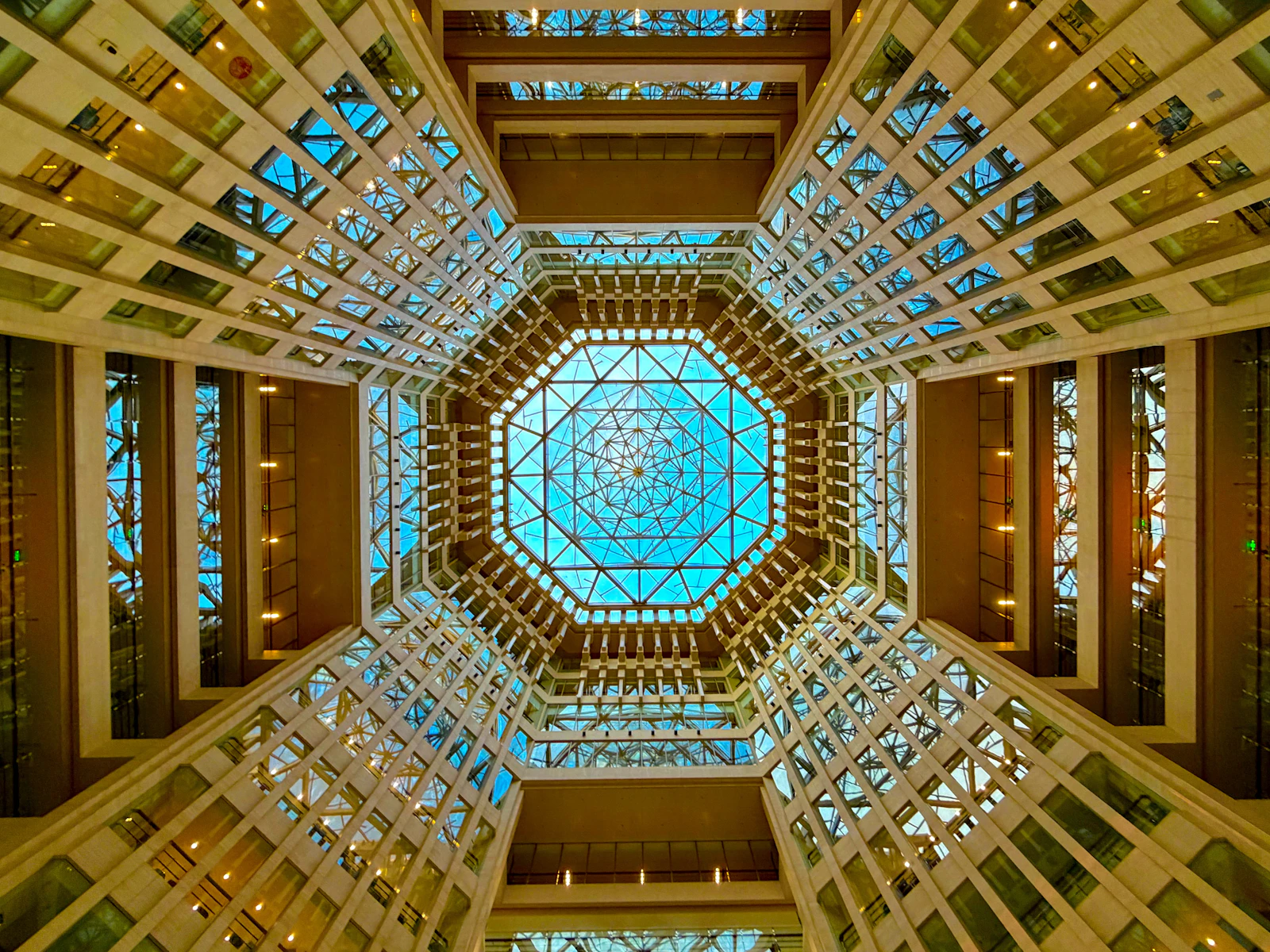
Looking up at an octagonal glass-ceilinged hotel atrium ringed with balconies

It’s 2:40 on a Tuesday afternoon, it has started to drizzle, and every café on the block has a laptop at every seat and a sign that says “45-minute limit.” This is when quiet hotel lobbies in Manhattan earn their keep. A good one gives you a deep chair, soft light and a room that was designed for lingering, for the price of a coffee or a single drink.

I’ve come to think of a handful of these lobbies as the city’s best-kept living rooms. Not all of them are calm all day, and none of them owe you a seat. This guide covers six that work for a slow hour, what each one actually asks of you, and when to go so you’re not sitting in the middle of a happy hour or an Instagram queue.

Quick Answer: The Calmest Lobbies, at a Glance

  • For a grand, unhurried hour: Waldorf Astoria’s Peacock Alley (Midtown East) — the whole lobby functions as bar seating, so order something.
  • For the most dramatic room: The Beekman’s Bar Room under its nine-story atrium (Financial District) — calmest before the after-work crowd.
  • For a literary afternoon: The Algonquin (Theater District) — a compact lobby lounge with the Blue Bar folded into it.
  • For a fireplace and a book: Kimpton Hotel Eventi (Chelsea/NoMad edge) or Romer Hell’s Kitchen’s Study corner.
  • For a garden in winter light: The Ludlow’s Lobby Lounge & Garden (Lower East Side).
  • Rule of thumb: go between roughly 10 a.m. and 3 p.m. on a weekday, order at least one thing, and keep calls outside.

What Makes a Hotel Lobby “Quiet” (and Open to You)

Most hotel lobbies open to the public in NYC fall into one of three types. Some are pure pass-throughs — a front desk, two chairs and a lot of luggage. Others are bars wearing a lobby’s clothes, where every seat is technically restaurant seating. The rare third kind is a true living room: soft seating set apart from the elevator traffic, where a guest and a neighbor can share a sofa without either feeling out of place.

For this list I looked for four things: seating that isn’t on the path to the elevators, low or no music during the day, a reasonable way to buy a coffee or a drink, and a room that doesn’t fill up with photographers. Rooms that are beautiful but built for passing through didn’t make it, however photogenic they are.
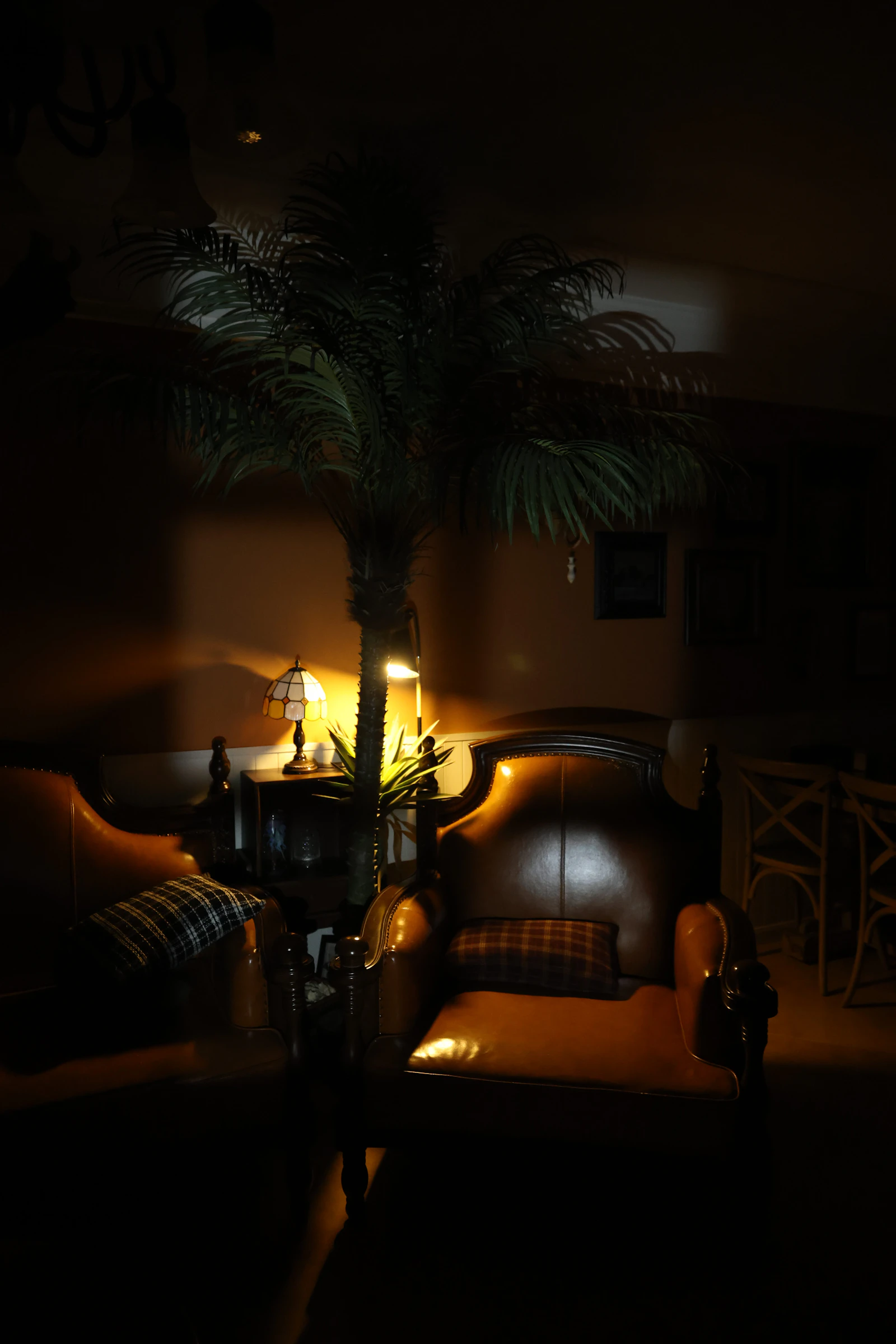
A dim lounge corner with leather armchairs, a potted palm and warm table lamps

6 Quiet Hotel Lobbies in Manhattan

1. Waldorf Astoria — Peacock Alley (Midtown East)

The Waldorf reopened in 2025 after an eight-year, roughly $2 billion restoration, and Kinfolk notes that its Art Deco public rooms remain open to everyone, not just guests. Peacock Alley has been returned to its 1931 design, with Cole Porter’s grand piano and the restored Waldorf clock at its center.

The detail that matters for sitting: according to VinePair’s look at the new bar, the public part of Peacock Alley now covers not just the bar stools but the entire lobby. In practice that means the lobby seats are bar seats, and ordering is the expected price of the chair. Go mid-morning or early afternoon, when the room is closest to the hushed hall it was built to be.

2. The Beekman — The Bar Room under the Atrium (Financial District)

The Beekman’s nine-story Victorian atrium, topped with a pyramidal skylight, is one of the most photographed interiors downtown. The Bar Room beneath it is dressed like a 19th-century parlor — leather and velvet sofas, bookcases, and portraits of Edgar Allan Poe, who once worked in the building, as Oyster’s review describes. The hotel lists an all-day menu for the space.

The honest caveat is timing. After-work hours are busy: one reviewer who booked the Bar Room for 6 p.m. on a Monday found it packed, and the room is a magnet for people who pop in to photograph the atrium. Late morning is the window I’d aim for. Pick a sofa toward the edges rather than dead center under the skylight, where sound collects.

3. The Algonquin (Theater District)

The Algonquin has been operating since 1902, and its lobby is where the Round Table — Dorothy Parker and company — gathered for lunch in the 1920s. A pandemic-era redesign by Stonehill Taylor moved the Blue Bar into the lobby itself, as Hospitality Design reported, with curved velvet seating and drapes that divide the room into smaller pockets.

It’s a compact room, not a cavernous one, so it suits a solo reader better than a group. Afternoons before the pre-theater rush are the calm window. The hotel’s resident cat — currently Hamlet VIII, per the hotel’s own description — is a quiet bonus, not a promise; he keeps his own schedule.

4. Kimpton Hotel Eventi — The Living Room (Chelsea / NoMad edge)

Eventi’s lobby was redesigned around Kimpton’s “living room” concept, with tufted leather sofas, slipper chairs and a fireplace. A 2015 refresh also used blackened steel and textured glass screens to separate the lobby seating from the adjoining lounge, per Hospitality Design — which is exactly what keeps noise from the bar from washing over the sofas.

Kimpton properties have historically offered guests morning coffee and an evening wine hour in the lobby, but treat that as a guest perk and confirm at the desk before counting on it. For non-guests, buying something at the street-level café or the bar is the courteous move. This is a good pick if you’re near Penn Station or the Flower District and want twenty quiet minutes before a train.

5. Romer Hell’s Kitchen — The Study (Midtown West)

Romer leans into the neighborhood-living-room idea, with a lobby café, a “Corner Store” in place of a gift shop, and So & So’s piano bar for evenings. The part slow travelers want is the Study, a fireplace corner that reviewers describe as surprisingly quiet for reading or work.

The trade-off is that this is a social hotel at night, so keep it to the daytime. In the morning and early afternoon, before the piano bar takes over the building’s energy, it feels much more like a library than a hotel.

6. The Ludlow — Lobby Lounge & Garden (Lower East Side)

The Ludlow’s lobby lounge is open daily and serves light fare, and it opens onto a garden — rare in a neighborhood where most “outdoor seating” is a sidewalk. Lobby coffee and newspapers are listed among the hotel’s common-area amenities, though whether non-guests can help themselves is a question for the staff, not an assumption.

This is the most neighborhood-scaled room on the list: low lamps, deep chairs, and a crowd that tends to be locals rather than tour groups. On a bright fall or winter afternoon, the garden light is the reason to come.
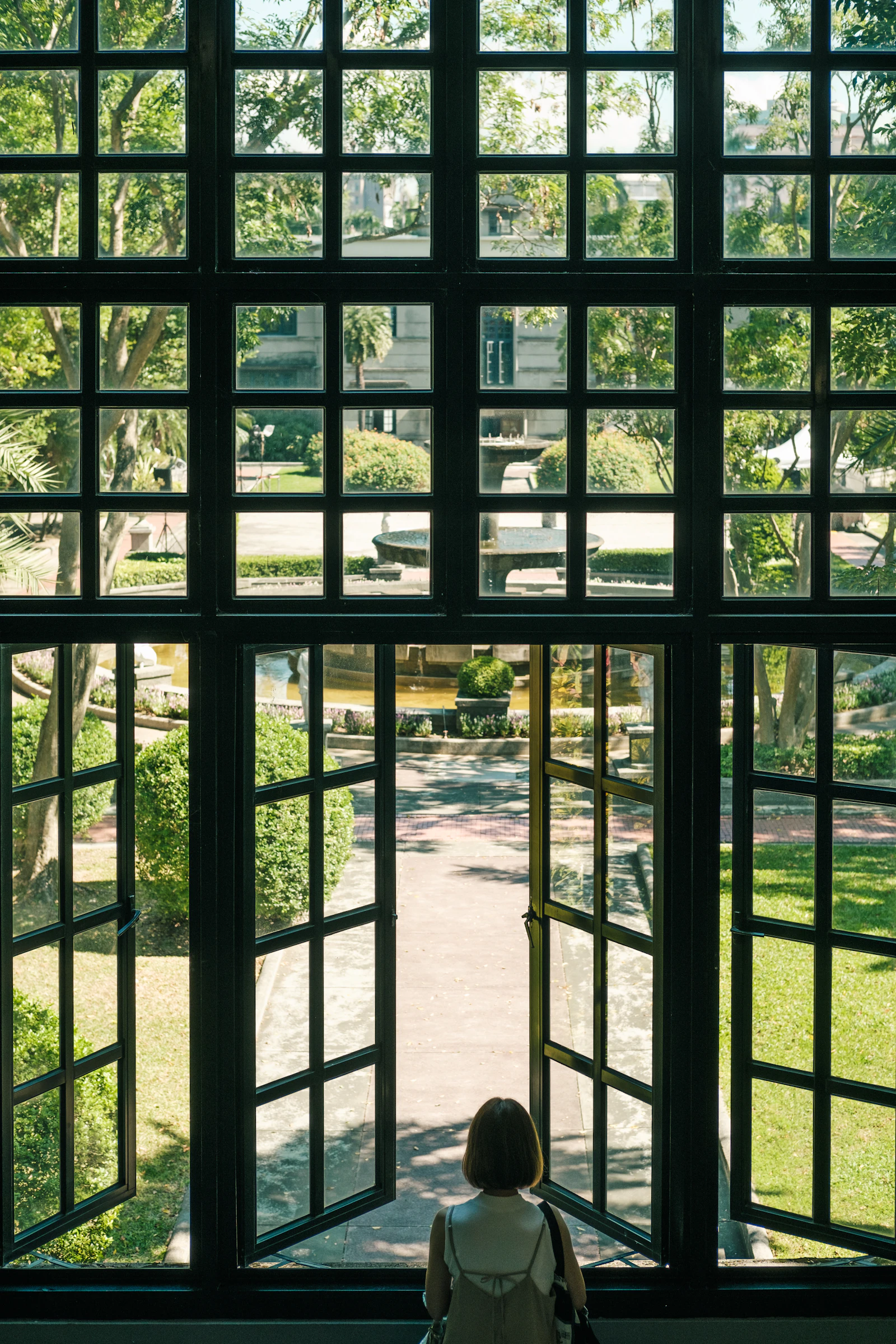
A garden courtyard with a fountain seen through open black steel-framed windows

Comparison: Which Quiet Lobby Fits Your Afternoon
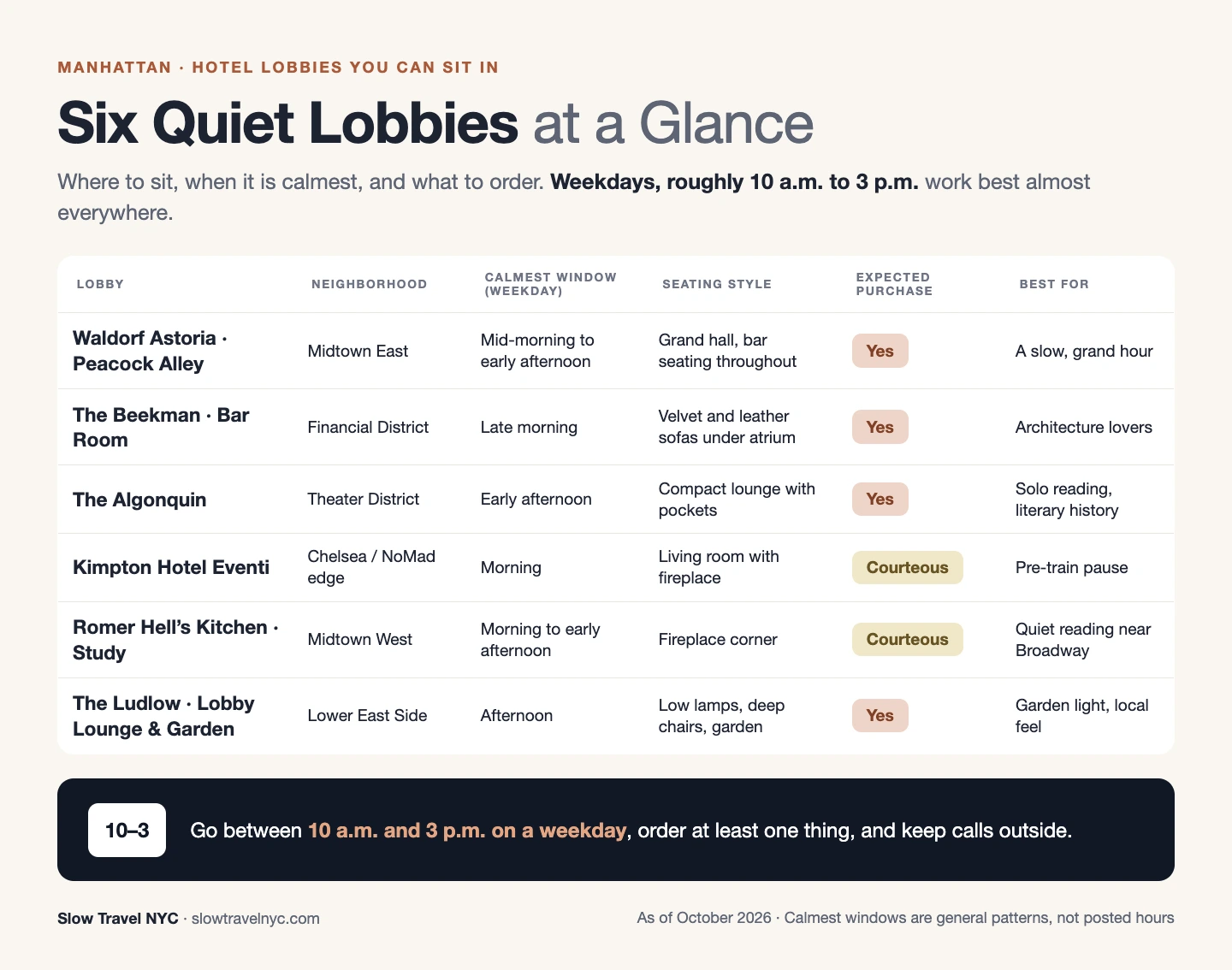
Comparison chart of six quiet hotel lobbies in Manhattan by neighborhood, calmest hours, seating style and what to order

Calmest windows are general patterns, not posted hours. As of October 2026, check each hotel’s current hours before you go.

Reality Check: The Unwritten Rules (and the Real Costs)

A lobby is private property, and “open to the public” means welcome, not entitled. Here’s what nobody posts on the door:

  • You’re buying the chair, not the coffee. At most of these rooms, a drink is the polite cost of an hour. I haven’t confirmed current menu prices for each hotel, so budget generously and check menus on arrival. If you’re working out what to leave on a lounge tab, the NYC Tip & Tax Calculator does the math.
  • Seating can be reclaimed. Bars that double as lobbies often hold tables for guests or reservations once the evening starts. If staff ask you to move, that’s the arrangement.
  • Laptops and calls change the room. A quiet lobby stays quiet because people treat it like a library. Long video calls are the fastest way to lose that welcome — step outside for them.
  • Wi-Fi isn’t guaranteed. Some hotels offer lobby Wi-Fi to everyone, some only to guests or loyalty members. Plan as if you’re offline.
  • Busy beats beautiful. The most famous rooms fill up fast after 5 p.m. and on weekends. A less dramatic lobby on a Tuesday will often feel more luxurious than a spectacular one on a Saturday.
  • Things close. The Graduate on Roosevelt Island, long a favorite calm lobby, appeared to close abruptly in November 2025. Confirm before you make the trip.

Lobbies That Look Calm but Aren’t

The Ace Hotel New York on West 29th Street is still one of the city’s best-known lobby hangouts, with Stumptown next door and long communal tables. It’s also dark, social and often loud, with backless stools and a lobby that shifts to a bar scene at night — great for energy, not for stillness. Hotel bars in general are a different experience; if that’s what you’re after, my guide to glamorous hotel bars in Manhattan covers the evening side of this city.

If a lobby is full, don’t fight for a seat. Some of the calmest places in Midtown aren’t hotels at all — I’ve gathered them in the quietest places to sit in Midtown.
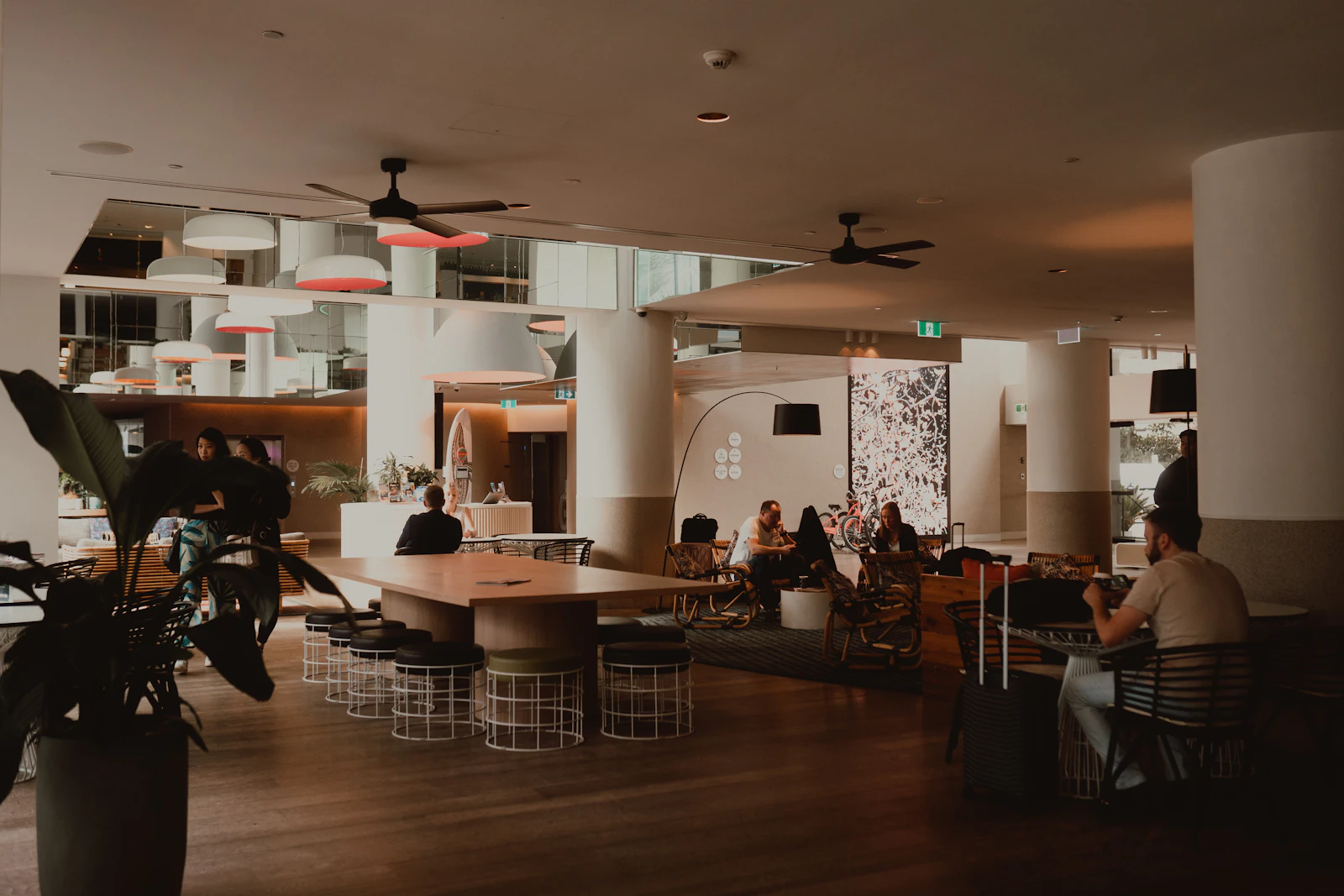
People sitting at tables in a spacious hotel lobby lounge with a long wooden table and ceiling fans

How to Spend a Slow Hour in a Hotel Lobby

My own rule is simple: one book, one drink, phone face down. The point of a hotel lobby open to the public in NYC isn’t to work for free — it’s to borrow a room that was built with more care than most of the city’s indoor spaces, and to give it back a little calmer than you found it.

A few habits that help:

  1. Arrive with a purpose that fits the room. Reading, writing a postcard, or waiting for dinner reservations all suit a lobby. Spreading out three devices doesn’t.
  2. Order early. Ordering in the first five minutes signals that you’re a customer, not a squatter, and staff tend to leave you be.
  3. Sit on the edges. Corners and side alcoves are quieter than the center of any atrium.
  4. Pair it with a walk. The Beekman sits close to the Brooklyn Bridge walkway; the Algonquin is a short walk from Bryant Park. A lobby makes a good bookend to a slow walk.

If you’re building a whole afternoon around reading, where to read alone in NYC has more ideas, and an afternoon tea in Manhattan is the more formal cousin of a lobby hour.

FAQ

Can you sit in a hotel lobby in NYC if you’re not a guest?

Usually, yes, but it’s at the hotel’s discretion. Most quiet hotel lobbies in Manhattan expect non-guests to buy something at the lobby bar or café, and staff can ask you to leave or move, especially during busy evening hours.

Which hotel lobbies are open to the public in NYC without a reservation?

Waldorf Astoria’s Peacock Alley, The Beekman’s Bar Room, The Algonquin’s lobby lounge, Kimpton Hotel Eventi, Romer Hell’s Kitchen and The Ludlow all welcome walk-ins to their lobby bars or lounges, though The Beekman can fill up and may prioritize reservations and guests in the evening.

What’s the best time to visit a quiet hotel lobby in Manhattan?

Weekdays between roughly 10 a.m. and 3 p.m. After 5 p.m., most lobby bars fill with the after-work crowd, and weekends bring more visitors and photographers.

Is it OK to work on a laptop in a hotel lobby?

Quiet laptop work is generally tolerated, but hotels aren’t coworking spaces. Buy something, avoid video calls, don’t hold a large table for hours, and assume Wi-Fi may be limited to guests.

Do I have to tip in a hotel lobby bar?

If you order from a server or bartender, tip as you would at any NYC bar — commonly 18–20% at table service or $1–2 per drink at the bar. The NYC Tip & Tax Calculator can help.

The Quietest Room Is the One You Don’t Rush

A Manhattan hotel lobby can be the most generous room in a crowded city, if you treat it like a living room rather than a free office. Choose one, go early on a weekday, order something you’ll enjoy slowly, and let an hour pass the way it’s supposed to. The city will still be there when you step back out.
Related Reading

NYC Hotel Tax Per Night in 2026: What a $300 Room Really Costs

The NYC hotel tax per night adds 14.75% plus $3.50 to every room, so a $300 rate becomes $347.75 before any destination fee. Here is each line explained, with the few ways to pay less.

A vintage brass service bell on a wooden desk

As of October 2026. Tax rates and fee rules change, so check the official pages linked below before you book.

Disclosure: This post mentions hotel loyalty programs and credit cards. Program terms change, nothing here is financial or tax advice, and some links on this site may be affiliate links. See our disclosure page.

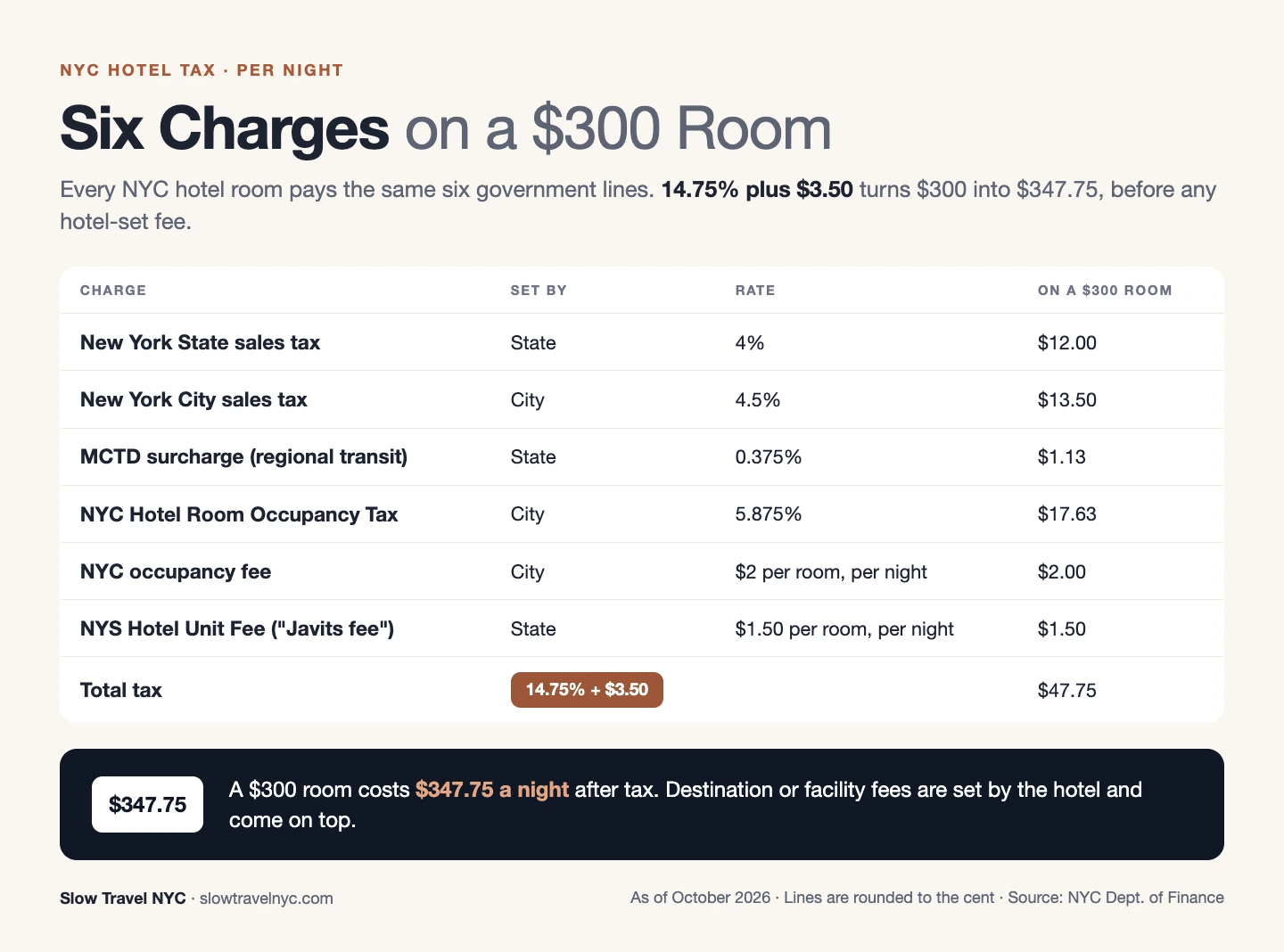
A $300 night in Manhattan costs $347.75 before the hotel adds a single fee of its own. That $47.75 gap is the NYC hotel tax per night. It is made up of six separate government charges, and they land on every bill, whether you stay in a Midtown tower or a twelve-room inn on a quiet West Village block.

None of it is hidden, exactly. It is just scattered. Some charges are percentages, some are flat dollar amounts, and many hotels add a destination or facility fee on top. This guide goes through each line, shows what common room rates turn into, and is honest about the short list of ways to pay less.

Quick Answer: The NYC Hotel Tax Per Night at a Glance

  • The formula: 14.75% of the room rate plus $3.50 per room, per night (for rooms priced at $40 or more).
  • On a $300 room: $47.75 in tax, so $347.75 a night.
  • Destination fees are separate. The hotel sets them, not the government. Since February 21, 2026, a city rule requires them to be included in the advertised price, but taxes can still be shown separately.
  • A small cut may come. The city’s 5.875% portion is scheduled to fall to 5% on December 1, 2027, unless it is extended again.
  • Real exemptions are narrow. For most travelers they come down to very long stays and some points bookings.

What Makes Up the NYC Hotel Tax Per Night

The Hotel Association of New York City lists the charges every NYC hotel guest pays. Two are state and city sales taxes, which are usually combined on your bill as one 8.875% line. One is a regional transit surcharge. The rest are specific to hotels: a city occupancy tax and two flat nightly fees.

Here is how they add up on a $300 room.

Infographic showing six NYC hotel tax lines that turn a $300 room into $347.75 per night

Lines are rounded to the cent. The exact total is $47.75.

Two details catch people off guard. The $2 city fee is charged per room, so a two-room suite pays it twice; the NYC Department of Finance hotel tax page has the full rules. And the $1.50 state fee is commonly called the Javits Center fee. It is a fixed nightly charge, not a percentage, so it is the same at a budget hotel and at The Carlyle.

What Common Room Rates Really Cost

Because $3.50 of the tax is flat, the effective rate is a little higher on cheaper rooms and a little lower on expensive ones. Every room in New York ends up somewhere between about 15% and 17% above its listed rate.

Nightly room rateTax per nightTotal per nightEffective tax rate
$150$25.63$175.6317.1%
$200$33.00$233.0016.5%
$300$47.75$347.7515.9%
$500$77.25$577.2515.5%
$800$121.50$921.5015.2%
$1,100$165.75$1,265.7515.1%

On a four-night trip at $300, the tax alone comes to $191. That is roughly the cost of a good dinner for two, so it belongs in the budget from the start. Our NYC Trip Budget Calculator lets you add it next to transit, food, and tips.

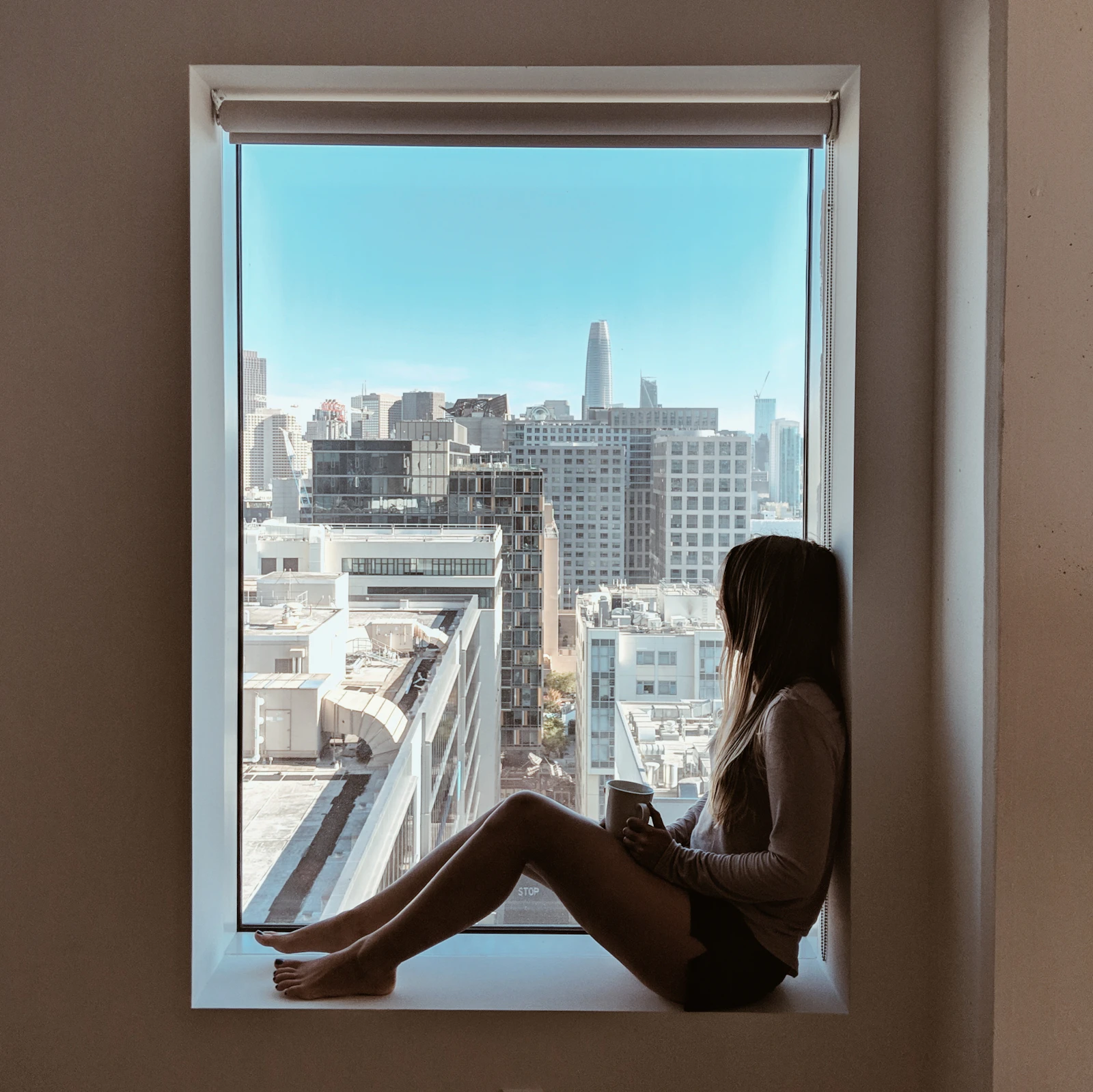
A woman sitting in a hotel room window ledge with a cup, looking out over a city skyline in daylight

What Is the Javits Fee on an NYC Hotel Bill?

The Javits fee is the nickname for New York’s hotel unit fee, a flat $1.50 per room per night on hotel and short-term rental stays in New York City. Section 1104 of the state tax law calls it the convention center hotel unit fee and has applied it since April 1, 2005. The money backs bonds for the Jacob K. Javits Convention Center, which is where the nickname comes from.

Here is what the state tax department’s hotel bulletin says about it:

  • It is a fixed amount. A $150 room and a $1,500 room both pay $1.50 a night. A four-night stay adds $6 per room, and two rooms for four nights add $12.
  • It is not taxed again. The bulletin says the unit fee is not subject to state and local sales taxes, and the invoice must show it as its own line.
  • Short-term rentals pay it too. The state’s short-term rental page says the $1.50 unit fee applies to every short-term rental occupancy in New York City, on top of the sales tax that began March 1, 2025.
  • Permanent residents are exempt. The statute does not apply the fee to occupancy by a permanent resident, and the bulletin’s day table lists the unit fee only for the first 90 days of occupancy.

On a booking screen the Javits fee is usually grouped into “taxes and fees,” so it can be hard to spot. It is already counted in the $3.50 per night in this guide: the $2 fixed hotel tax plus the $1.50 unit fee.

NYC Hotel Destination Fees: The Line That Isn’t a Tax

The second surprise on many bills is a hotel-set charge, called a destination fee, facility fee, or amenity fee depending on the brand. The government does not set it. The hotel decides whether to charge one and how much.

Here is one real example. As of October 2026, YOTEL New York Times Square’s help center lists the standard NYC taxes, a mandatory facility fee of $51.02 per night including tax, and a $50 nightly incidental hold that is released after checkout. It also warns that guests who booked through a third-party site may owe some taxes and fees at arrival.

To see how an NYC hotel destination fee changes the math, here is an illustrative hotel with a $40 nightly fee (tax included):

Per night4 nights
Room rate$300.00$1,200.00
Government taxes$47.75$191.00
Destination fee (incl. tax)$40.00$160.00
What you actually pay$387.75$1,551.00

So the “$300 room” is closer to $390. On a longer stay, the fee can add up to more than the tax increase you were worried about.

What changed in 2025 and 2026

Two rules now shape how these prices reach you. The FTC’s federal “junk fees” rule took effect on May 12, 2025. It requires hotels to show a total price that includes mandatory fees.

New York City then went further. On January 21, 2026, the city announced a final rule from the Department of Consumer and Worker Protection, effective February 21, 2026. According to a summary by Herrick, Feinstein:

  • The advertised price must include all mandatory fees. Only government-imposed taxes and fees can be left out.
  • The final amount must be shown at least as prominently as the advertised total.
  • Starting January 22, 2027, hotels must also state their standard deposit or card-hold amount, when they might keep it, and how long a release takes. That part of the rule starts later than the rest.
  • The rule covers booking sites and online travel agencies selling NYC hotels, not just the hotels.
  • Fines run from $525 for a first violation to $3,500 for repeat violations.

How to read a booking screen now

  • Advertised total: room rate plus the hotel’s mandatory fees. Taxes may not be included yet.
  • Final amount: this is the number to compare. It should include everything above plus the 14.75% and $3.50.
  • Deposit or hold policy: required to be shown before you pay starting January 22, 2027. Until then, check the hotel’s policy yourself, especially if you use a debit card.
A guest standing at a wooden hotel check-in counter in a bright lobby

Ways to Pay Less on NYC Hotel Taxes (and What Doesn’t Work)

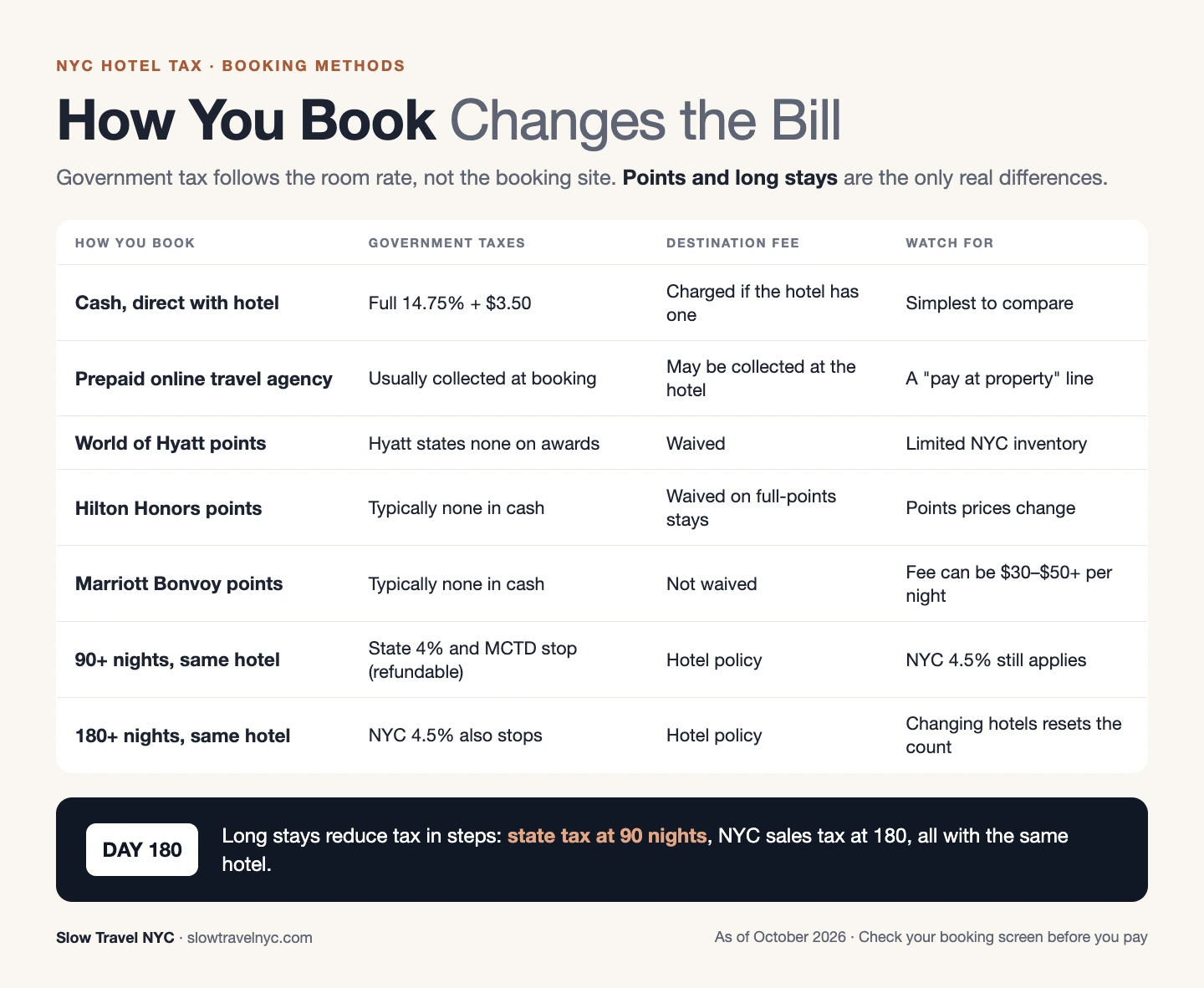
Government tax cannot be negotiated at the front desk. What you can change is the base rate it is calculated on, the way you book, and occasionally whether certain charges apply at all.

Infographic comparing cash, online travel agency, points and long stays by taxes and destination fees in NYC

The points rows come from The Points Guy’s resort fee guide: Hilton and Hyatt waive resort fees on award stays, and Marriott does not. The long-stay rows come from New York State’s hotel occupancy bulletin. Under those rules, a guest becomes a “permanent resident” after 90 consecutive days, but NYC’s local sales tax keeps applying until day 180.

A few other approaches work in smaller ways:

  • Lower the base rate. Most of the tax is a percentage, so 25% off the room is also 25% off most of the tax. NYC Hotel Week works this way.
  • Treat credits as credits, not tax relief. Programs like Amex Fine Hotels + Resorts may add breakfast and a property credit, but the tax line is calculated on the room rate you pay.
  • For very long stays, compare apartments. If you are staying for months, corporate housing is taxed under different rules and may be cheaper.

What doesn’t work: asking the desk to remove the tax, booking in another currency, or paying with a foreign card. A no-foreign-transaction-fee card avoids your bank’s 1–3% fee, but the city’s 14.75% stays the same.

Reality Check

  • Don’t budget around the 2027 cut. A 2023 city law extended the 5.875% rate to December 1, 2027, and set it to fall to 5% after that. The rate has been extended repeatedly since 2009. Even if the cut happens, it saves about $2.63 a night on a $300 room.
  • The advertised total still isn’t final. NYC’s rule lets government taxes sit outside the advertised total. Always compare final amounts.
  • Points nights are not free nights. You are spending points that have a cash value, and a Marriott redemption can still come with a nightly destination fee.
  • Holds are not charges, but they matter. A $50-a-night hold on a debit card can lock up real money for days or weeks after checkout. The new rule will make hotels disclose holds from January 22, 2027; it does not end them.
  • Exemptions are specific. Government, nonprofit, and some diplomatic exemptions require official forms. A business card or a polite request does not qualify.
  • Room-service and bar charges are taxed differently. They carry the regular 8.875% sales tax, not the hotel taxes. Our NYC Tip & Tax Calculator handles that math.
A dark credit card with a chip lying on a white surface

A Slower Way to Think About It

The tax rises with the price of the room, but it does not change with the location. A $300 room twenty minutes from where you want to be carries the same $47.75 as a $300 room around the corner from it.

That is where I would spend the thinking. Pick the neighborhood first, then the hotel. One fewer night somewhere you can walk out to a quiet café at 8 a.m. usually feels better than an extra night that starts on a crowded train platform. The six tax lines are fixed; where your mornings begin is not.

FAQ

How much is the hotel tax in NYC per night?

For any room priced at $40 or more, it is 14.75% of the room rate plus $3.50 per room, per night. On a $300 room, that is $47.75, for a total of $347.75 before any hotel-set fees.

Is an NYC hotel destination fee a tax?

No. A destination, facility, or amenity fee is set by the hotel, not the government. Since February 21, 2026, NYC requires mandatory fees like this to be included in the advertised price, but the fee itself is still allowed.

Do I pay NYC hotel tax on a points stay?

Often not in cash, but check the booking screen before you confirm. World of Hyatt says award stays carry no taxes or fees. Hilton waives resort fees on full-points stays. Marriott generally charges the destination fee on award stays.

Is NYC hotel tax going down in 2027?

It is scheduled to. The city’s 5.875% occupancy tax is set to drop to 5% on December 1, 2027. The city has extended the higher rate several times before, so treat the cut as possible, not certain.

Do these taxes apply if I book through Expedia or Booking.com?

Yes. The same NYC taxes apply no matter where you book. Depending on the rate, the booking site may collect them upfront, or the hotel may collect taxes and fees when you arrive.

What is the Javits fee on an NYC hotel bill?

It is the nickname for New York’s $1.50 per room per night hotel unit fee, which backs bonds for the Javits Convention Center. It is a flat fee, not a percentage, and it is not subject to sales tax.

Final Thoughts

The NYC hotel tax per night is predictable once you know the formula: 14.75% plus $3.50, every night, on every room. The real variable is the hotel’s own fee. The new disclosure rules make it easier to see, but they don’t remove it. Compare final amounts, check the deposit policy, and spend your effort on the neighborhood rather than the tax line.

Related Reading

Boutique Hotels Near Central Park With Gym: 4 Top Picks for Runners

Planning a running trip to Manhattan? These four boutique hotels near Central Park combine round-the-clock fitness centers with a short walk to the park’s best running loops, plus practical tips for marathon season.

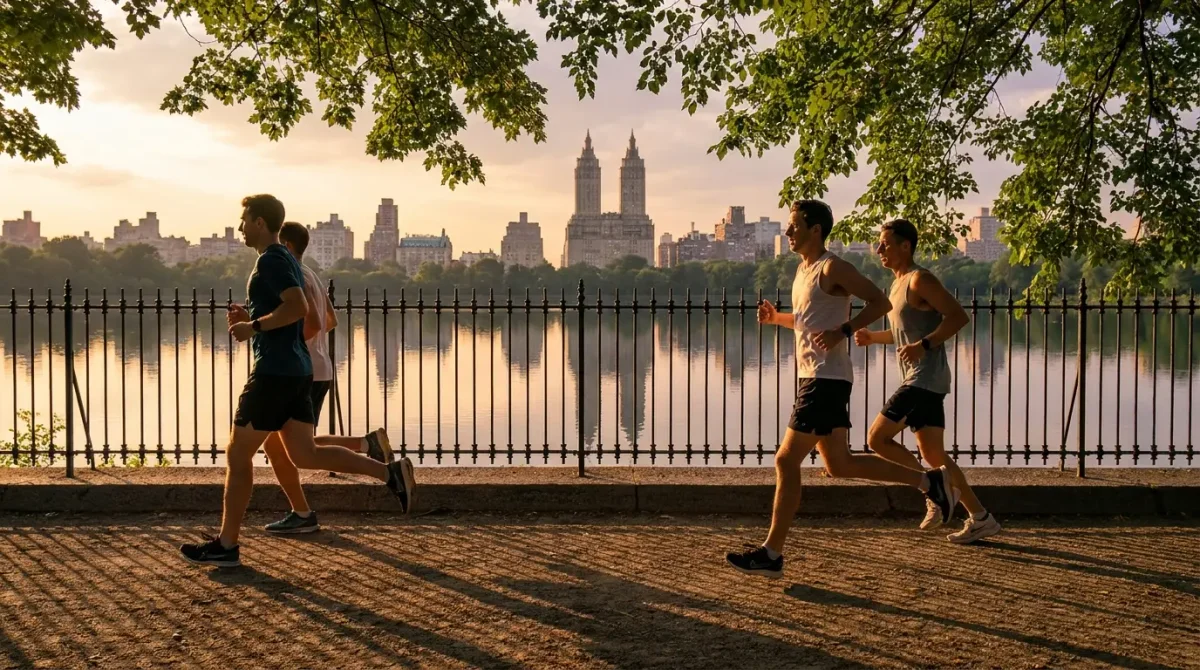
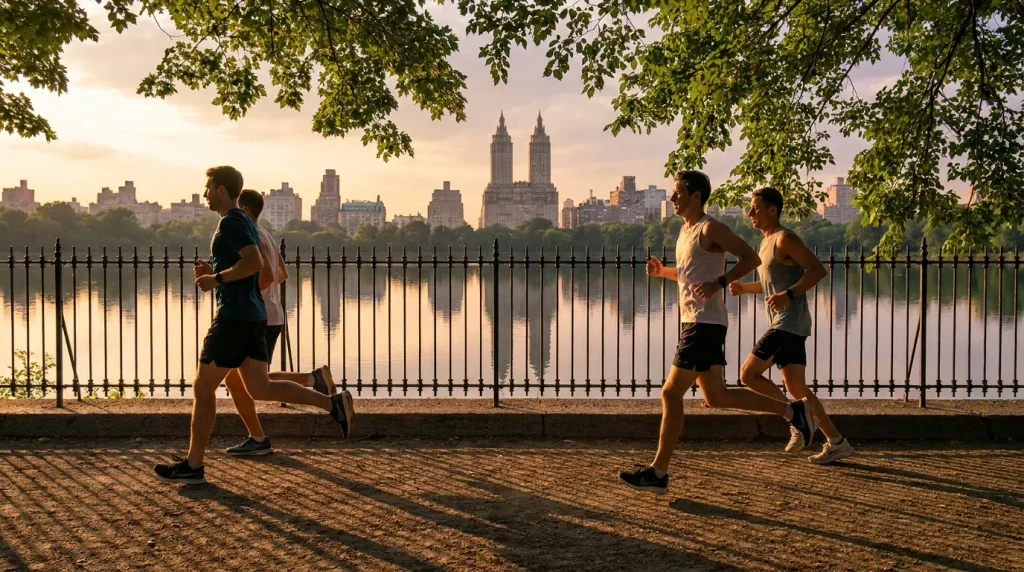
    Runner jogging in Central Park at sunrise near boutique hotels with gym access in Manhattan

    If you’re a runner or lifter heading to Manhattan, location and amenities decide everything. The best boutique hotels near Central Park with gym access put you a few minutes from the park’s running loops, then give you a proper fitness center for strength sessions, late-night workouts and rainy-day training.

    This guide covers four of the best hotels near Central Park for runners. I compared each hotel’s own pages, travel listings and Central Park Conservancy route data, so you know what to expect before you book.

    Quick Comparison: Boutique Hotels Near Central Park With Gym

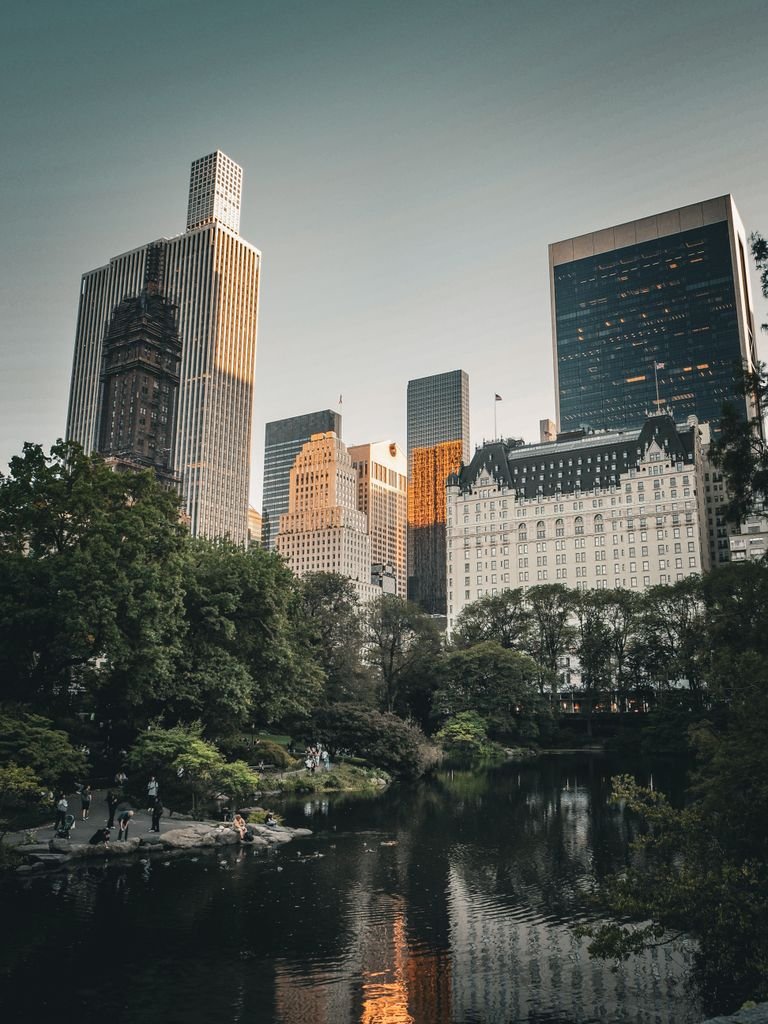
    Central Park South entrance with Manhattan hotels in the background
    HotelAreaWalk to Central ParkGym HighlightsVibe
    1 Hotel Central ParkCentral Park SouthAbout 1 block24-hour Field House, Peloton bikes, rowers, kettlebellsEco-luxury
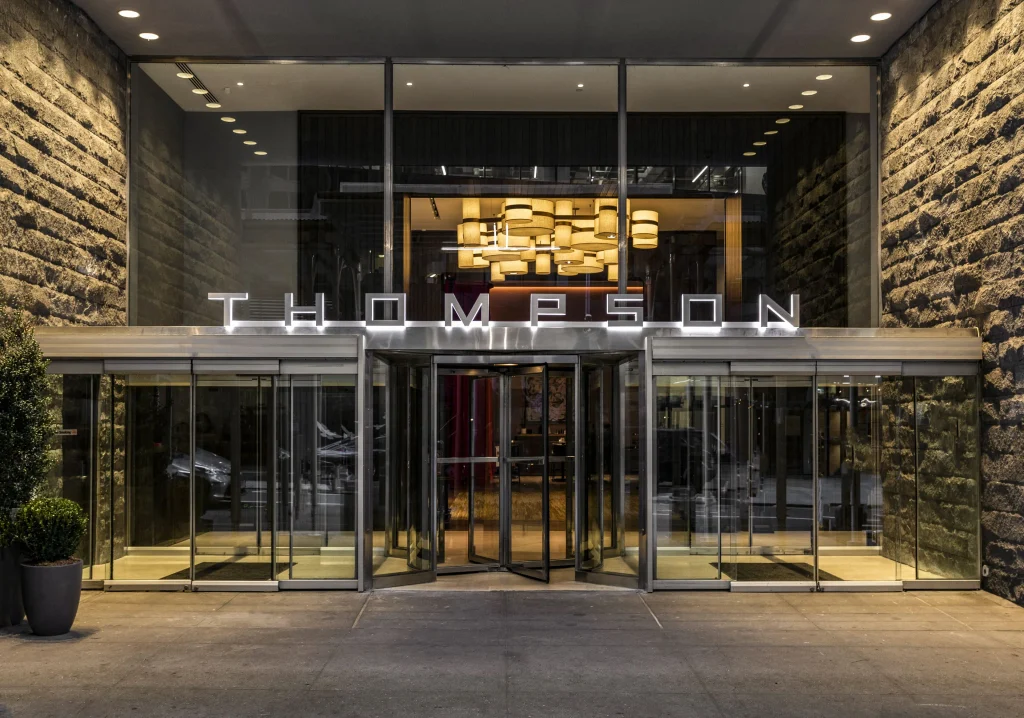
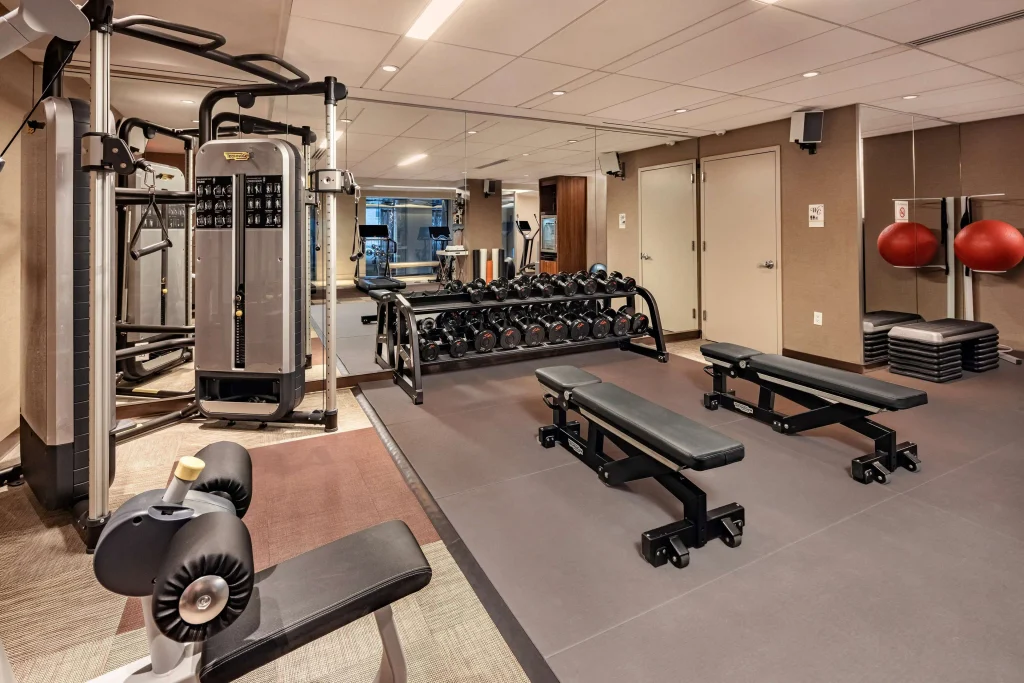
    Thompson Central ParkMidtownAbout 5 minutesSubterranean gym (“The Underground”), Peloton bikesSleek, mid-century
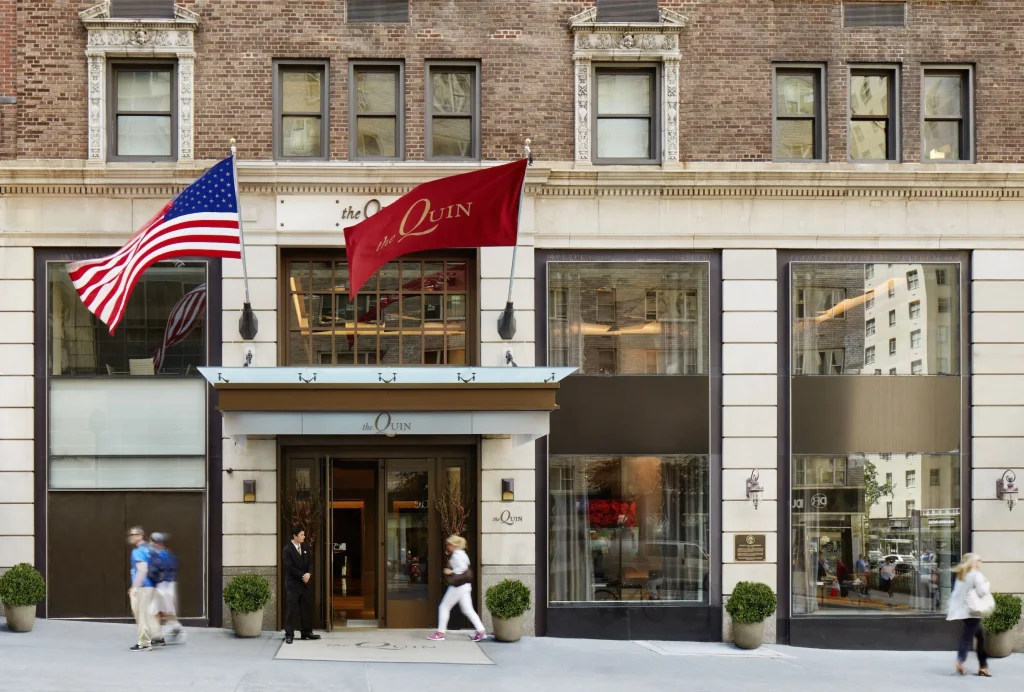
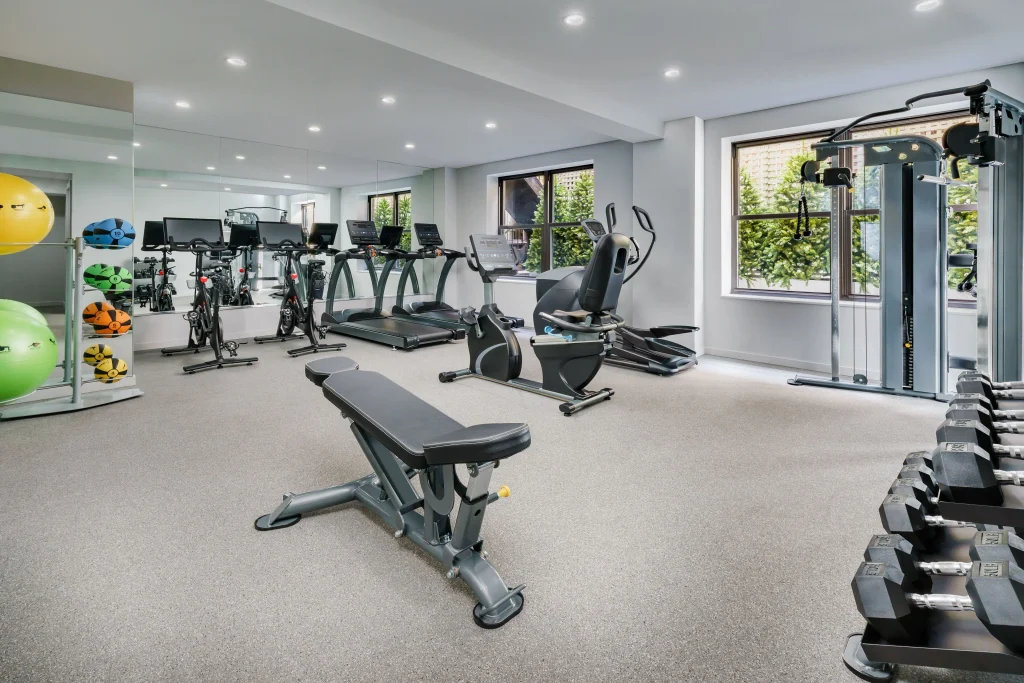
    The Quin (Hilton Club)MidtownAbout 2 blocks24-hour gym, Peloton bikes, personal training and private yogaArt-inspired, refined
    The WallaceUpper West SideAbout 10–15 minutes24-hour gym, 2 Peloton bikes, free weightsResidential, upscale

    Equipment and hours change often, so confirm with the hotel before you book.

    Why Choose Boutique Hotels Near Central Park With a Gym?

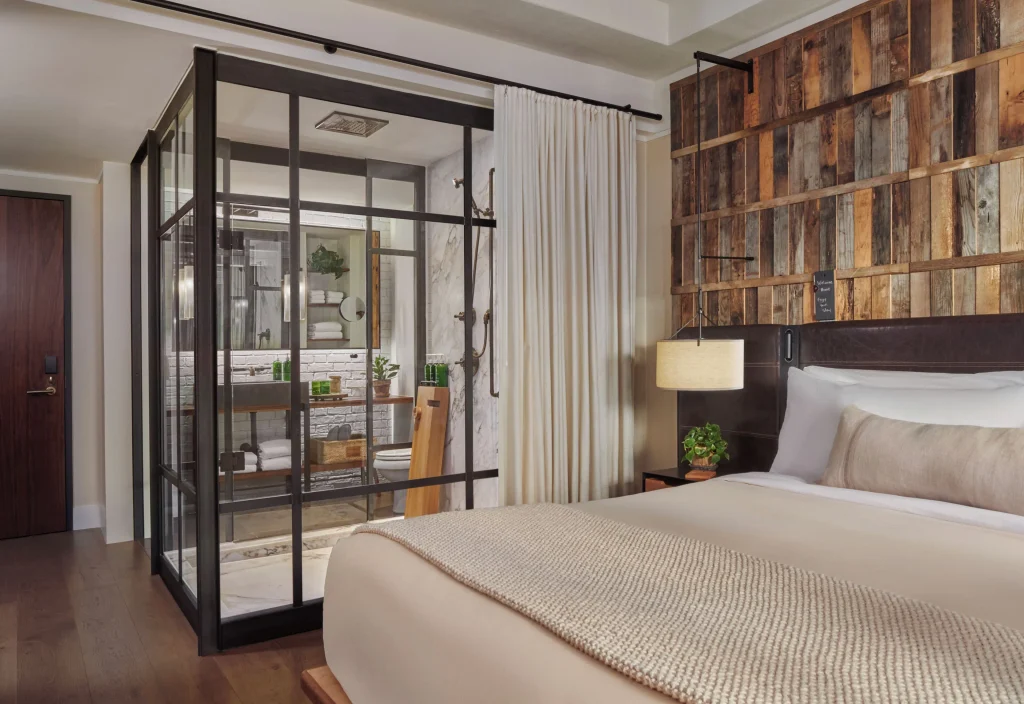
    Cozy boutique hotel room in Manhattan with natural light and modern decor

    Large chain hotels often have cramped basement gyms and slow elevators. Boutique properties are smaller, quieter and usually more thoughtful about wellness. Guests also tend to like the personal touches, such as running maps at the front desk and trainer referrals.

    Staying within a few blocks of the park matters too. You can start a run from the lobby without battling Midtown crosswalks, and you can still hit the gym at 5 a.m. or midnight if your schedule is off.

    4 Best Hotels Near Central Park for Runners

    1. 1 Hotel Central Park: Best for Wellness and Sustainability

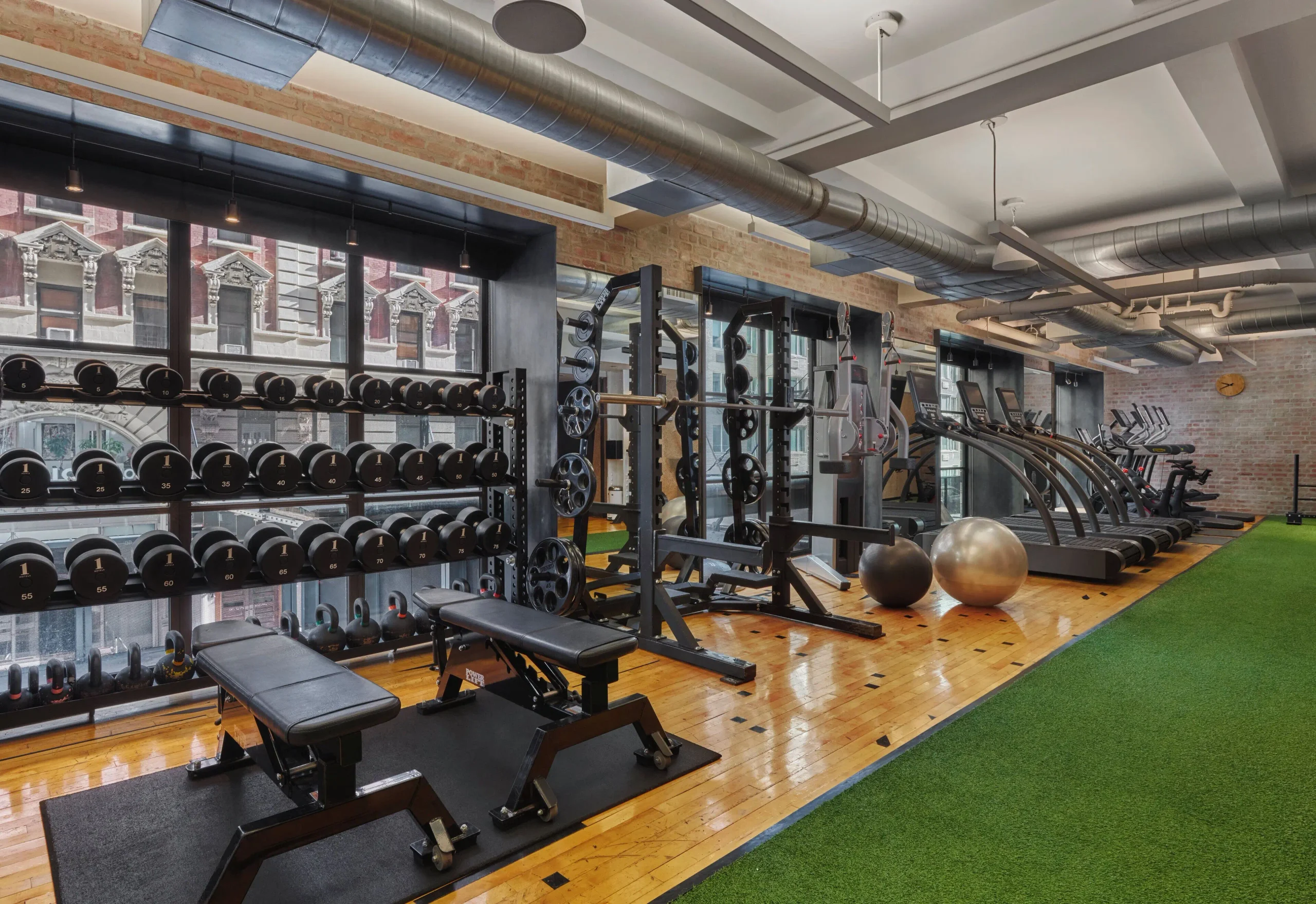
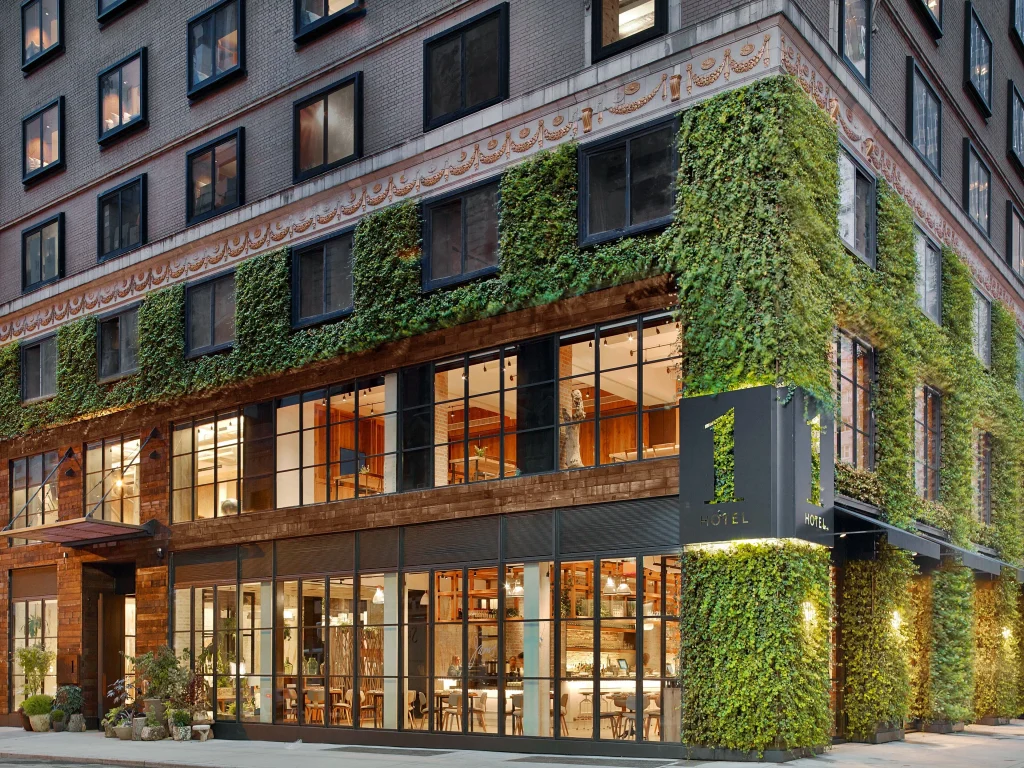
    Sitting at 1414 6th Avenue, 1 Hotel Central Park is the strongest all-round choice if you want eco-conscious design and serious fitness. Its Field House gym is on the second floor and open 24 hours daily. It has Peloton bikes, rowers, kettlebells, a resistance treadmill, and a stretching area with a reclaimed wooden floor.

    24-hour Field House gym at 1 Hotel Central Park with Peloton bikes and reclaimed wood floor
    boutique hotels near Central Park with gym

    Runner’s perk: The hotel offers a Central Park running map with loops from about 1.5 to 6 miles, and complimentary group classes for guests. Note that the hotel charges an amenity fee that covers wellness extras, so factor it into your budget.

    For the running routes, see the guide to running routes in Central Park.

    2. Thompson Central Park New York: Best for Peloton Fans

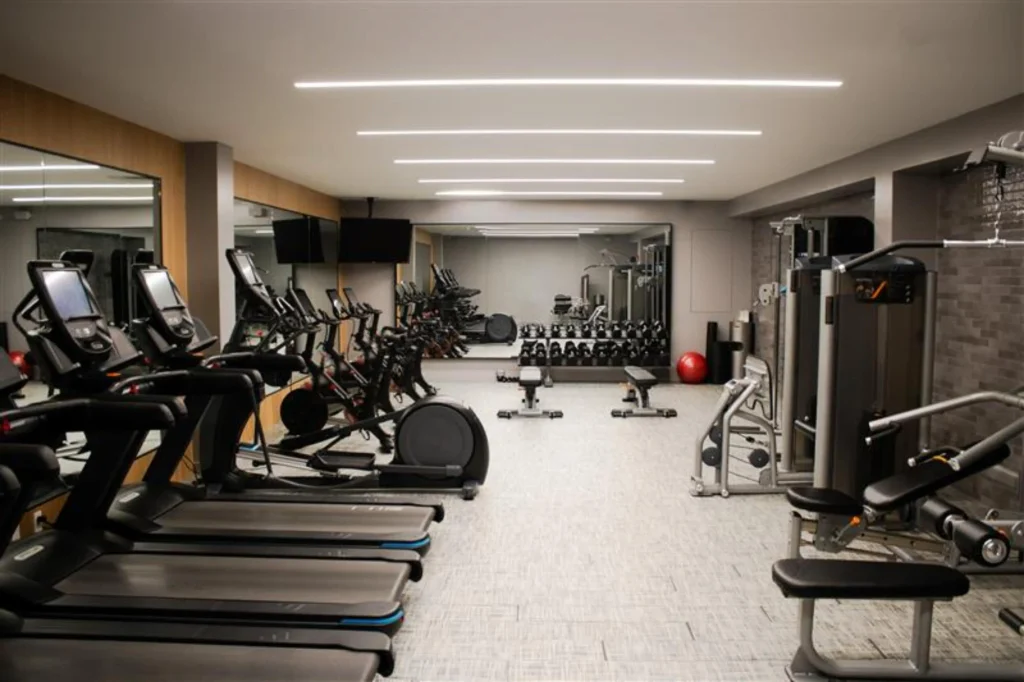
    Located at 119 West 56th Street, on the same block as Carnegie Hall, the Thompson is about a five-minute walk from the park. Its gym is underground and packed with modern equipment. The hotel has offered Peloton bikes since opening in 2021, and it encourages guests to take Peloton app classes in their rooms or on guided walks in the park, as described in Peloton’s hospitality case study.

    Peloton bikes in the underground fitness center at Thompson Central Park New York
    Peloton bikes in the underground fitness center at Thompson Central Park New York

    Runner’s perk: A straight shot up to the park’s southern entrance, which makes it a great base for tempo runs. Confirm current gym hours when you book if you plan on very early or late sessions.

    3. The Quin Central Park by Hilton Club: Best for Personal Training

    The 208-room Quin sits at 57th Street and Sixth Avenue, about two blocks from the park. Travel listings consistently describe a 24-hour fitness center that includes a Peloton bike and can arrange personal training and private yoga sessions. You can see the equipment details on Pelo Buddy’s listing.

    Fitness center at The Quin Central Park by Hilton Club, two blocks from the park

    Runner’s perk: It’s next to a subway station and close to the New York Road Runners RUNCENTER on 57th Street, which makes it easy to join group runs or use lockers.

    4. The Wallace Hotel: Best for a Quiet Upper West Side Stay

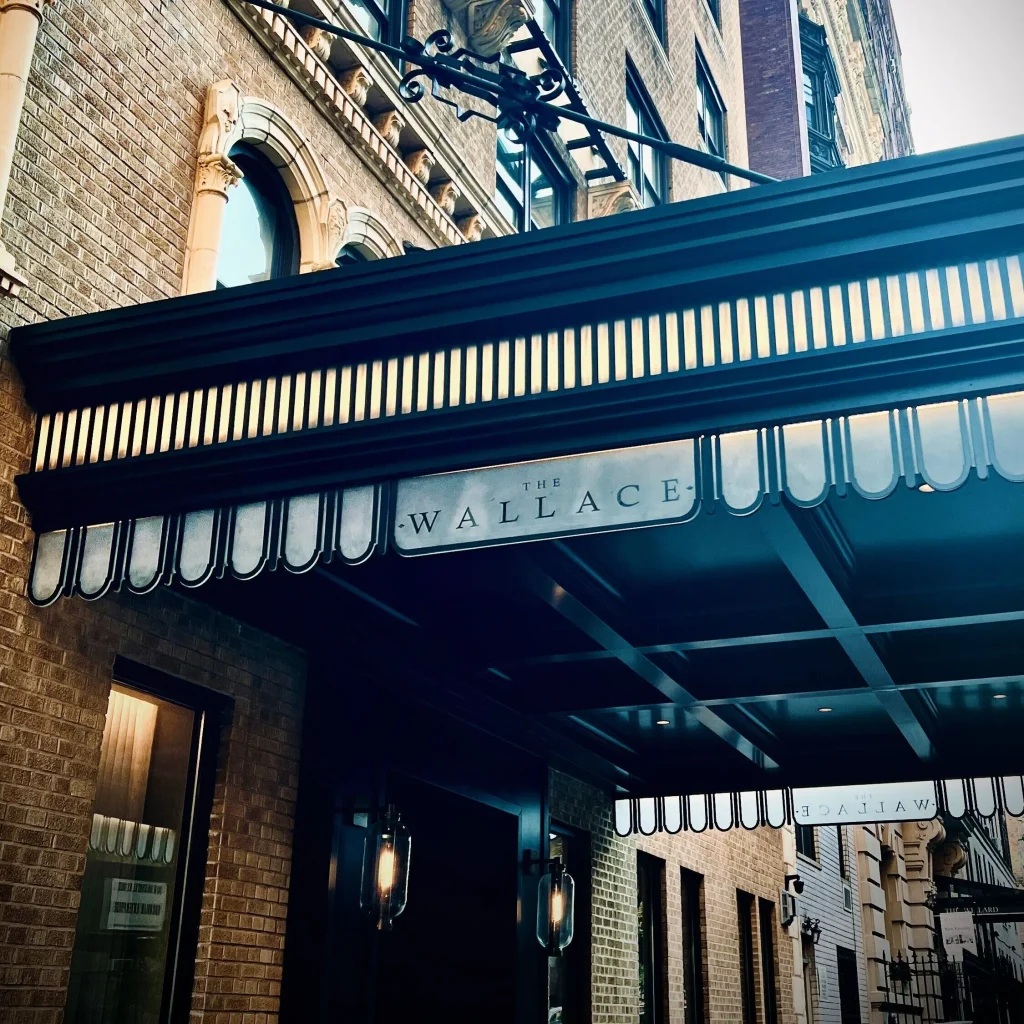
    At 242 West 76th Street, The Wallace trades Midtown bustle for tree-lined residential streets. Its 124 rooms are paired with a complimentary 24-hour fitness center featuring cardio equipment, free weights and 2 Peloton bikes, according to Haute Living.

    The Wallace Hotel gym on the Upper West Side with cardio equipment and Peloton bikes
    The Wallace Hotel gym on the Upper West Side with cardio equipment and Peloton bikes

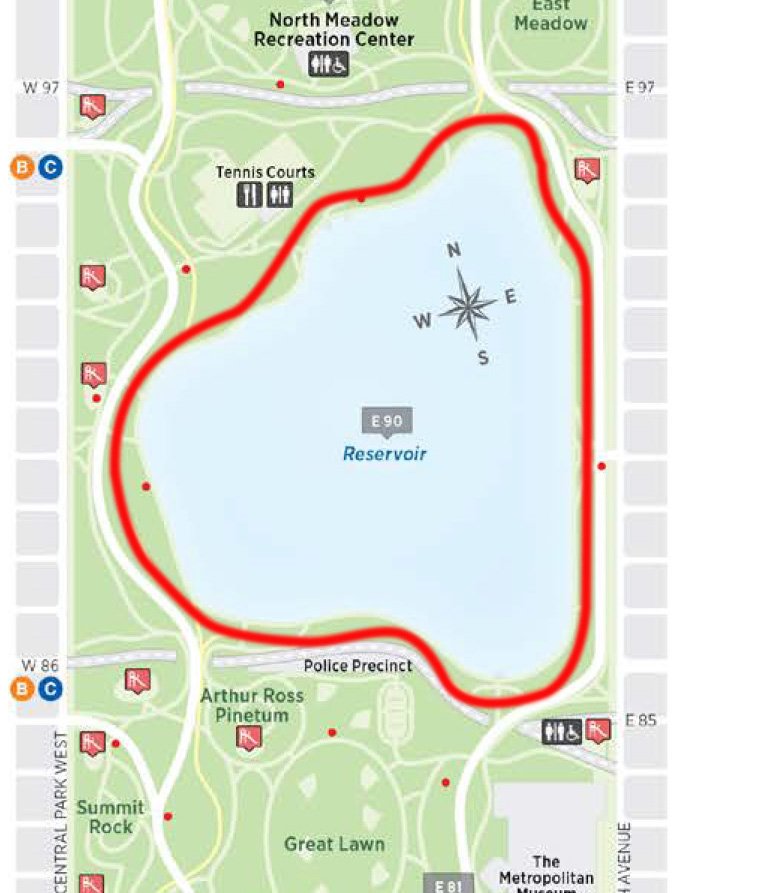
    Runner’s perk: You’re a reasonable walk from the park’s west side and the Reservoir track, and you’ll avoid most tourist crowds. Some guest reviews mention occasional equipment downtime, so don’t count on a specific bike being available.

    Where to Run Once You’re Out the Door

    Whichever hotel you choose, these Central Park Conservancy routes are the ones to know:

    Runners on the 1.58-mile Central Park Reservoir track with the Manhattan skyline
    Reservoir running track
    • Reservoir running track: a 1.58-mile loop with some of the best skyline views, and a softer surface than pavement.
    • Full park loop: 6.1 miles on the paved drive, with transverse roads for shorter options.
    • Bridle path: a 1.66-mile soft-surface loop around the Reservoir track.

    The park roads can open to traffic at certain times, so weekends and mid-day weekdays are safest. Official running maps also mark water fountains and restrooms.

    What to Look for in Hotels Near Central Park for Runners

    Before you book, run through this checklist:

    1. True 24-hour access. Confirm the gym is open overnight, not just “extended hours.”
    2. The exact equipment you need. Peloton, treadmills and free weights vary by property and can change.
    3. Distance in walking minutes, not blocks. The difference between 1 block and 15 minutes matters at 6 a.m.
    4. Late checkout or bag storage. Essential if you’re running a race and want a post-race shower.
    5. Hidden fees. Amenity and resort fees can change the real price.

    Staying Near the Finish Line on Marathon Weekend

    The TCS New York City Marathon finishes in Central Park, and the 2026 race was held on Sunday, November 1. If you are racing or spectating in a future year, book early. Hotels near the park fill up fast, and staying close means a shorter walk back after 26.2 miles.

    FAQ

    Are there boutique hotels near Central Park with a gym that’s open 24 hours?
    Yes. 1 Hotel Central Park, The Quin and The Wallace all advertise 24-hour fitness centers. Check the Thompson’s hours directly.

    Which hotel is closest to the Reservoir track?
    The Wallace on the Upper West Side is generally closest to the park’s western side. The Midtown hotels are better for the southern end and the 6.1-mile loop.

    Do these hotels have Peloton bikes?
    All four are reported to have Peloton bikes, but availability varies, so call ahead if it’s a dealbreaker.

    Final Recommendation

    For the most complete experience among boutique hotels near Central Park with gym access, 1 Hotel Central Park combines park proximity, a 24-hour gym and wellness programming. If you prefer a quieter neighborhood, The Wallace is a strong pick. And if Peloton or personal training is your priority, look closely at the Thompson and The Quin.

    Whichever you pick, confirm gym hours and equipment directly with the hotel.

    Related posts you might enjoy: