

Disclosure: This post may contain affiliate links. Loyalty program rules, award prices and card terms change often, and nothing here is financial advice. Check the program’s own site before you transfer or redeem. See our full disclosure policy.
This spring, one reviewer booked a night at the Conrad New York Midtown. It cost either $641 including tax or 95,000 Hilton Honors points. A few blocks away, The Time New York now starts at 15,000 World of Hyatt points after dropping a category in May. Both rooms are in Midtown. The point totals differ by more than six times.
That gap explains most of what you need to know about the best hotel points for NYC. A bigger point balance does not mean more nights. What decides it is how each program prices a Manhattan night, what fees still show up at checkout, and whether your credit card points can move there at all. Every figure below is as of October 2026.
Key Takeaways
- World of Hyatt usually gives the most value per point in NYC. It still has a published chart: Category 5 hotels cost 15,000 to 35,000 points a night, and Category 8 costs 35,000 to 75,000.
- Marriott Bonvoy has the most hotels in NYC, but prices are fully dynamic. Luxury nights often cost 100,000 points or more, and resort or destination fees are not waived on award stays.
- Hilton Honors uses big numbers for small points. A flagship Conrad night near 95,000 points can still be a decent Hilton redemption, because a Hilton point is worth less than a Hyatt point.
- Transfers decide a lot. Chase points go to Hyatt 1:1. Amex points go to Hilton 1:2 and to Marriott 1:1. Transfers are final.
- Check the cents-per-point math before every booking. The same hotel can be a great deal on a Tuesday in February and a poor one during Thanksgiving week.
How Hyatt, Marriott and Hilton Price a Night in New York
All three programs will let you sleep in Manhattan on points. They count very differently, and New York, with some of the highest cash rates in the country, makes those differences larger.

World of Hyatt: still a chart, now with five tiers
On May 20, 2026, Hyatt replaced its three pricing levels (Off-Peak, Standard, Peak) with five: Lowest, Low, Moderate, Upper and Top. Each category still has a fixed floor and ceiling, which no other big chain offers. The current Hyatt award chart puts a Category 5 standard room at 15,000 to 35,000 points a night, a Category 6 at 20,000 to 40,000, a Category 7 at 25,000 to 55,000 and a Category 8 at 35,000 to 75,000.
The same update moved several New York hotels. Andaz 5th Avenue went from Category 7 to 8, The Beekman went from 6 to 7, and The Time New York dropped from 6 to 5. Upgraded Points noted that The Time can now cost as little as 15,000 points a night.
Marriott Bonvoy: the biggest footprint, no chart
Marriott has more New York hotels than either rival, from Moxy and AC to The St. Regis and two Ritz-Carltons. It publishes no award chart, so each night is priced by demand. In July 2026, The Points Guy reported top nightly rates at The Ritz-Carlton New York, NoMad of 160,000 points, up from 142,000 a year earlier.
Marriott does have one structural advantage: every member gets the fifth night free on award stays, with no status required.
Hilton Honors: big numbers, small points
Hilton also prices dynamically, and its numbers look alarming at first. The Conrad New York Midtown, an all-suite hotel near Central Park, usually prices standard rewards at about 90,000 to 95,000 points. But a Hilton point is worth far less than a Hyatt point. NerdWallet values Hilton points at 0.4 cent, so 95,000 points is less of a splurge than it sounds.
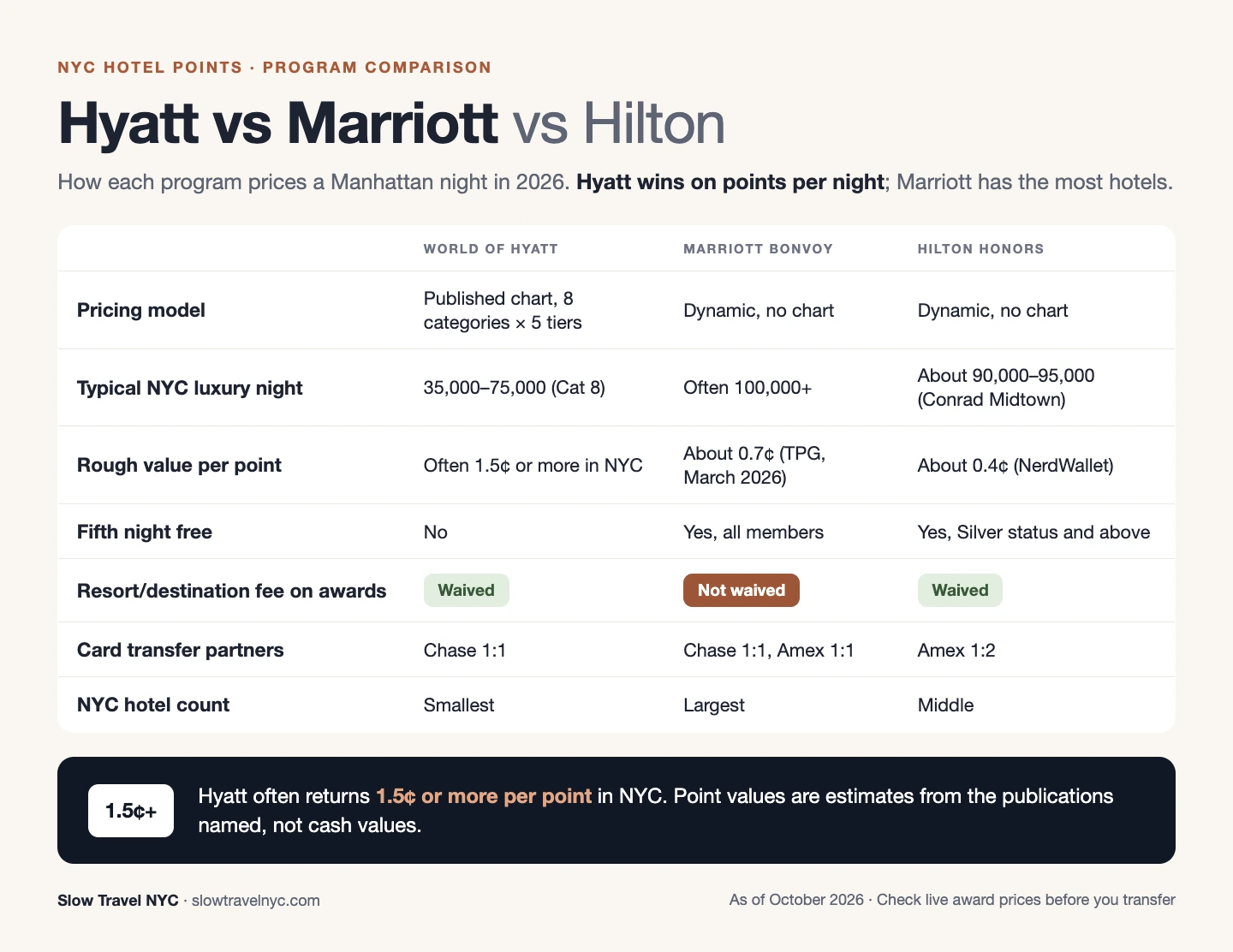
As of October 2026. Point values are estimates from the publications named, not cash values.
Hyatt vs Marriott vs Hilton NYC: Real Hotel Examples
Program-level comparisons only go so far. You book a specific hotel on a specific date. These are reported price ranges for well-known New York properties. Live prices on your dates will differ.
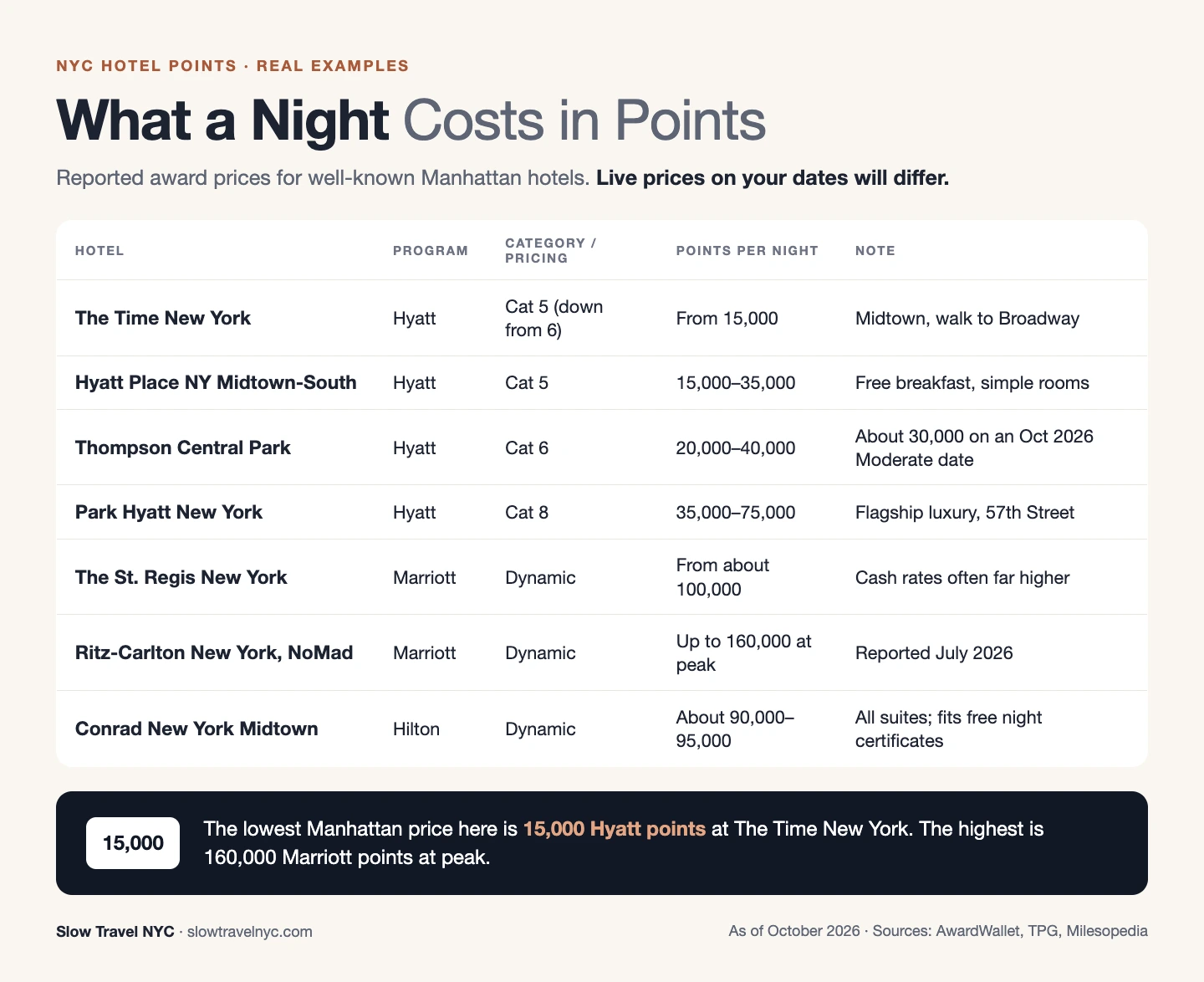
As of October 2026. Sources: AwardWallet (Thompson), TPG (St. Regis), Milesopedia (Conrad). Always check live availability before transferring points.
Thompson Central Park is a useful reference point. AwardWallet found an October 2026 night priced at 30,000 points, up just 1,000 from the old chart. For a Category 6 near the park, that was a smaller increase than many feared. If you run Central Park loops on your trips, our guide to boutique hotels near Central Park with a gym covers what is nearby on a paid rate.
The Math: When a Points Night Is Worth It
There is one formula, and it is simple:
Cash rate after taxes and fees ÷ points required = cents per point (¢).
Compare the result with a reasonable value for that program. If you get less, pay cash and keep the points for a better night.

A real Hilton example. The Conrad night above: $641 ÷ 95,000 points = about 0.67¢ per point. That is well above NerdWallet’s 0.4¢ baseline for Hilton, so it was a sound use of Hilton points, even though 95,000 sounds like a lot.
An illustrative Hyatt example. Suppose a Category 6 night prices at 25,000 points when the cash rate is $450 after tax. $450 ÷ 25,000 = 1.8¢. That is a strong result. If the same night jumped to the 40,000-point Top tier, the value would fall to about 1.1¢, and you should probably reconsider.
An illustrative Marriott example. A 100,000-point night at a hotel charging $900 works out to 0.9¢, only modestly above TPG’s 0.7¢ estimate. Marriott redemptions in Manhattan often land here: acceptable, but rarely remarkable.
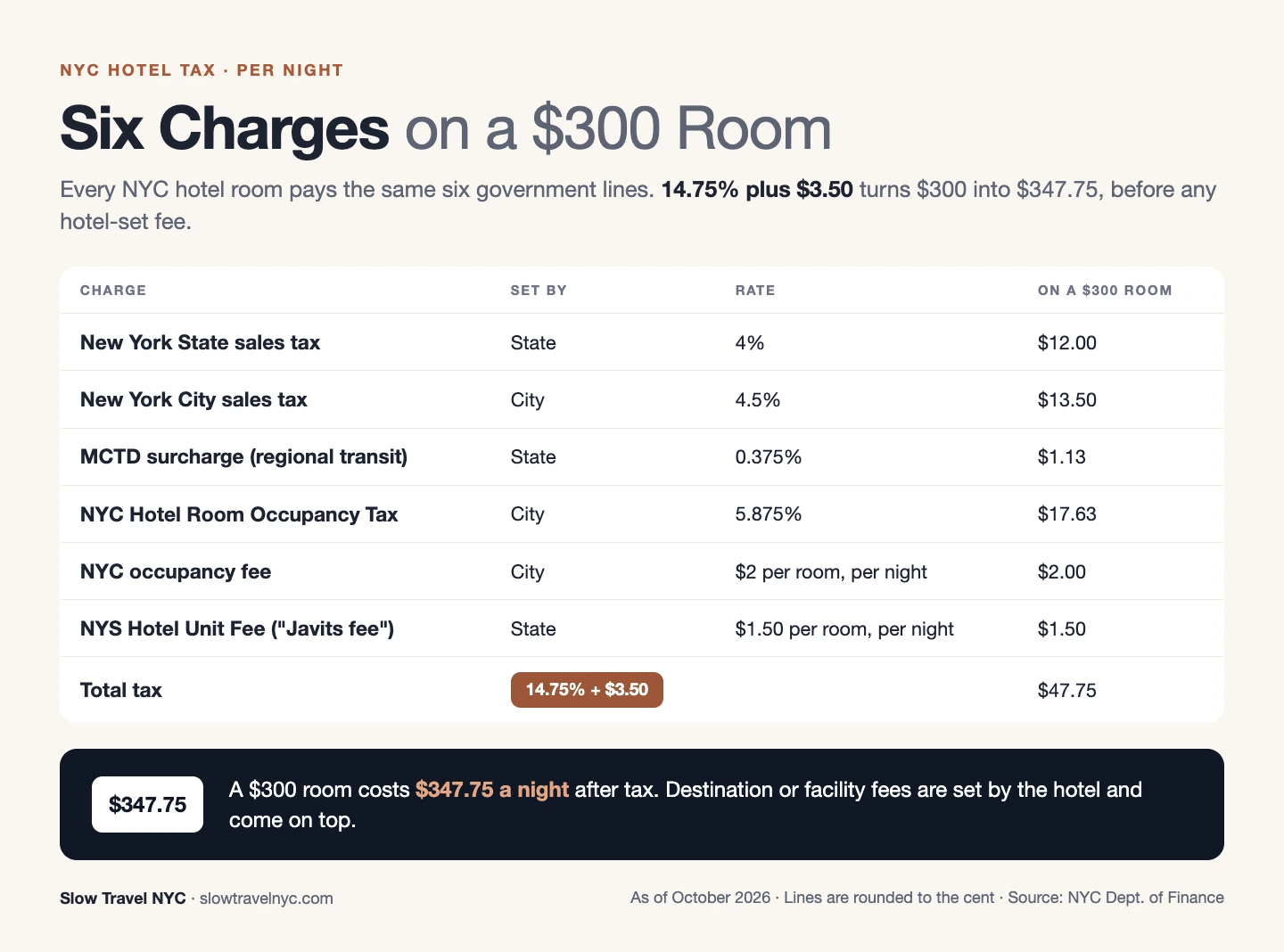
Hotel taxes matter in this calculation. Cash nights in New York carry sales and occupancy tax plus fixed per-night fees. Include them when you calculate the cash rate, because that is the money a points night saves you. Our NYC Trip Budget Calculator can help you price the cash version of the trip first.
Where Your Credit Card Points Should Go
For most New Yorkers, the hotel points they care about come from a credit card, not from paid stays. The transfer partners decide which program makes sense for you.
| Card currency | Hyatt | Marriott | Hilton | Best NYC use |
|---|---|---|---|---|
| Chase Ultimate Rewards | 1:1 | 1:1 | No | Hyatt, almost always |
| Amex Membership Rewards | No | 1:1 | 1:2 | Hilton during transfer bonuses; Marriott rarely |
As of October 2026. Chase and Amex both say travel partner transfers are final.
If you hold a Chase Sapphire card, Hyatt is usually the obvious choice. Amex points have no Hyatt option. Their Hilton ratio doubles the point count, though Hilton points are worth roughly half as much each. That trade improves during Amex’s occasional transfer bonuses to Hilton. If you also use those Amex points for flights, our guide to business class to NYC with points explains why airline transfers usually earn more.
The most important rule applies to every program: find the award night first, then transfer. A transfer cannot be reversed, and Hyatt’s new tiers mean the price you saw in September may not be the price you see now.
Fees, Taxes and the Fifth Night
The headline points price is not the full cost. Two rules quietly shift the comparison between programs.
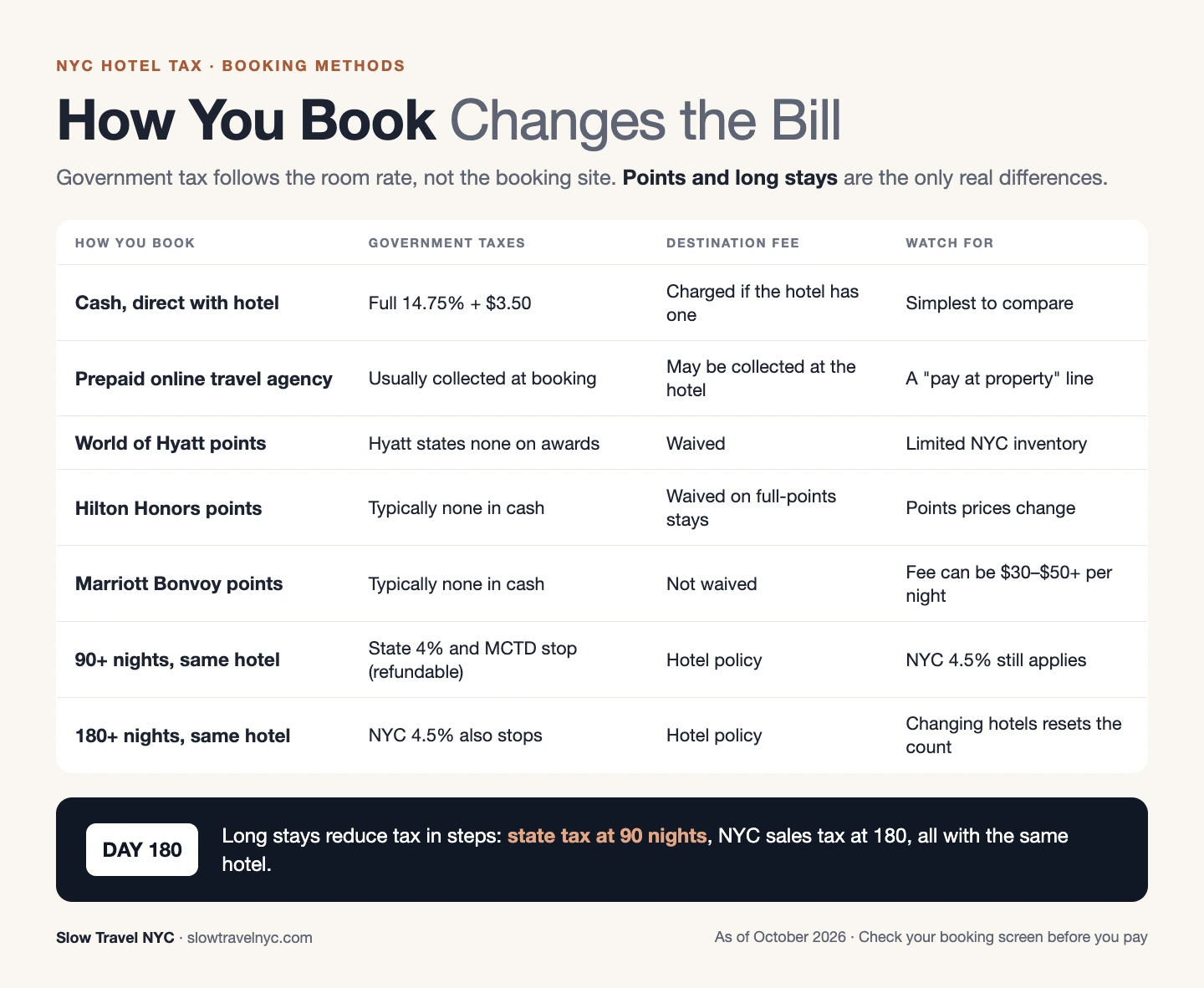
Resort and destination fees. Plenty of New York hotels charge a daily “destination fee” for Wi-Fi, a gym or a drink voucher. Hilton and Hyatt waive these on stays booked entirely with points, but Marriott does not. On a five-night Marriott award with a $40 nightly fee, you would still owe about $200 in cash, plus any tax on the fee. Hyatt goes further: TPG reports no taxes or fees on its award redemptions.
The fifth night free. Marriott gives every member a free fifth night when you book five consecutive award nights, and the free night is the cheapest of the five, not necessarily the fifth. Hilton offers the same benefit to Silver status and above, which you can get with Hilton’s no-annual-fee Amex card. Hyatt has no equivalent. For a week-long stay, this can narrow the gap between Marriott or Hilton and Hyatt.
Even on a points stay, you will probably still tip housekeeping and the bell desk. Our NYC Tip & Tax Calculator covers the usual amounts.
Which Program Fits Which Kind of NYC Trip
The best program depends on how you travel, not on a ranking.

- Solo or couple, three nights, flexible dates: Hyatt. A Category 5 or 6 night in Midtown at Low or Moderate pricing is often the best use of points in the city.
- Five nights or more: Run the numbers on Marriott and Hilton. The fifth night free can make a longer stay competitive, especially at a mid-range hotel.
- Once-a-year splurge: A Hilton Aspire free night certificate at the Conrad Midtown, or a Hyatt Category 8 night on a quiet date. Avoid peak holiday weeks, when Top-tier pricing applies.
- Downtown or Brooklyn base: Marriott, simply because it has the most hotels outside Midtown.
- Already have status: Elite benefits like breakfast and late checkout can matter more than points prices. Hyatt Globalist and Hilton Gold breakfast benefits add real value in a city where breakfast for two can top $60.
Reality Check
Points can still be worth using, but New York is one of the hardest places to get good value from them.
- Award availability is uneven. “No blackout dates” does not mean a standard room is open every night. Busy weeks like the Marathon, Thanksgiving, December and fashion week sell out early.
- Hyatt’s new top tiers bite at the worst times. Hyatt says it will limit Upper and Top pricing in 2026 but expand it later. Expect your favorite dates to cost more over time.
- Marriott raises prices without notice. With no chart, a hotel can cost 20% more points next year and nothing is announced.
- Small hotel rooms are still small. A 15,000-point Hyatt Place room is a good deal, but it is not a suite. Know what you are booking.
- Free night certificates have rules of their own. Category caps, expiration dates and standard-room limits all apply. We’ll cover NYC certificates separately.
A Calmer Way to Use Points in New York
Here’s my bias as a slow traveler: the best points night is often not the most expensive room you can book. It is the one that buys you time. That might mean a later checkout so you are not dragging a suitcase through Midtown at 11 a.m., or a hotel close enough to the park that a morning walk takes ten minutes instead of a subway ride.

A modest Category 5 night near Bryant Park or the park’s southern edge, with the points saved for a second trip, is often worth more than one Top-tier night spent mostly in transit. Book where you want to start your mornings, then let the city slow down. Our list of the quietest places to sit in Midtown is a good companion to any Midtown points stay.
FAQ
What are the best hotel points for NYC in 2026?
For most travelers, World of Hyatt. Its published chart keeps many Manhattan hotels between 15,000 and 40,000 points a night, and it waives resort fees on award stays. Marriott has the most hotels and Hilton works well with free night certificates, but both often require far more points for similar rooms.
Is it worth transferring Chase points to Hyatt for New York?
Usually yes, if you have found an available award night first and the math reaches about 1.5¢ per point or better. Chase transfers to Hyatt at 1:1, but transfers cannot be reversed, so confirm the date and price before you move any points.
Hyatt vs Marriott vs Hilton in NYC: which is best for a long stay?
For five nights or more, compare all three. Marriott gives every member the fifth night free, and Hilton does the same for Silver members and above. Hyatt has no fifth-night benefit, but its lower nightly prices often win anyway. Run the total points and any remaining fees for your exact dates.
Do you pay hotel tax on a points stay in New York?
It depends on the program. TPG reports that Hyatt award redemptions carry no taxes or fees. With other programs, check your folio, because Marriott can still charge destination fees on award nights. On cash nights, New York adds sales and occupancy tax plus per-night fees.
Final Thoughts
The best hotel points for NYC come down to a calm, repeatable habit, not a single winner. Check the live award price, divide the cash rate by the points, and compare the result with what that program’s points are usually worth. Hyatt will usually come out ahead in Manhattan. Marriott and Hilton earn their place on long stays, in other neighborhoods, and when you have a certificate to use.
If the math does not work, pay cash and save the points for a quieter week. New York will still be here, and it is easier to enjoy when you are not watching the meter.