
Search a three-night stay in Manhattan on Airbnb and the map looks strangely quiet. That is not a glitch. As of November 2026, New York City has a little over 3,500 registered short-term rental hosts for a city of more than eight million people. So, is Airbnb legal in NYC? Yes, but only in one narrow shape: you rent a room in someone’s home, they stay there with you, and you bring no more than one other guest.
This guide explains Local Law 18 for travelers in plain English: what the rules are, how to tell a legal listing from a risky one, what the proposed changes would and would not do, and how to choose a stay that fits a slower trip.
This post is general information, not legal advice. Rules are summarized as of November 2026 and can change. Some links on this site may be affiliate links; see our disclosure.
Quick Answer: Is Airbnb Legal in NYC?
- Under 30 nights: legal only if the host is a permanent resident, lives in the same unit, stays there during your visit, and hosts no more than two guests (children under 4 are not counted). The host must also be registered with the city.
- Entire apartment or house for under 30 nights: not legal, whether the host is a tenant or the owner. This rule predates Local Law 18 by decades.
- 30 nights or longer: outside Local Law 18. Furnished monthly rentals are the main legal route to having a whole place to yourself.
- Hotels: legally licensed for short stays and exempt from the registration system.
- Is the law changing? A bill called Intro 879 would loosen the rules for owner-occupied one- and two-family homes. As of November 2026, it is still in committee and has not become law.
Local Law 18 for Travelers: The Rules in Plain English
Local Law 18 of 2022 did not invent New York’s short-term rental limits. It built a registration system on top of rules that, according to the Mayor’s Office of Special Enforcement (OSE), have existed since the 1960s. Booking platforms began complying in September 2023. The listing count dropped sharply, and it has stayed low since.
The 30-night line
Everything turns on length of stay. A rental of fewer than 30 consecutive days is a short-term rental under city law. At 30 days or more, Local Law 18 does not apply, and you are in ordinary rental territory. OSE’s 311 guidance lists stays of 30+ days as exempt from registration.
The host has to be home
For any stay under 30 nights, the host has to live in the same apartment and be present while you are there. OSE also requires that guests have full access to the unit. That means no locked-off “guest suite” carved out of a larger apartment. In practice, a legal NYC Airbnb is a room in someone’s home, not a home of your own.
Two guests, maximum
The cap is two guests at a time. OSE’s official rule page notes that children under 4 do not count toward that limit. A couple fits. A family of four with school-age children does not, at least not under current law.
Units that can never qualify
Some homes are excluded no matter how willing the host is. OSE does not register rent-regulated apartments or NYC Housing Authority units. It also denies applications from buildings on the city’s Prohibited Buildings List, where owners have told OSE that short-term rentals are not allowed. Many co-op and condo buildings are on that list.
What booking platforms must do
The law’s main enforcement tool sits inside the booking flow. Airbnb, Vrbo, Booking.com and similar services must check each listing against OSE’s verification system before processing a payment. In a 2026 settlement announcement, OSE stated that each unverified transaction carries a penalty of the lower of $1,500 or three times the revenue earned.
Your Legal Ways to Stay in NYC, Compared
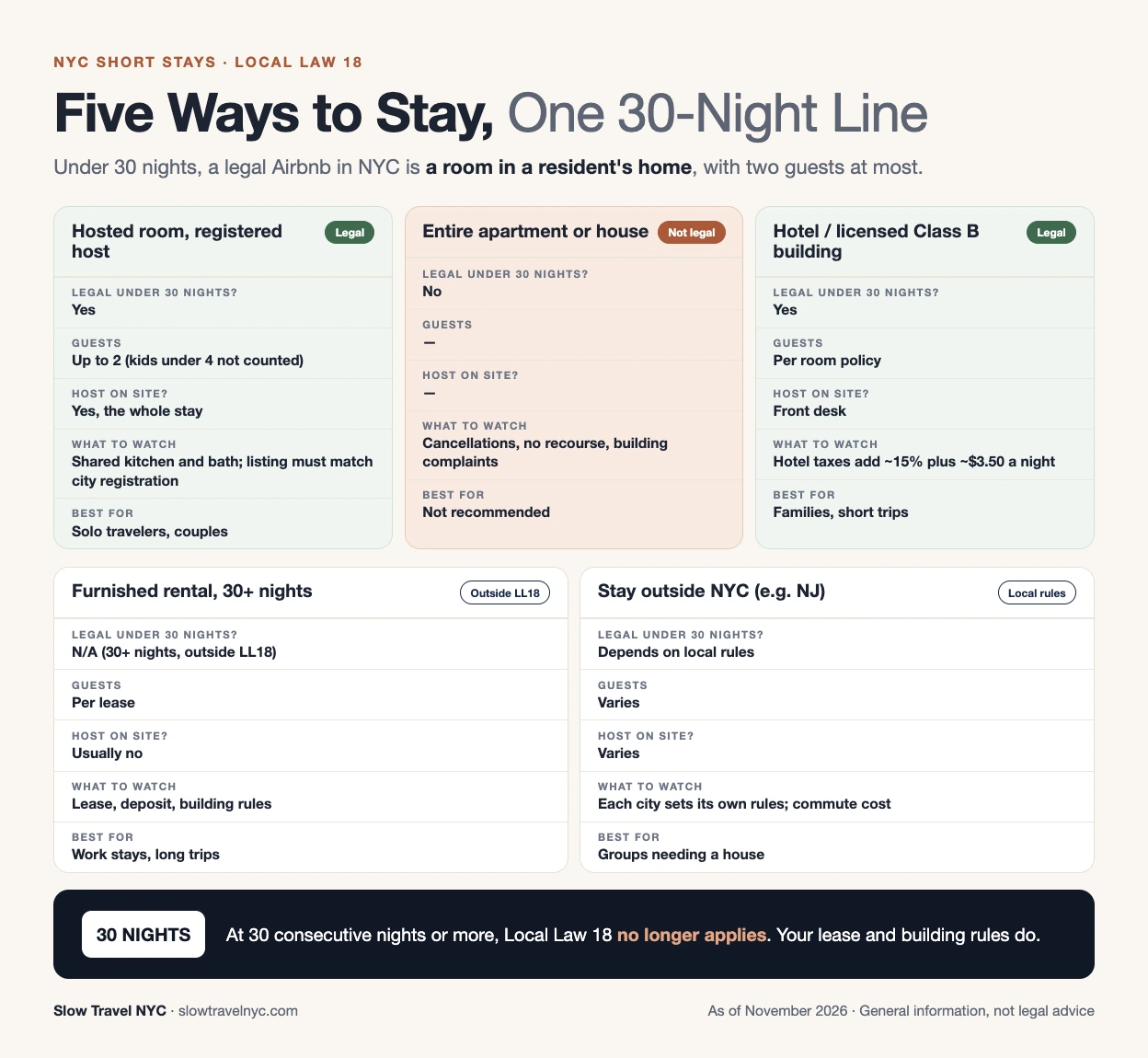
As of November 2026. Hotel tax estimate based on the Hotel Association of New York City breakdown of state and city taxes.
If you are staying a month or more, our guide to luxury corporate housing in NYC covers serviced apartments and what they actually include.
How to Tell If a NYC Listing Is Legal
A registration number on a listing is a good sign, but it is not the whole story. In April 2026, Skift reported that OSE reviewed part of the approved listings and found about 27% offering stays that broke the rules: entire homes, more than two guests, or both. A legal registration can be attached to an illegal offer.
Before you book a stay of under 30 nights, check five things:
- The listing says “room,” not “entire home.” If you will have the place to yourself, it is not a legal short-term rental.
- The guest count is two or fewer. A listing that accepts three or four adults is out of compliance.
- The host lives there. Look for language about the host being home, sharing the kitchen, or staying in the next room.
- The registration number checks out. OSE publishes a registration dataset that guests can search to confirm a listing is validly registered.
- The address matches. OSE asks guests who booked a registered listing but were sent to a different address to file a complaint. Treat any change of address after booking as a red flag.
What Happens If You Book an Illegal Listing?
The penalties in Local Law 18 are aimed at hosts and booking services, not travelers. Hosts can face fines and revocation of their registration. Under the law’s text, hosting without a registration carries a civil penalty of up to the lesser of $5,000 or three times the revenue per violation, and registered hosts who break the rules face up to $5,000 per violation, according to Local Law 18 itself and the OSE host FAQ. Starting in 2025, OSE began issuing notices of intent to revoke registrations from hosts it found breaking the rules.
For a guest, the realistic risk is losing the stay rather than paying a fine. I did not find a penalty aimed at guests in the law’s penalty section or on OSE’s pages, which describe penalties for hosts and booking services. What a guest risks:
- A cancelled booking close to arrival, if the platform removes the listing or the host loses registration.
- Being moved to a different address than the one you booked.
- No front desk and no clear recourse if the building’s doorman, co-op board or neighbors object.
- Insurance gaps. If a trip falls apart, check what your policy covers before you depend on it. Our guide to NYC trip delay insurance explains what usually qualifies.
Is Local Law 18 Changing? Intro 879 in 2026
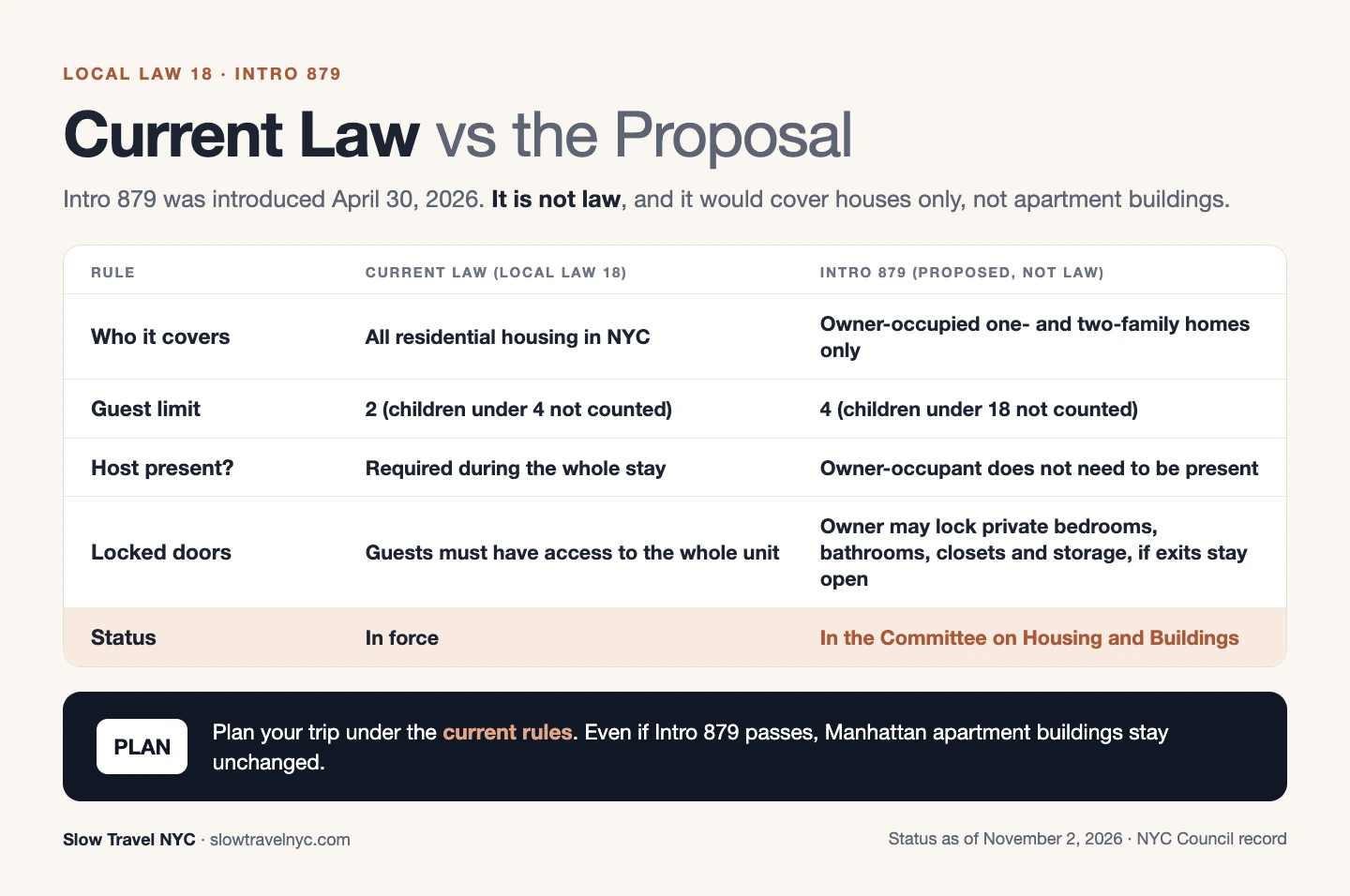
The most-watched reform is Intro 879, introduced in the City Council on April 30, 2026. It applies only to owner-occupied one- and two-family homes. Apartment buildings are not covered.
Status as of November 2, 2026, per the NYC Council legislation record and intro.nyc.
The debate is heated. Supporters, including the bill’s sponsor, Council Member Mercedes Narcisse, argue that homeowners with a spare room lost income they used for mortgages and repairs. The Hotel Association of New York City opposes the bill and argues it could open a door for investors. amNY’s September 30 report notes that the bill would still need to pass the Council and get the mayor’s signature.
Earlier versions, Intro 948 and Intro 1107, had a hearing in November 2025 and were never brought to a vote; they lapsed at the end of the 2024–2025 session. For travelers, the practical takeaway is simple: plan under the current rules. Even if Intro 879 passes, it would change rules only in houses, not in Manhattan apartment buildings.
One more date to know: OSE registrations last up to four years, and renewal applications were expected to open in October 2026. Some listings could disappear over the next few months if hosts do not renew. Book early, and confirm again closer to your trip.
Reality Check: The Trade-Offs Nobody Puts in the Listing

A legal hosted room is a homestay, not a rental. You share a kitchen, often a bathroom, and someone’s daily routine. For a solo traveler who wants to see how a neighborhood actually lives, that can be the best part of the trip. For a couple on a quick anniversary weekend, it may not be.
Most legal hosts are not in Midtown. OSE’s 2026 report found about 76% of registrations go to homeowners and about 68% are in one- and two-family homes. Brick Underground’s summary of a Pratt Center analysis found the registered market leans toward homeowners in outer-borough neighborhoods. Expect brownstone Brooklyn, Queens or Harlem, not a doorman tower near Times Square.
Hotels are not tax-light. As of November 2026, a hotel room in NYC carries state and city sales tax plus the city hotel occupancy tax (5.875% of the rate plus $2 per room per night) and a state $1.50 nightly unit fee. On a $300 room, that comes to about $347.75 per night before resort or facility fees. Run your own numbers with our NYC Trip Budget Calculator, and see our full breakdown in NYC hotel taxes explained.
“30-day minimum” listings come with real paperwork. A monthly furnished rental is legal, but it usually means a lease, a deposit and building approval. It is not a loophole for a five-night trip; a listing that says “30-night minimum” but lets you leave after a week is a warning sign.
A Slower Way to Choose Where You Sleep
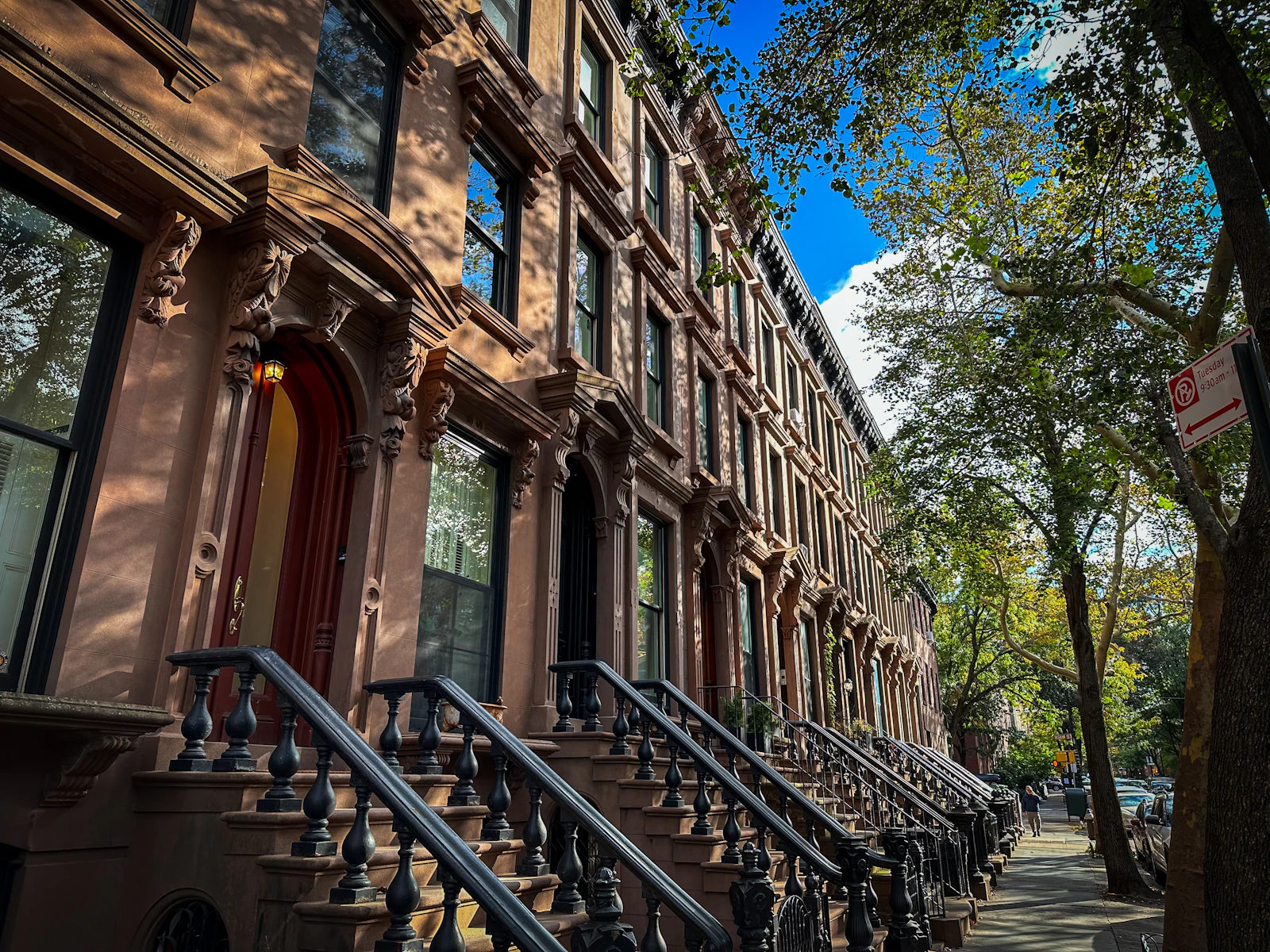
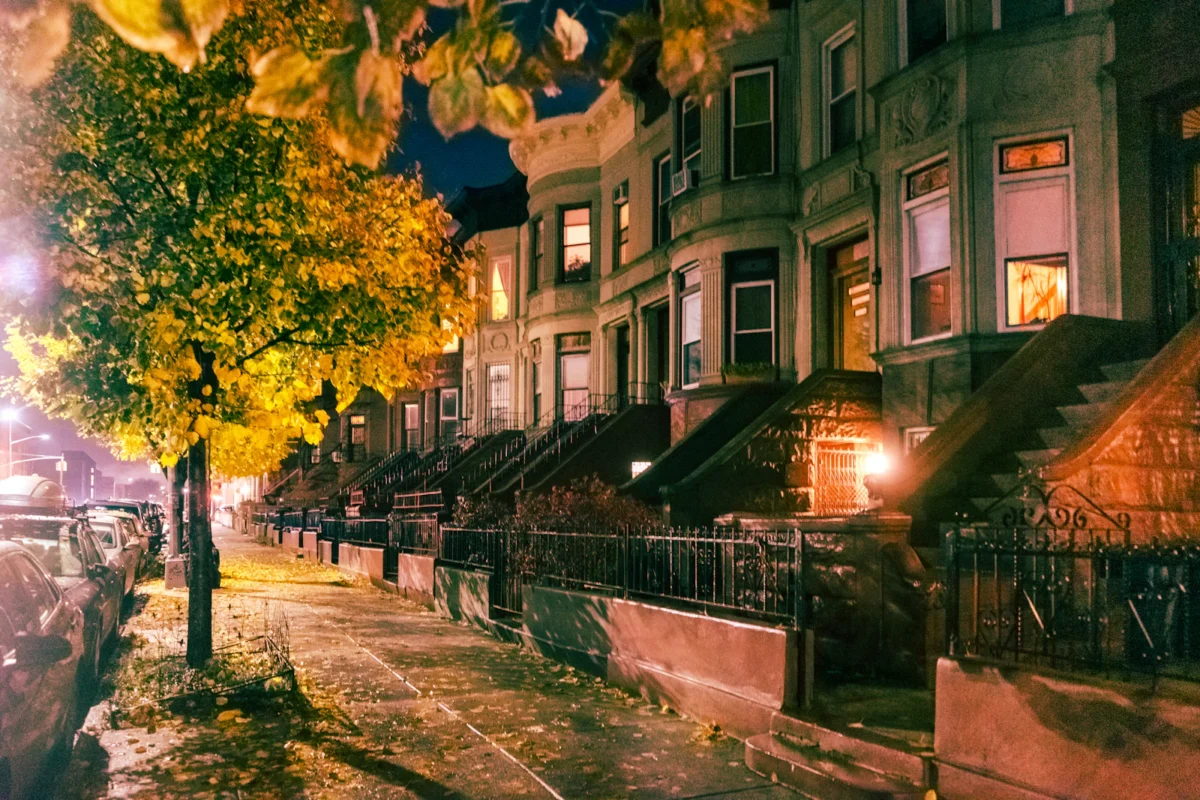
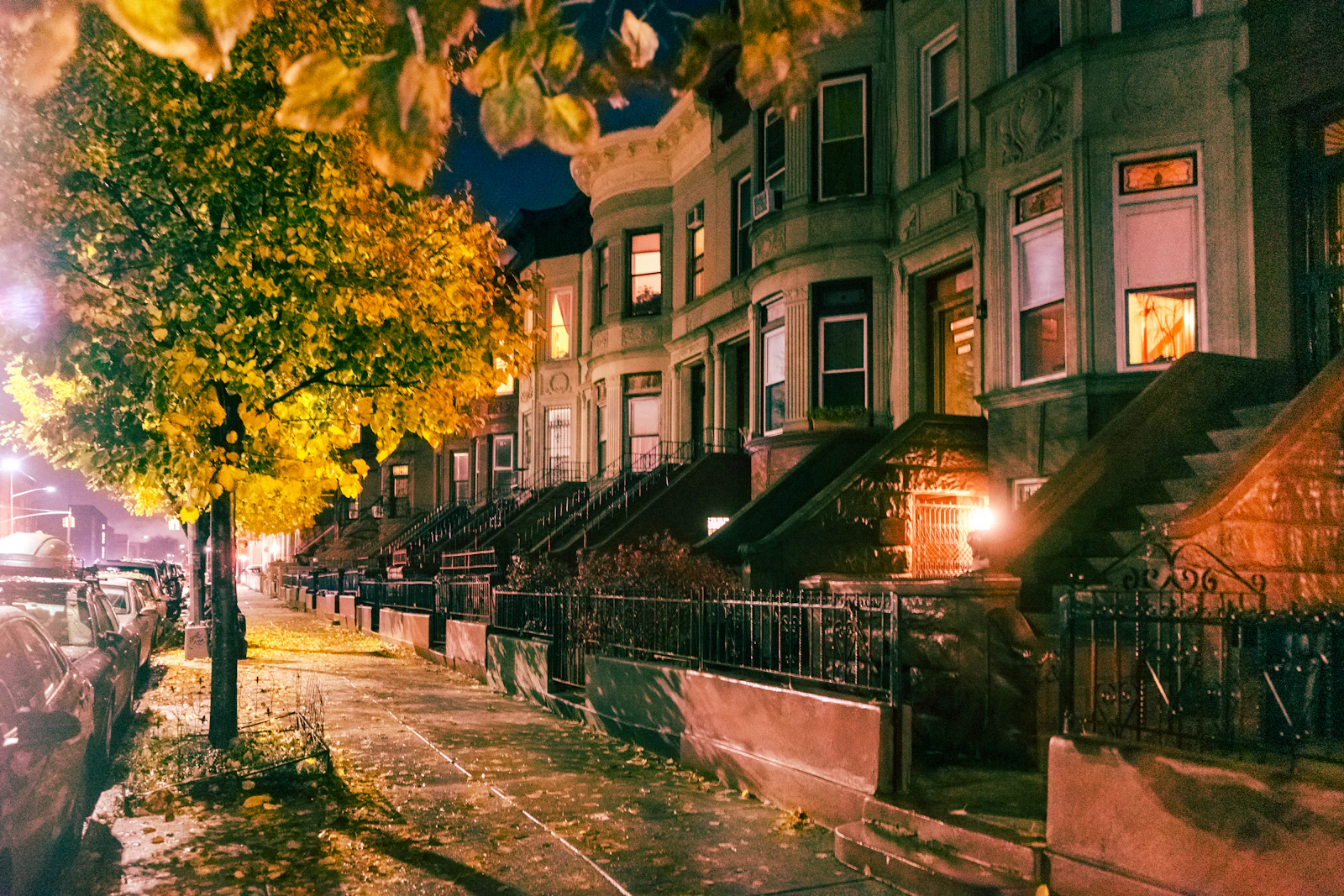
The law has a side effect worth noticing: it pushes the question back to where you want to wake up, not just what kind of place. Walk a block of Brooklyn brownstones at dusk and you can see the appeal of a hosted room. The parlor lights come on, someone is carrying groceries up a stoop, and the city lowers its voice a little.
If that is the trip you want, a registered hosted room in a residential neighborhood can be the most honest way to have it. If you want privacy, a late check-in and a door that locks, a small hotel in a neighborhood you actually like will serve you better than a whole apartment that might be cancelled the night before. Our guide to luxury boutique hotels in SoHo and Tribeca is a good place to start, and our first-time NYC travel checklist covers the rest of the planning.
FAQ
Is Airbnb legal in NYC if I stay 30 days or more?
Yes. Stays of 30 consecutive days or more fall outside Local Law 18 and do not require a host registration. Your lease and the building’s rules still apply, so read both before you sign.
Can I rent an entire apartment in NYC for a weekend?
No. Renting an entire apartment or house for fewer than 30 days is not legal in New York City, whether the host is a tenant or the owner. The host must live in the unit and be present during your stay.
Can a family of four stay in a legal NYC Airbnb?
Under current law, a host can have only two guests at a time. Children under 4 do not count toward that limit. Intro 879 would raise the limit to four guests in owner-occupied one- and two-family homes, but as of November 2026 it has not been passed.
Has Local Law 18 been amended in 2026?
No. As of November 2, 2026, Local Law 18 has not been amended. Intro 879, introduced April 30, 2026, is in the Council’s Committee on Housing and Buildings. It would need a Council vote and the mayor’s signature to take effect.
How can I check whether a NYC listing is registered?
Search the listing in OSE’s public short-term rental registration dataset on nyc.gov. Then compare the details: a registered listing that offers a whole home or space for three or more guests is still breaking the rules.
The Bottom Line
Is Airbnb legal in NYC? In the form most travelers picture, a whole apartment for a long weekend, no. In the form the law allows, a room in a resident’s home with no more than two guests, yes, and it can be a lovely way to see the city slowly. Decide which trip you are taking first, then pick the stay that fits it: a hosted room, a hotel, or a monthly rental. Check the rules again before you book, because this is one New York story that is still being written.