

Best Dining Credit Card NYC (2026): Amex Gold vs Sapphire Reserve for Everyday Eating

Looking for the best dining credit card NYC locals can actually use? We run Amex Gold vs Sapphire Reserve dining math on three real New York eating patterns, including groceries, takeout, tax and tip.

Latte in a dark cup on a wooden café table beside a window and a folded newspaper

Disclosure: Card terms, credits and earning rates change often, and this is not financial advice. Figures below are as of November 2026; check the issuer’s page before you apply. This post may contain affiliate links. See our disclosure page for details.

A $14 bacon, egg and cheese with coffee on a Tuesday. A $68 dinner for two at the Thai place on the corner on Thursday. A $38 Seamless order on a rainy Sunday. None of these feels like “dining spend,” but in New York they add up fast, often to $500–$900 a month before groceries. That everyday pattern, not the once-a-year tasting menu, is what decides the best dining credit card NYC for most people.

This guide compares the two cards New Yorkers ask me about most, the American Express Gold Card and the Chase Sapphire Reserve, strictly on ordinary eating: neighborhood restaurants, takeout, coffee and the weekly grocery run. If you want the splurge side, I’ve covered Michelin dining and the Resy credit separately, and the Reserve’s Exclusive Tables credit and city-life perks have their own post.

Quick Answer: Amex Gold vs Sapphire Reserve Dining

  • For everyday eating, the Amex Gold usually wins. It earns 4x at restaurants (up to $50,000 a year) and 4x at U.S. supermarkets (up to $25,000), against the Reserve’s 3x dining and 1x groceries.
  • The fee gap is $470. Gold is $325 a year; the Reserve is $795 (as of November 2026).
  • The Gold’s credits fit an NYC routine (Uber Cash, Seamless/Grubhub, Resy), and a regular user can roughly cover the fee with them.
  • The Reserve is a travel card that happens to earn well on dining. Its case rests on the $300 travel credit, lounges and hotel credits, not on restaurant points.
  • If you already hold the Reserve, adding the Gold for food is close to fee-neutral if you use its credits, and it lifts grocery earning from 1x to 4x.

The Two Cards at a Glance (As of November 2026)

The table below sticks to what matters at a dinner table or a checkout line. Earning rates and credits come from American Express’s Gold Card page and Chase’s Sapphire Reserve page.
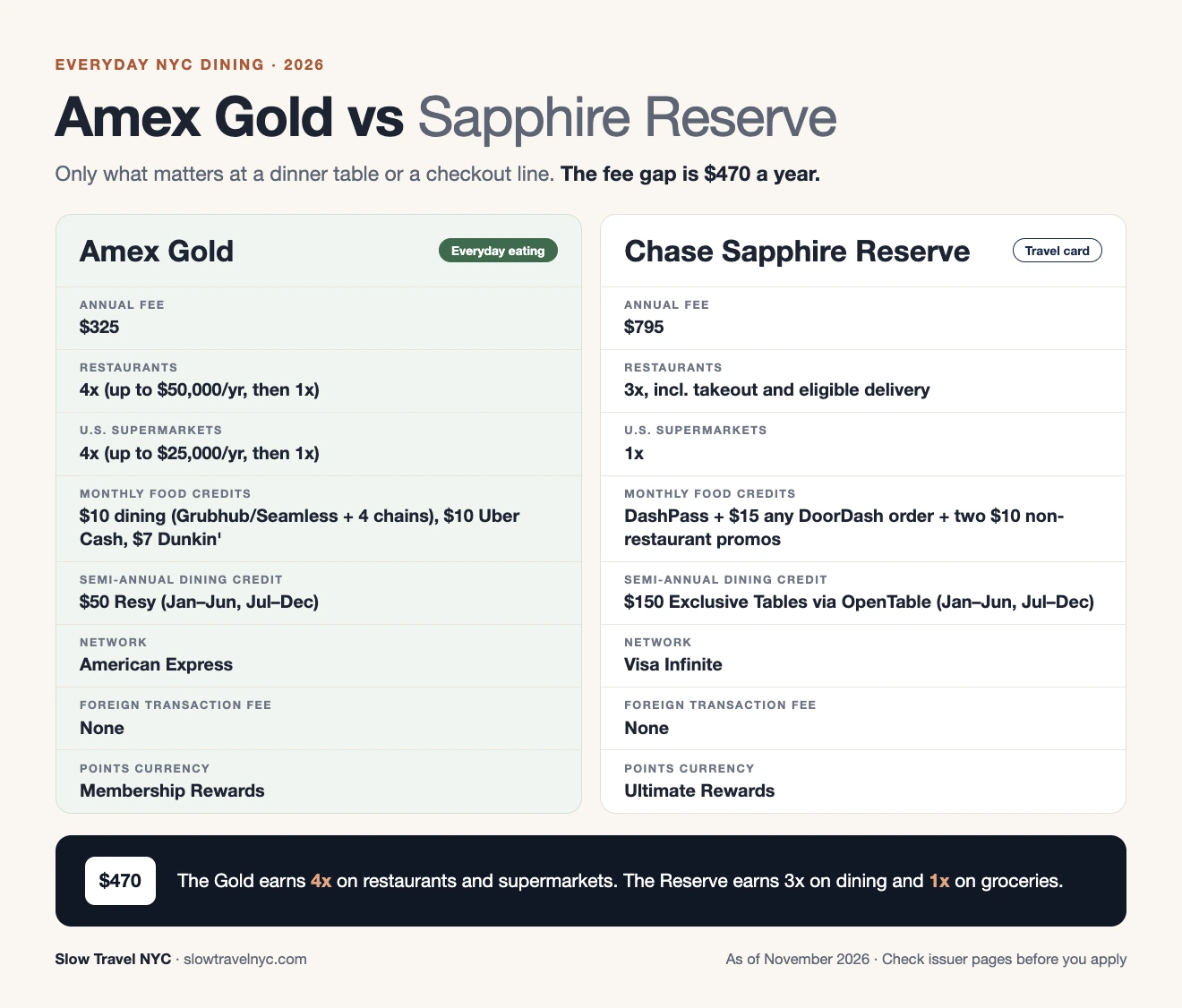
best dining credit card nyc

Two details are easy to miss. First, the Gold’s $10 monthly dining credit only works at its named partners; after an April 2026 refresh those are Grubhub (including Seamless), The Cheesecake Factory, Five Guys, Buffalo Wild Wings and Wonder, per Amex’s dining guide. Second, Chase raised the Reserve’s DoorDash restaurant credit from $5 to $15 a month starting October 1, 2026, and it now works on any eligible order (Chase’s announcement).

Everyday NYC Dining Math: Three Real Eating Patterns

Points tables flatter whichever card has the bigger number. A better test is to run each card against how people in this city actually eat. Here is how the Amex Gold vs Sapphire Reserve dining comparison plays out across three common New York patterns, using annual spend and each card’s base earning rates.
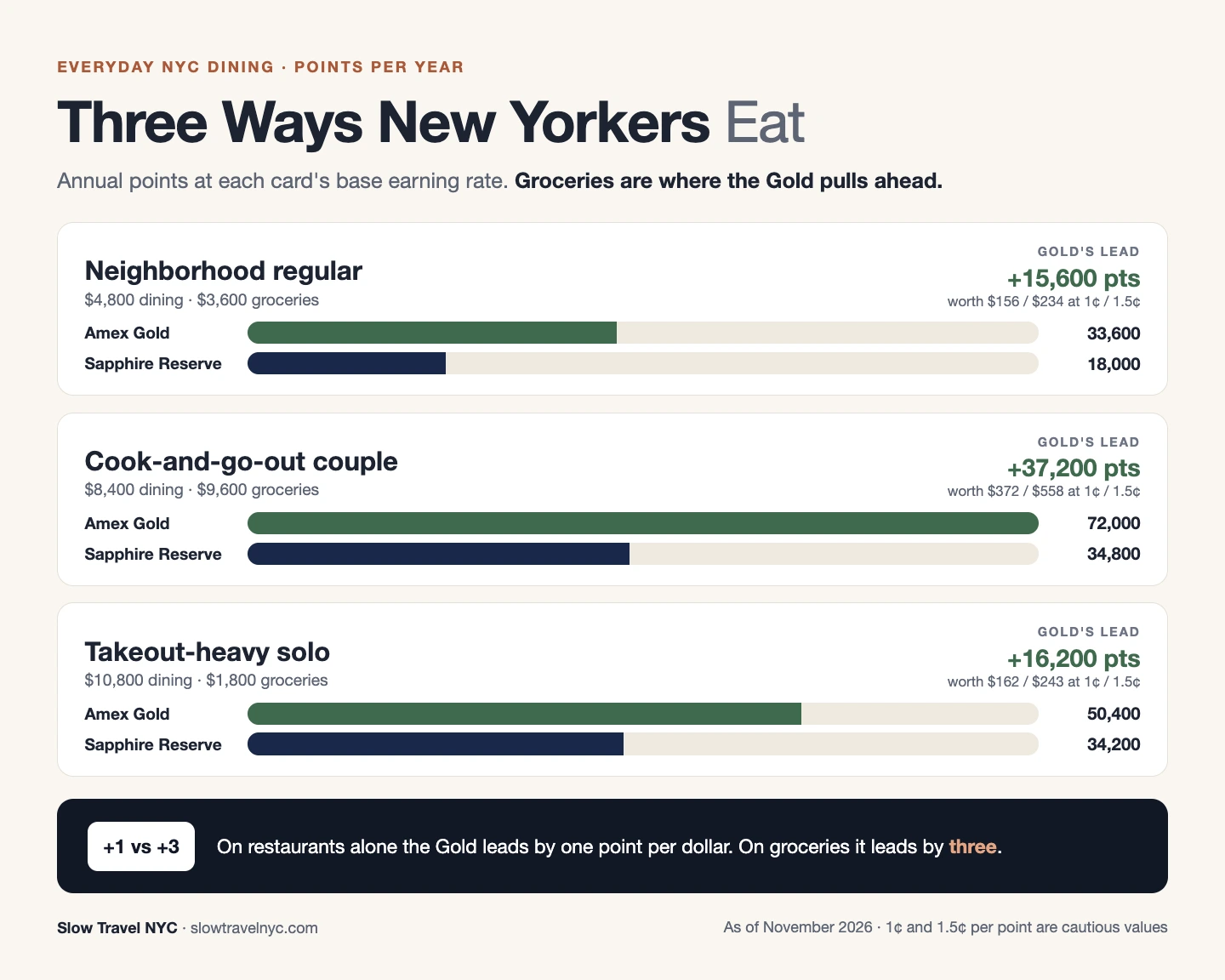
Bar chart of annual points earned by Amex Gold and Sapphire Reserve across three New York eating patterns

The pattern is clear once you look at where the gap comes from. On restaurants alone, the Gold is ahead by only one point per dollar. On groceries, it is ahead by three, so the household that cooks at home gets most of the benefit. If your fridge holds little more than oat milk and hot sauce, the two cards are closer than the 4x headline suggests.

A note on the point values: 1 to 1.5 cents per point is a cautious range for either currency. You can do better by transferring to airline partners, and worse by cashing out. Since June 2025, the Reserve’s fixed 1.5-cent portal rate has been replaced by variable “Points Boost” pricing, with older points grandfathered through October 26, 2027, as One Mile at a Time explains.

Don’t forget tax and tip

In New York, your card is charged for the tip and the 8.875% sales tax along with the food, and both earn points. An $80 dinner becomes about $103 after tax and a 20% tip, which is roughly 412 Gold points versus 309 Reserve points. Our NYC Tip & Tax Calculator gives you the real total before you pay.

Credits That Fit a New York Routine

A food delivery cyclist with a green insulated bag riding through a rainy city street at night

Statement credits only count if you’d spend the money anyway. Here is how each card’s food-related credits line up with an ordinary NYC month.

Amex Gold: small, monthly and urban

The Gold’s credits are built for a city like this one. Uber Cash ($10 a month) covers a short ride or part of an Uber Eats order. Seamless, which many New Yorkers already use, triggers the $10 dining credit. The $50 Resy credit each half-year is easy to use here, because a large share of the city’s sit-down restaurants are on Resy. You don’t have to book through the app; you just pay with the card at a participating restaurant.

The Dunkin’ credit ($7 a month) is real money only if Dunkin’ is already part of your morning. Mine is a slow pour-over at a café where time actually slows down, so I’d count that one as zero.

Sapphire Reserve: bigger numbers, more structure

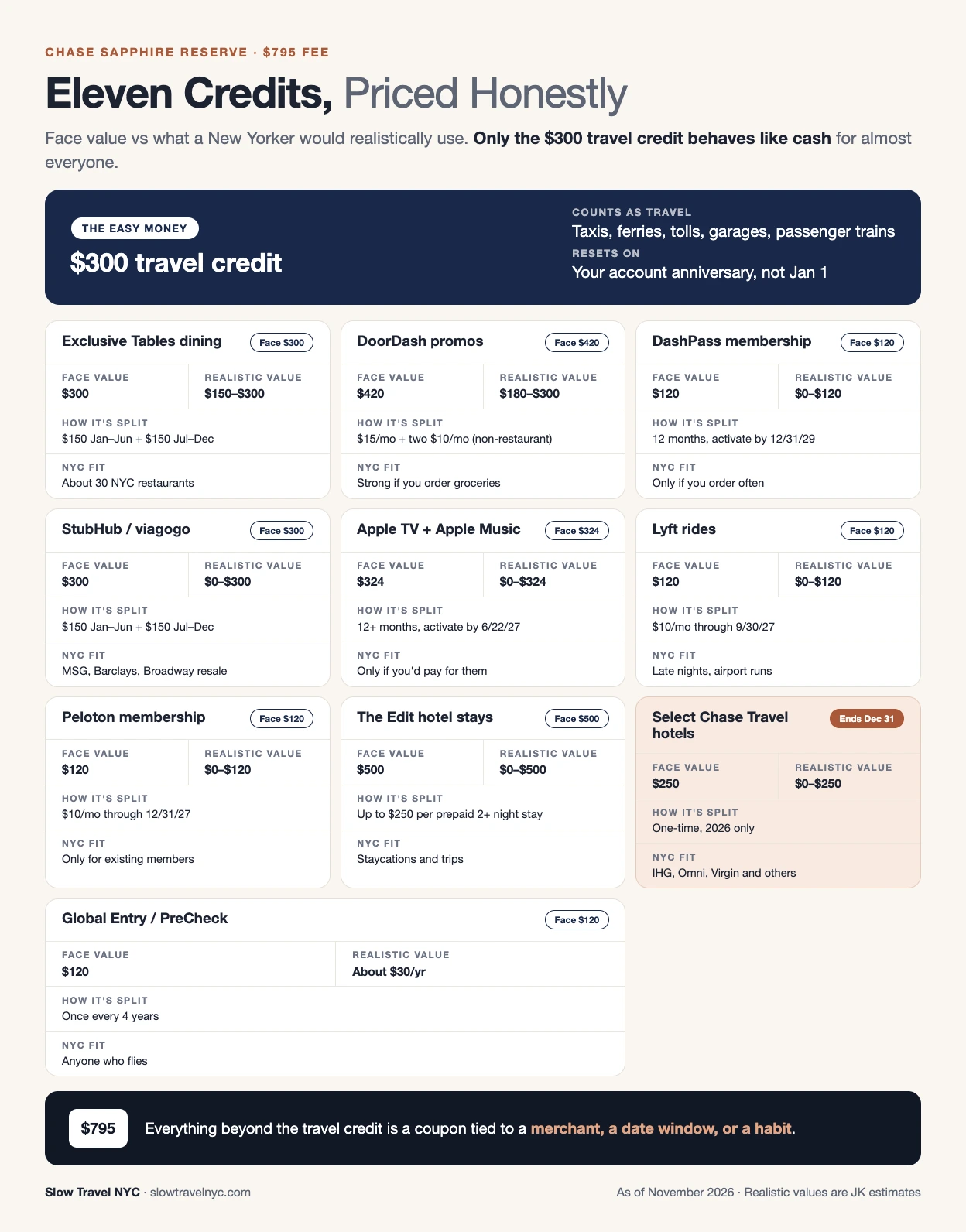
The Reserve’s food credits look larger on paper. With DashPass activated, you get a $15 monthly promo on any eligible DoorDash order plus two $10 promos for grocery or convenience orders. If you already order through DoorDash, that’s up to $420 a year. The $300 Exclusive Tables credit ($150 per half-year) is real too, but it applies only to participating restaurants on OpenTable, which lean toward special-occasion spots rather than the corner Thai place.
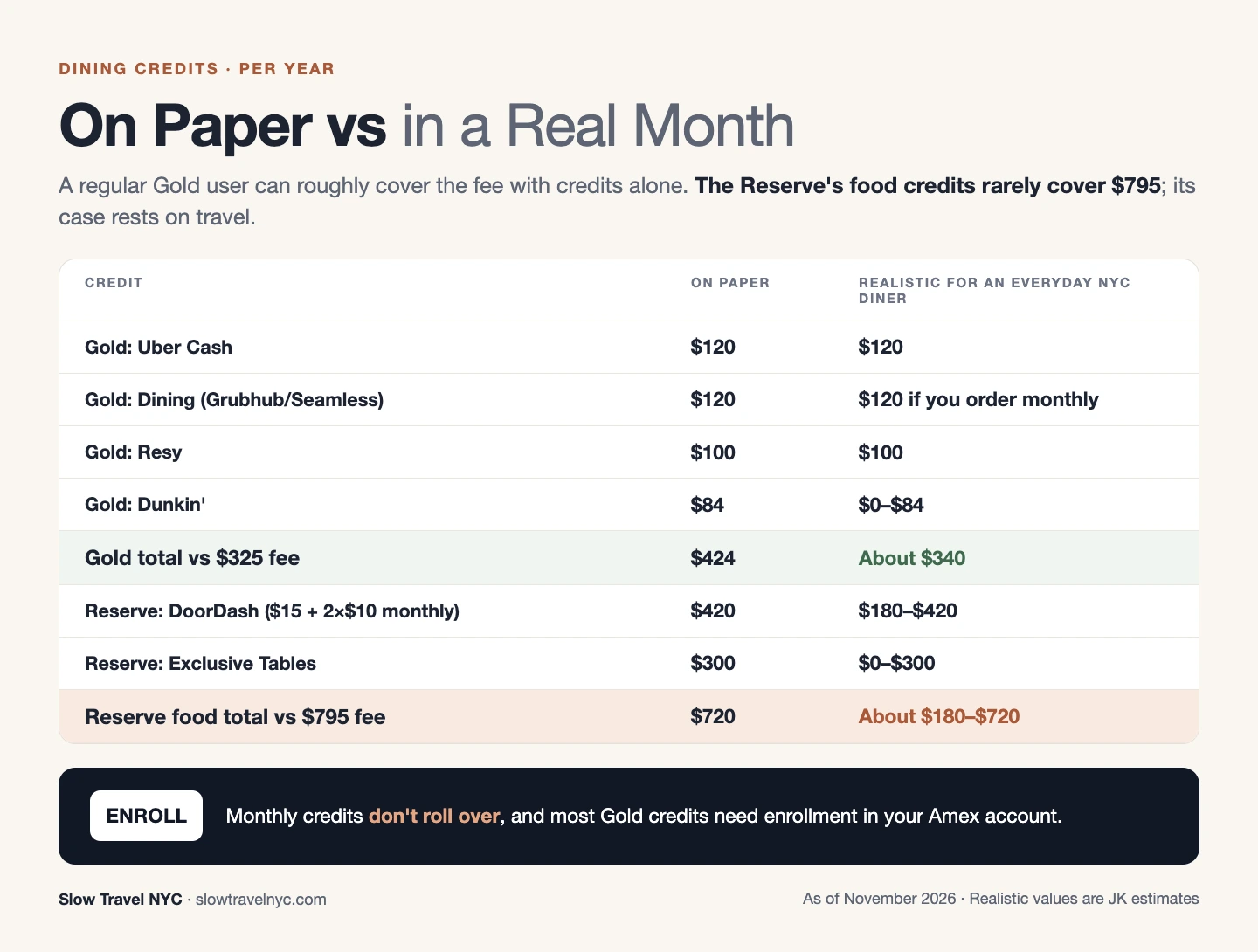
Table graphic showing on-paper versus realistic annual value of Amex Gold and Sapphire Reserve dining credits

Read that bottom line carefully. A regular Gold user can roughly cover the fee with the credits alone. The Reserve’s food credits rarely cover a $795 fee by themselves, which is why its value case depends on the $300 travel credit, lounges and hotel credits. I’ve weighed those separately in our NYC airport lounge credit card guide.

Which Card Fits How You Actually Eat

There is no single winner for everyone, so here is a plain sorting.

Choose the Amex Gold if:

  • You cook several nights a week and shop at supermarkets like Trader Joe’s or Whole Foods.
  • You already use Uber, Seamless or Resy-listed restaurants.
  • You want strong dining earning without paying for lounges you rarely visit.

Choose the Sapphire Reserve if:

  • You fly several times a year and will use the $300 travel credit, lounge access and hotel credits.
  • You already order through DoorDash every month.
  • You’d rather hold one Visa that works nearly everywhere, at home and abroad.

Consider both if: you already hold the Reserve for travel. Adding the Gold for food costs $325, which the credits can roughly offset, and it moves your grocery spend from 1x to 4x. The trade-off is managing two point programs and a handful of monthly credits.

Consider neither if: dining is your only goal and you’d skip most credits. The Chase Sapphire Preferred earns the same 3x on dining as the Reserve for a $95 annual fee (as of November 2026), and a no-annual-fee card may suit a lighter spender better.

Reality Check: The Catches

A person tapping a credit card on a handheld payment terminal beside a latte on a café table

Every premium card asks for something back. Here is what to weigh before you apply.

  • Amex acceptance still has gaps. Most NYC restaurants take Amex, but some small cafés, bakeries and food stalls don’t, and a few are cash-only. Carry a Visa or Mastercard backup. Visitors can see our no-foreign-transaction-fee card guide.
  • Merchant coding decides your points. A restaurant inside a hotel may code as lodging. A deli or bodega may code as convenience, not as a supermarket or restaurant. Amex also excludes superstores and warehouse clubs from 4x groceries. Check your first few statements.
  • Monthly credits expire. Gold’s dining, Uber and Dunkin’ credits reset every month and don’t roll over. Miss January, and that $10 is gone. Most of the Gold credits also require enrollment in your Amex account.
  • Credits shape behavior. A $10 Five Guys credit is only “value” if you’d have eaten there anyway. Ordering delivery to use a promo can cost more than it saves after fees and tip.
  • The 4x caps exist. They’re generous ($50,000 dining, $25,000 groceries a year), but heavy business-dining spenders can hit them.
  • Point values move. Chase’s switch to Points Boost and Amex’s history of rotating dining partners are reminders that the math above can change within a year.

How I’d Decide, Slowly

Before choosing, pull three months of statements and sort them into three buckets: restaurants and takeout, supermarkets, and travel. It takes about twenty minutes with a coffee, and it answers the question better than any comparison table, including mine.

If groceries are a meaningful bucket, the Amex Gold is likely the better daily dining card. If travel is the biggest bucket and dining is a close second, the Reserve earns its keep elsewhere and its 3x dining is a solid bonus. Either way, look at the fee you’ll pay against the credits you’d truly use in an ordinary month, not an ideal one.

FAQ

What is the best dining credit card in NYC for everyday meals?

For most New Yorkers who eat out and cook, the Amex Gold is the strongest everyday option as of November 2026. It earns 4x at restaurants and U.S. supermarkets, and its Uber, Seamless and Resy credits fit a city routine. Frequent travelers may still prefer the Sapphire Reserve for its travel benefits.

Does the Amex Gold earn 4x on takeout and delivery?

Amex’s terms count takeout and delivery from U.S. restaurants in the 4x restaurant category. Orders through a delivery app usually code as dining, but coding depends on the merchant, so check your statement after your first few orders.

Is the Sapphire Reserve worth $795 just for dining?

Rarely. Its 3x dining rate is good, but the Sapphire Preferred earns the same 3x for $95. The Reserve’s fee makes sense when you’ll use its travel credit, lounge access and hotel credits as well.

Can I use the Amex Gold Resy credit at any NYC restaurant?

No. It applies only at participating U.S. restaurants listed on Resy, up to $50 from January to June and $50 from July to December. Enrollment is required, and you don’t need to book through Resy to receive it.

Should I hold both the Amex Gold and the Sapphire Reserve?

It can make sense if you already have the Reserve for travel. Use the Gold for restaurants and groceries and the Reserve for travel and places that don’t take Amex. The combined fee is $1,120 a year, so it only works if you use most of both cards’ credits.

The Bottom Line: The Best Dining Credit Card NYC Pick

The best dining card is the one that matches the meals you already eat. For most New Yorkers, that’s the Amex Gold: 4x where the money actually goes, a $325 fee that its city-friendly credits can cover, and no pressure to eat differently. The Sapphire Reserve remains an excellent card, but its case is mostly made at the airport, not at your neighborhood restaurant.

Planning a visit around food? Our NYC Trip Budget Calculator helps you estimate dining costs before you go.


Related Reading

Chase Sapphire Reserve for NYC Residents (2026): Is $795 Worth It Without the Lounges?

Is the Chase Sapphire Reserve for NYC residents worth $795 if you rarely use airport lounges? Here’s each local credit priced at what a New Yorker would actually spend, plus three break-even profiles.

Hands, a coffee mug, a card reader, a tablet and a phone on a wooden table seen from above

Disclosure: Card terms change often, and this is not financial advice. Figures are as of November 2026 and come from Chase’s public card page unless noted. Some links on this site may be affiliate links; see our disclosure policy.

Seven hundred ninety-five dollars works out to about $66 a month, or roughly 22 subway rides at the $3 base fare. It is also the annual fee on the Chase Sapphire Reserve, and that number is why so many people are now asking whether the Chase Sapphire Reserve for NYC residents still makes sense once the welcome bonus is spent.

Most reviews answer that question from an airport. This one stays in the city. The lounges are real, but if you live here, the question is whether the Sapphire Reserve credits in NYC fit the way you already eat, move, and spend your evenings in New York. I’ve written separately about NYC airport lounge credit cards, so lounges get one paragraph here and the rest of the page goes to the credits you’d use at home.

Quick Answer

  • The fee: $795 a year, plus $195 per authorized user (as of November 2026).
  • The easy money: The $300 travel credit is the most flexible piece for a New Yorker. Chase’s travel category includes taxis, ferries, tolls, parking garages, and passenger trains.
  • The conditional money: The $300 dining credit only works at roughly 30 NYC restaurants on Chase’s Exclusive Tables list, split into two $150 halves.
  • The habit money: DoorDash, Lyft, Peloton, StubHub, and Apple credits only count if you’d pay for those services anyway.
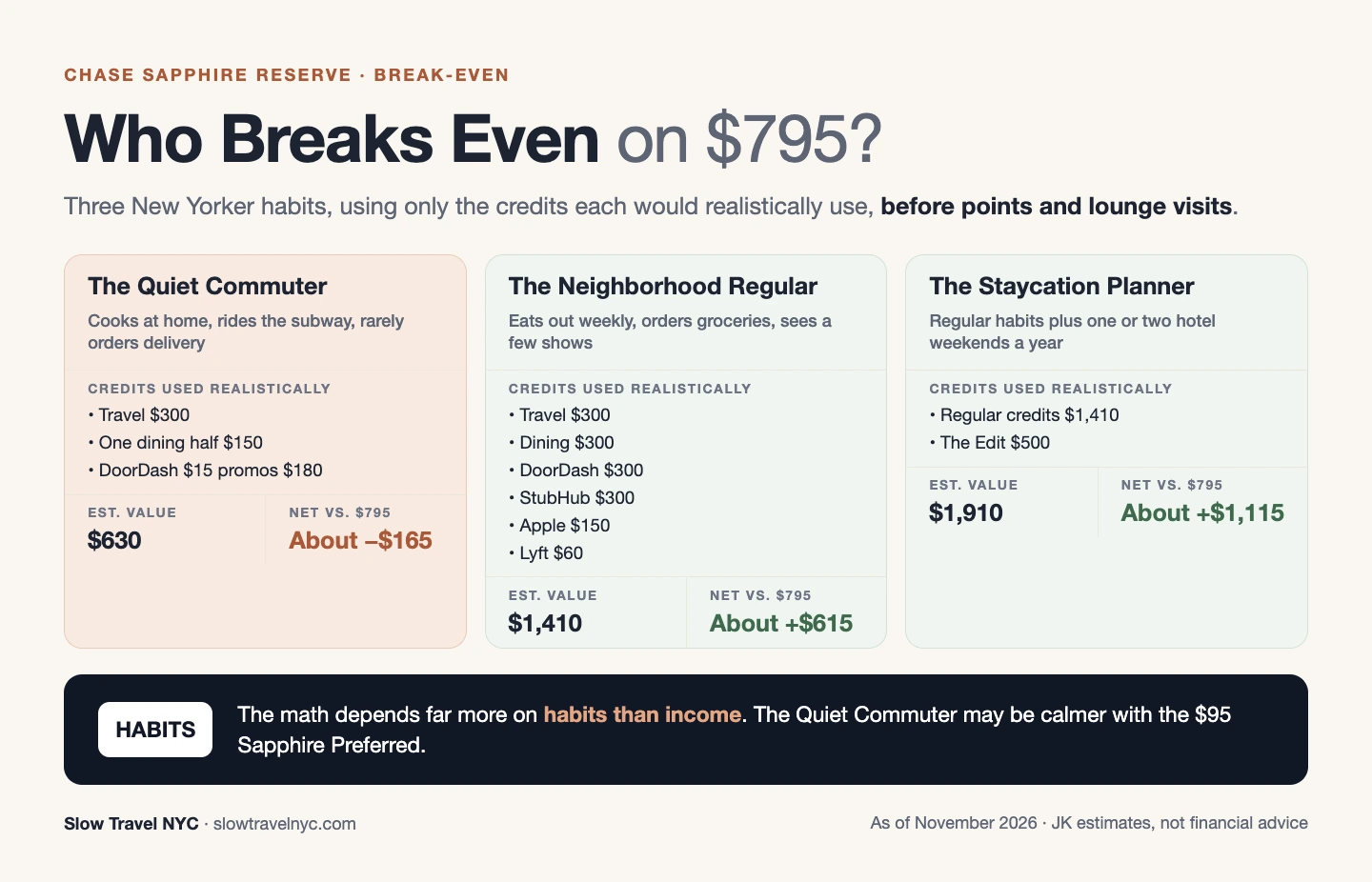
  • The verdict: If you’d naturally use the travel credit, both dining halves, and most of the DoorDash promos, you’re close to break-even before lounges. If not, the $95 Sapphire Preferred is the calmer choice.
  • Deadline: The July–December dining and StubHub halves, and the 2026-only $250 hotel credit, all expire December 31, 2026.

What the $795 Actually Buys (As of November 2026)

Chase markets the card as delivering “$3,000+ in annual value.” That figure assumes you use nearly every credit, every month, at full face value. The useful exercise is to price each credit at what it would replace in your own budget, not at the number on the brochure.

The card earns 8x points on Chase Travel purchases, 4x on flights and hotels booked direct, 3x on dining worldwide, and 1x on everything else, according to the Chase Sapphire Reserve card page. Points are part of the story, but for a resident who mostly spends locally, the statement credits do the heavy lifting.

Sapphire Reserve credits in NYC, priced honestly

Infographic of Chase Sapphire Reserve credits for New Yorkers with face value, how each splits, and realistic yearly value

Laid out like this, the Sapphire Reserve credits in NYC fall into two groups. Only one credit, the $300 travel credit, behaves like cash for almost everyone. Everything else is a coupon tied to a merchant, a calendar window, or a habit.

The $300 Travel Credit Is the New Yorker’s Easiest Win

A yellow taxi driving past lit storefronts on a city street at night

Chase defines the travel category broadly. Its card terms list taxis, limousines, ferries, toll bridges and highways, parking lots and garages, buses, and passenger trains alongside airlines and hotels. For someone who lives here, that means the credit can disappear into ordinary life: a few cab rides home from dinner, a month of garage parking, E-ZPass tolls on a trip upstate, or Metro-North tickets to the Hudson Valley.

Two details matter. First, the credit resets on your account anniversary, not on January 1, so check your own renewal month. Second, purchases covered by the credit don’t earn points, which slightly reduces the value of the earning rates while the credit is being used up.

What I’d verify: Subway and bus taps through OMNY should logically fall under “passenger trains” or “buses,” but I haven’t confirmed how every OMNY charge codes. Look at your statement after a week of commuting before you count on it.

The $300 Dining Credit: Exclusive Tables Only

This is where the card gets more selective. The dining credit works only at restaurants in the Sapphire Reserve Exclusive Tables program on OpenTable, with up to $150 from January through June and another $150 from July through December. The halves do not roll over.

As of a July 2026 check, AskSebby counted 30 NYC restaurants on the list, down from a longer earlier version. The list leans toward places like Don Angie, Estela, l’abeille, and the Dining Room at Gramercy Tavern. It also includes neighborhood spots where $150 covers a meaningful share of an ordinary dinner: Joseph Leonard, Fairfax, Jeffrey’s Grocery, Scarr’s Pizza, and SAPPEISAN. Always check the live Exclusive Tables page on OpenTable before booking, because Chase says the list can change.

Candlelit restaurant bar counter with glasses and warm light reflecting on the wood

The slow-travel angle here is practical. A credit that pushes you toward a tasting menu you wouldn’t otherwise book isn’t saving money; it’s moving it. The better use is a restaurant already on your shortlist, ideally a bar seat on a weeknight when the room is calm. If you’re comparing this with Amex’s Resy-based dining perks, my Michelin restaurants and credit card perks guide covers that side.

Chase’s terms also exclude purchases made through third-party payment processors or delivery platforms. Takeout ordered through an app won’t trigger the credit; paying the restaurant directly at the table should.

DoorDash, Lyft, Apple, Peloton, and StubHub: The Habit Credits

These are the credits that look largest on paper and vary the most in real life.

DoorDash: $15 a month is easy, the $10s take planning

As of October 1, 2026, Chase lists a $15 monthly promo on any qualifying DoorDash order plus two $10 promos each month for non-restaurant orders such as groceries and household items, available through December 31, 2029. The discounts apply to the subtotal only, and any unused value on a single order is forfeited.

For a New Yorker who already orders groceries through DoorDash, this is closer to real money than it sounds. For someone who shops at the corner market and the Union Square Greenmarket, the $10 promos may go unused most months.

Lyft: useful, with a narrow definition of a ride

The $10 monthly Lyft credit applies only to rideshare modes like Standard, Extra Comfort, XL, and Black through September 30, 2027. It doesn’t cover bike or scooter rides, so Citi Bike, which Lyft operates, doesn’t count toward the credit. Chase does say eligible Lyft bike rides and memberships bought in the Lyft app earn 5x points through the same date, which may help if you’re a Citi Bike member, but check how your membership is billed.

Apple, Peloton, and StubHub: value only what you’d buy anyway

Chase values the Apple TV and Apple Music subscriptions at $324 a year. If you already pay for both, that’s close to real savings. If you don’t, the honest value is zero. The same rule applies to the $10 monthly Peloton credit and the StubHub credit, which offers $150 in each half of the year through 2027. A Knicks game or a resale Broadway seat you were already planning to buy is a good use. A ticket bought because the credit was expiring is a purchase, not a savings.

Hotel Credits for Staycations

Bedside wall lamp glowing beside a hotel bed with white pillows

The Edit credit gives up to $250 back on each prepaid stay of two nights or more booked through Chase’s The Edit collection, up to $500 per calendar year. The Edit stays also come with perks Chase lists as a $100 property credit, daily breakfast for two, and room upgrades and early check-in when available.

For residents, the question is whether you’d ever book two nights in a hotel in your own city or a nearby escape. Some New Yorkers do, especially for a birthday, a parent visit, or a quiet weekend away from a loud apartment. Prepaid rates through a portal can run higher than booking direct, so compare the real total, including NYC hotel taxes, before treating the credit as a discount. My Amex Fine Hotels + Resorts guide uses the same approach for The Plaza and The Carlyle.

One 2026-only extra: Cardholders also get a one-time $250 credit on prepaid stays of at least two nights at select brands booked through Chase Travel in 2026, including IHG, Montage, Pendry, Omni, Virgin Hotels, Minor, and Pan Pacific, per AwardWallet’s guide to the credit. In New York, that could mean a Kimpton or InterContinental property, Omni Berkshire Place, or Virgin Hotels New York City. Look for the eligibility label in Chase Travel. It ends December 31, 2026.

Chase Sapphire Reserve for NYC Residents: Three Profiles

The math depends far more on habits than on income. These are my estimates, using only the credits each profile would realistically use, before points and lounge visits.

Infographic comparing three New Yorker profiles and whether Chase Sapphire Reserve credits cover the $795 annual fee

The Quiet Commuter is the most “slow” New Yorker on this list, and the card works least well for that life. That isn’t a flaw in the person. It’s a reminder that premium cards reward a specific pattern of spending, and the pattern isn’t always yours.

If you want to see how these credits change the cost of an actual trip, plug the numbers into the NYC Trip Budget Calculator, and use the NYC Tip & Tax Calculator when you’re estimating restaurant checks against the $150 dining halves.

Reality Check: The Limits for New Yorkers

Open dated planner on a desk beside a laptop and a computer mouse
  • It’s a calendar job. Two semiannual credits, two monthly DoorDash promos, one monthly Lyft credit, and one anniversary-year credit all reset on different schedules. If you don’t enjoy tracking them, the value shrinks fast.
  • New York residents get slightly weaker coverage. Chase’s card terms say that for New York residents, auto rental coverage inside the U.S. is secondary to personal auto insurance, purchase protection lasts 90 days instead of 120, and lost luggage reimbursement is capped at $2,000 per bag and $10,000 per trip.
  • The restaurant list moves. About 35 NYC and nearby restaurants dropped off the Exclusive Tables list between versions, according to AskSebby’s July 2026 comparison.
  • Points earning is ordinary off-travel. Groceries, rent, and most everyday spending earn 1x. If your goal is rent rewards, see my Manhattan rent rewards and Bilt guide.
  • Authorized users are no longer cheap. At $195 each, adding a partner only makes sense if they’ll use the lounge access and their own spending.

What to Do Before December 31, 2026

If you already carry the card, November and December are when the 2026 credits either get used or disappear.

  1. Book one Exclusive Tables dinner to use the July–December $150 dining credit.
  2. Use the second StubHub half on an event you were already planning to attend, such as a holiday show or a winter game.
  3. Check the $250 select-hotel credit. If a two-night stay at an eligible brand is already in your plans, book it through Chase Travel before year-end.
  4. Claim this month’s DoorDash and Lyft credits, since monthly promos never carry over.
  5. Note your renewal month. If your annual fee posts soon, decide now whether the coming year matches the Neighborhood Regular profile or the Quiet Commuter one.

For winter flights, the card’s trip delay coverage applies after six hours or an overnight delay, up to $500 per traveler. My NYC trip delay insurance guide explains how to file if a snowstorm grounds you.

Frequently Asked Questions

Does the Sapphire Reserve travel credit work on NYC taxis and the subway?

Chase’s travel category includes taxis, buses, passenger trains, ferries, tolls, and parking garages, so yellow cabs and Metro-North tickets should qualify. Subway and bus taps through OMNY likely fall under that definition too, but check your statement to confirm how they code before relying on it.

Can I use the $300 dining credit on DoorDash or takeout?

No. The dining credit applies only to purchases made directly with restaurants in the Sapphire Reserve Exclusive Tables program on OpenTable. Chase’s terms exclude orders through delivery platforms and third-party payment processors.

Is the Chase Sapphire Reserve worth it for NYC residents who rarely fly?

It can be, but only if you’d naturally use the travel credit, both dining halves, and most of the DoorDash promos. Without those three, the remaining credits depend on subscriptions and habits that many New Yorkers don’t have.

What happens to unused Sapphire Reserve credits?

They expire. The dining and StubHub credits reset every six months, the DoorDash and Lyft credits reset monthly, and the travel credit resets on your account anniversary. None of them roll over.

Should I downgrade to the Sapphire Preferred instead?

If the credits don’t fit your life, the Sapphire Preferred has a $95 annual fee as of November 2026 and keeps you in Chase’s points ecosystem. You’d give up the Reserve’s credits, lounge access, and higher earning on Chase Travel. Call Chase before your renewal to ask about product change options.

The Slow Answer

The Sapphire Reserve isn’t really a luxury card for New Yorkers. It’s a set of small, scheduled rebates on things city people already do: take a cab, order groceries, book dinner, buy a ticket. If those things are already part of your week, the $795 fee can disappear quietly.

If they aren’t, the card asks you to change your routine to justify it, and that’s the opposite of slow living. Price each credit at what you’d spend anyway, and the right answer usually becomes obvious within a few minutes.

Related Reading

How to Dine at Michelin Star Restaurants NYC Credit Card Perks Can Unlock (2026)

A Michelin star restaurants NYC credit card strategy — built around the Resy dining credit NYC foodies rely on — can unlock impossible reservations and hundreds of dollars back on your next tasting menu.

Michelin star tasting menu plate at a fine dining restaurant

New York City remains the reigning capital of American fine dining, with 72 restaurants holding at least one Michelin star as of the most recent guide — more than any other city in the country. Landing a table at places like Cote, Gramercy Tavern, or Crown Shy can feel like a part-time job, and the bill afterward isn’t cheap either.

That’s exactly why a Michelin star restaurants NYC credit card strategy has become a favorite trick among seasoned foodies. Instead of relying on luck or refreshing a reservation app at midnight, savvy diners lean on the dining perks baked into their premium travel cards — including the increasingly popular Resy dining credit NYC regulars build entire dinner plans around — to unlock reservation inventory, earn hundreds back in statement credits, and rack up rewards on every bite.

Here’s the complete, up-to-date breakdown of how to use these benefits strategically in 2026.

Why a Michelin Star Restaurants NYC Credit Card Strategy Works

Elegant fine dining restaurant table setting in New York City at night

Major issuers have partnered directly with the reservation platforms that power NYC’s toughest tables — mainly Resy and OpenTable — to give cardholders privileges regular diners don’t get: earlier booking windows, notification priority when a table frees up, and in some cases, direct concierge lines into a restaurant’s event team. Two cards currently lead the pack for this exact use case.

American Express Platinum: Home of the Resy Dining Credit NYC Diners Rely On

Booking a restaurant reservation through a dining app on a smartphone

The Platinum Card’s dining benefits are built around two Resy-powered perks:

  • Global Dining Access by Resy: Once you add your Platinum Card to your Resy profile, you unlock exclusive reservation slots, Priority Notify alerts for cancellations, and a badge that flags you as a program member to participating restaurants. It’s genuinely most useful at high-demand-but-not-impossible restaurants — don’t expect it to guarantee a same-week seat at a six-seat omakase counter.
  • Resy Dining Credit: Cardholders get up to $100 back per quarter — $400 a year — on purchases at more than 10,000 qualifying U.S. Resy restaurants, essentially functioning as a built-in Resy dining credit NYC members can spend at hundreds of local spots.

Worth noting: the Platinum Card’s annual fee rose to $895 for renewals on or after January 2, 2026, so this only pencils out if you’re actually using the dining credit and lounge access regularly.

Chase Sapphire Reserve: Exclusive Tables and a Straightforward Dining Credit

Chase’s refreshed Sapphire Reserve takes a different approach, now carrying a $795 annual fee alongside a much bigger benefits stack than its earlier version:

  • Sapphire Reserve Exclusive Tables: A curated collection of 300+ restaurants nationwide, bookable through OpenTable, that hold peak-hour tables for cardholders.
  • $300 Annual Dining Credit: Delivered as up to $150 in statement credits every six months at Exclusive Tables restaurants.
  • $300 Annual Travel Credit: Automatically reimburses travel purchases, which can stretch to cover ride shares or transit to your reservation.
  • 3x Points on Dining Worldwide: Every meal — not just Exclusive Tables bookings — earns an elevated rewards rate that transfers well to airline and hotel partners.

Iconic NYC Restaurants to Target for Your Michelin Star Restaurants NYC Credit Card Play

Gramercy Tavern dining room interior in Flatiron, New York
Gramercy Tavern

Once your card is linked, strategy matters more than luck. Here are three standout targets:

  • Gramercy Tavern (Flatiron) — A one-Michelin-star NYC institution for classic American hospitality. Use a quarterly Resy dining credit NYC allotment here for the seasonal tasting menu or a more relaxed tavern-room lunch.
  • Cote Korean Steakhouse (Flatiron) — America’s first Michelin-starred Korean steakhouse, and one of the hardest reservations in the city. Amex Global Dining Access periodically opens priority booking windows that regular Resy users never see.
  • Ci Siamo (Hudson Yards) — Wood-fired Italian with an exceptional wine list; frequently surfaces preferred seating through card-linked concierge channels.
Korean steakhouse plated dish similar to Cote NYC's tasting menu
Cote Steakhouse – Butcher’s Feast

Calculating Your Real Dining ROI

Here’s how the math shakes out over a typical year of moderate-to-heavy dining spend:

Benefit / RebateRealized Annual Value
Amex Resy Dining Credit$400 ($100/quarter)
Chase Sapphire Reserve Dining Credit$300 ($150 biannually)
Dining Rewards (on ~$3,000 spend at 3x)~$90–$150 in transferable points value
No Foreign Transaction Fees (int’l visitors)~$90 (on $3,000 spend)
Total Harvested Culinary Value~$880–$940

Used consistently, these credits offset a real chunk of either card’s annual fee while you’re eating some of the best food in the country — though as several reviewers note, the math only works if you’re dining out often enough to actually redeem the credits rather than letting them expire unused.

Pro Tips for Landing “Impossible” NYC Reservations

  1. Link your card everywhere. Add your eligible card to both your Resy and OpenTable profiles so Global Dining Access or Exclusive Tables badges activate automatically.
  2. Turn on Priority Notify early. Cancellations happen constantly at NYC’s top tables — cardholders with notifications on get first crack at freed-up slots.
  3. Call the concierge desk for big occasions. For parties over six or milestone celebrations, Amex Platinum Concierge and Chase’s dedicated dining line often have direct contact with a restaurant’s events coordinator — something the general public can’t access.
  4. Book quarters strategically. Since Amex resets its Resy dining credit NYC quota every three months, plan one nicer outing per quarter rather than letting the credit lapse.

Frequently Asked Questions

Does a credit card guarantee a Michelin star reservation? No. These perks widen your access and give you earlier or additional booking windows, but they don’t override a restaurant’s total capacity — especially at the most in-demand tasting-menu counters.

Is the Resy dining credit NYC-specific? The Amex Resy credit works at any of the 10,000+ qualifying U.S. Resy restaurants, though NYC has one of the largest concentrations of eligible spots in the country.

Which card is better for NYC dining: Amex Platinum or Chase Sapphire Reserve? It depends on your spending pattern. Amex leans harder into exclusive reservation access via Global Dining Access, while Chase offers a simpler, guaranteed dining statement credit plus stronger everyday dining rewards.

resy-dining-credit-nyc

Final Verdict

Eating at NYC’s best Michelin-starred restaurants doesn’t have to blow your budget. By pairing a Resy dining credit NYC diners already love with smart use of Global Dining Access or Sapphire Reserve Exclusive Tables, you turn a premium credit card’s annual fee into a genuine culinary passport — and every dinner becomes a smarter financial move.

This post is for informational purposes only and isn’t financial advice. Card benefits, fees, and program terms change — always confirm current details directly with the issuer before applying or relying on a specific perk.

Related posts you might enjoy: